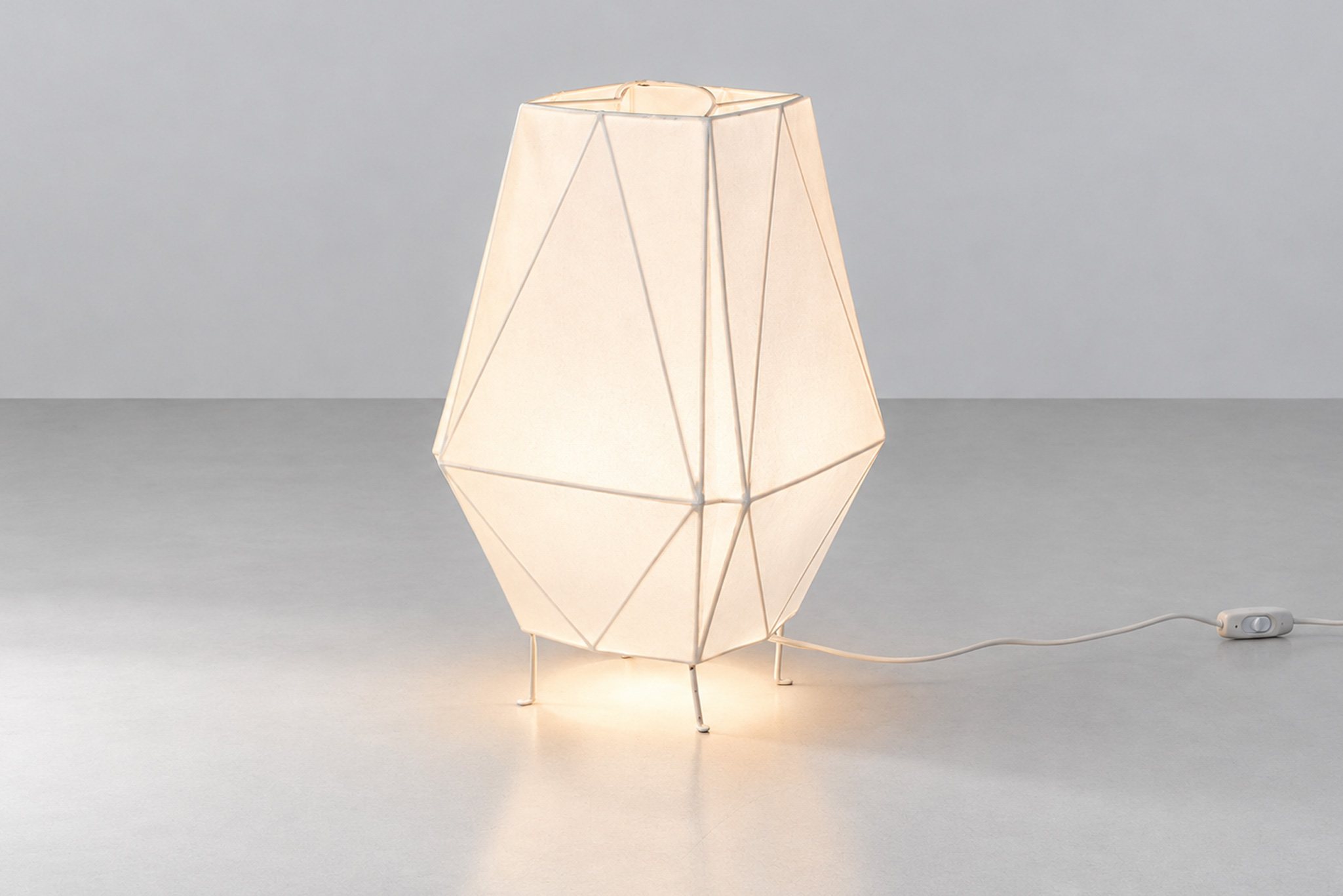
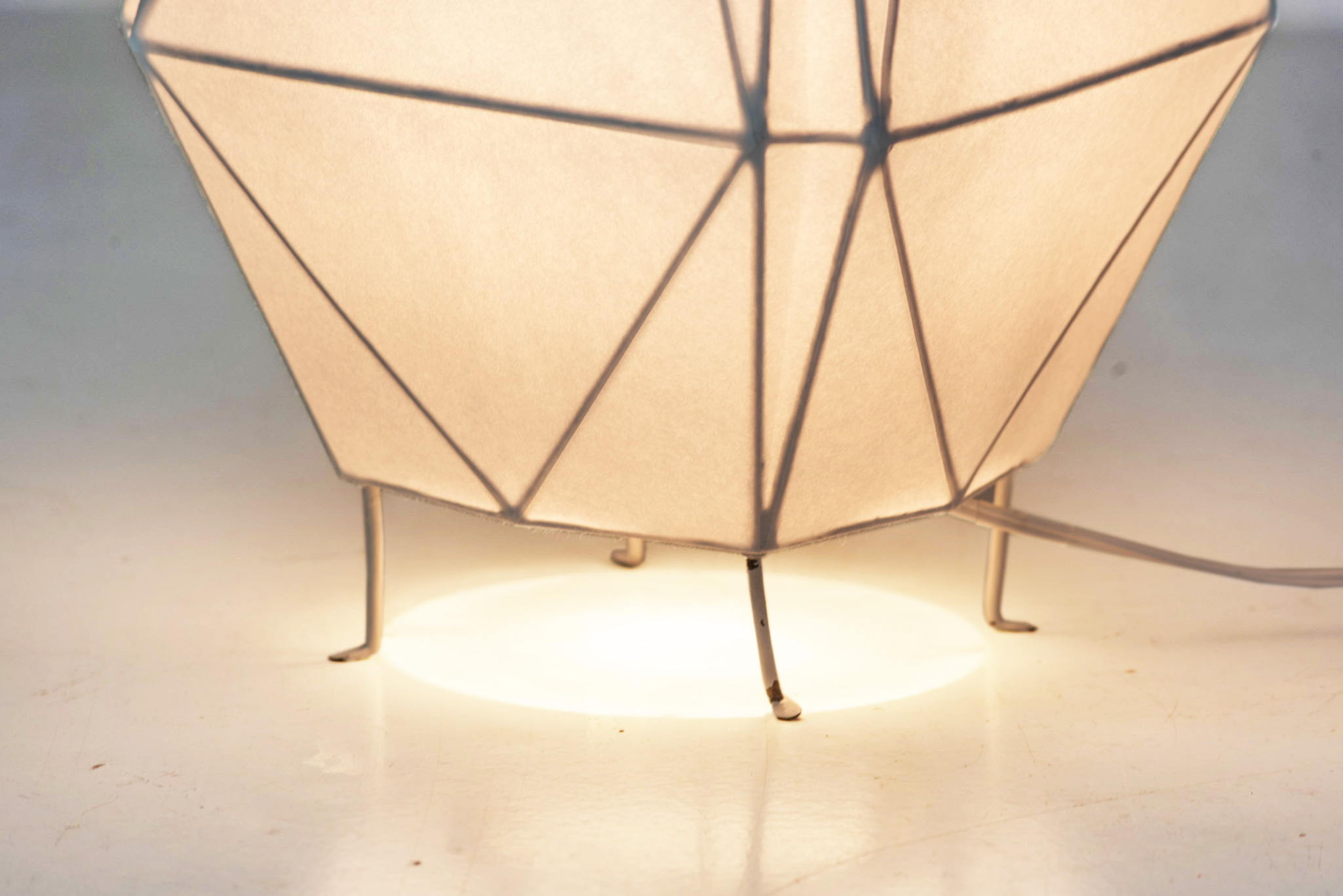
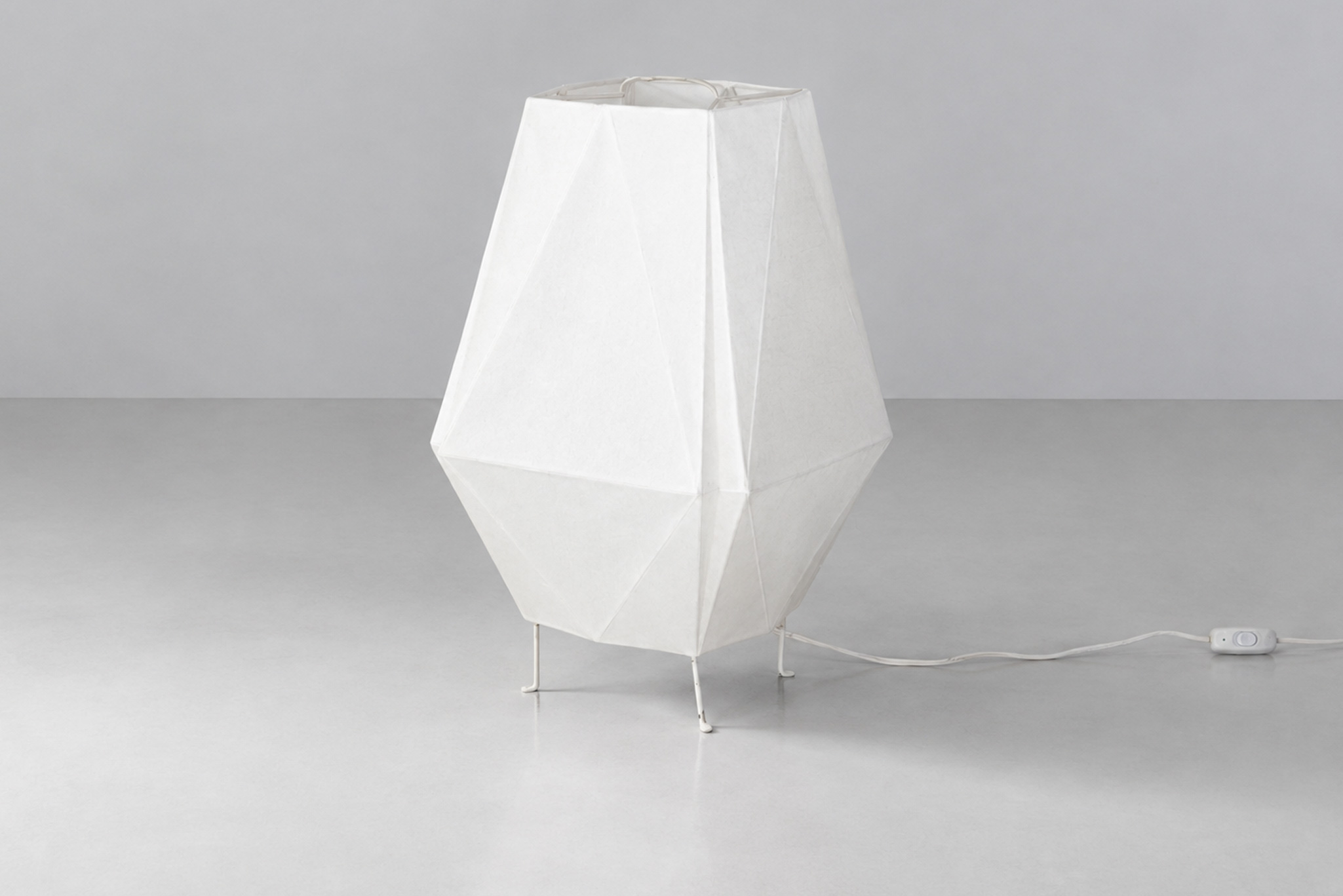
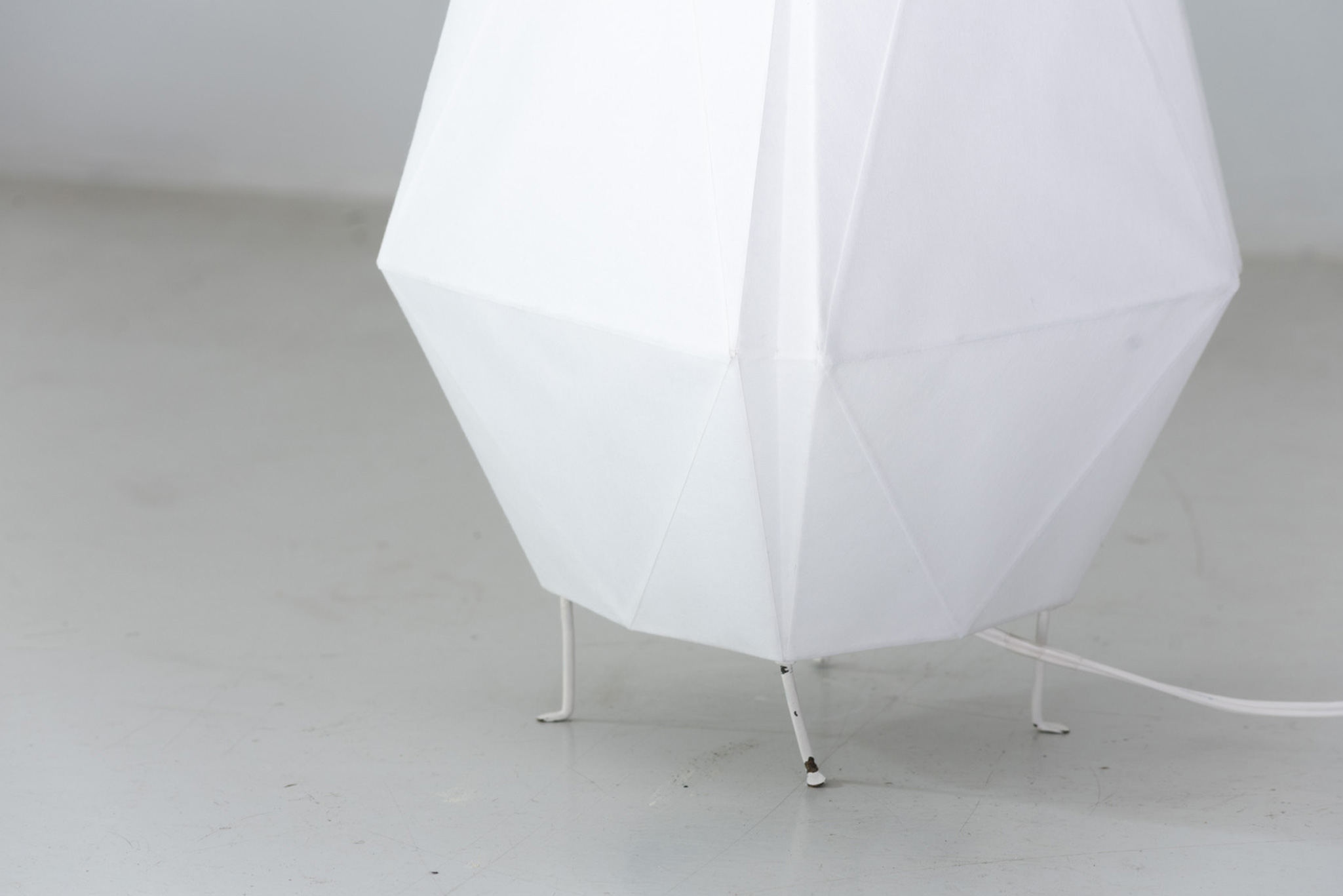
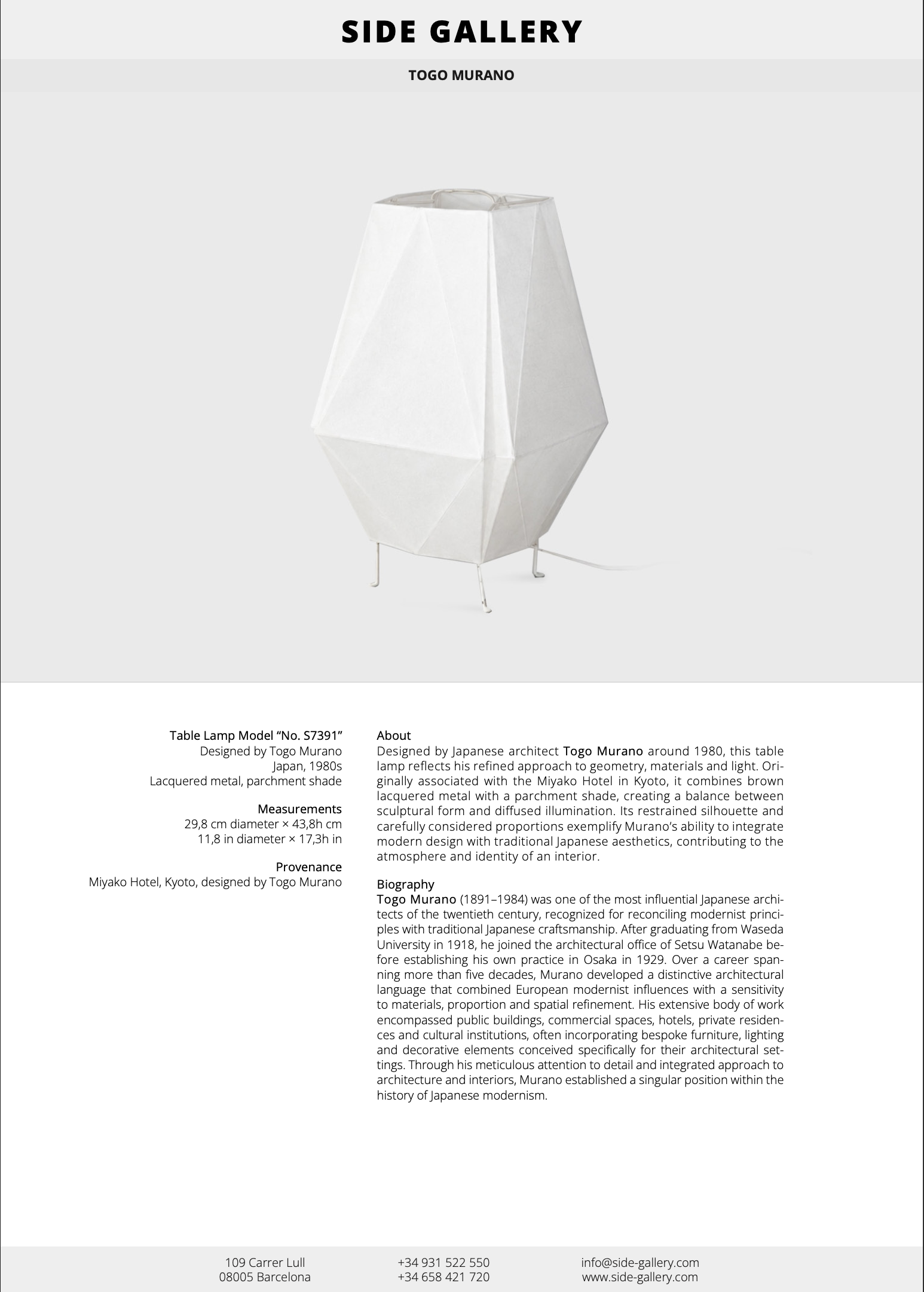
Table Lamp Model “No. S7391”
Designed by Togo Murano
Japan, 1980s
Lacquered metal, parchment shade
Measurements
29,8 cm diameter × 43,8h cm
11,8 in diameter × 17,3h in
Provenance
Miyako Hotel, Kyoto, designed by Togo Murano
About
This table lamp, designed by Japanese architect Togo Murano around 1980, exemplifies his exploration of refined geometric forms and his sensitivity to materials, proportions, and light. Originally associated with the Miyako Hotel in Kyoto, one of the architectural settings connected to Murano's extensive career, the lamp reflects his approach to integrating lighting and interior furnishings within a cohesive architectural environment.
Constructed from brown lacquered metal and complemented by a parchment shade, the lamp combines a restrained silhouette with a subtle interplay of textures and finishes. The contrast between the smooth, lacquered surface and the delicate translucency of the shade creates a harmonious composition, emphasizing both the sculptural presence of the object and its functional purpose.
The design reflects Murano's ability to reinterpret traditional Japanese aesthetics through modern materials and simplified forms. Its carefully balanced proportions and understated elegance demonstrate his commitment to creating objects that contribute to the atmosphere and spatial identity of an interior.
Biography
Togo Murano (1891–1984) was one of the most influential Japanese architects of the twentieth century, recognized for his distinctive architectural language and his ability to reconcile modernist principles with traditional Japanese craftsmanship. After graduating from Waseda University in 1918, he joined the architectural office of Setsu Watanabe, where he developed his early professional experience. In 1929, Murano established his own architectural practice in Osaka, beginning an independent career that would span more than five decades.
Throughout his career, Murano developed an architectural approach that resisted strict adherence to any single movement or style. His work combined the formal innovations of European modernism with a profound appreciation for Japanese architectural traditions, particularly their emphasis on materials, craftsmanship, and spatial refinement. His extensive body of work encompassed public buildings, commercial spaces, hotels, private residences, and cultural institutions, often incorporating furniture, lighting, and decorative elements conceived specifically for their architectural settings.
Murano's architecture is distinguished by its meticulous attention to detail, sophisticated treatment of materials, and sensitivity to the relationship between built environments and the human experience. His designs frequently explored the expressive possibilities of both traditional and modern construction techniques, establishing a dialogue between historical references and contemporary architectural forms. Through his integrated approach to architecture, interiors, and object design, Murano occupies a singular position in the history of Japanese modernism, leaving a legacy that continues to influence architectural practice and design.