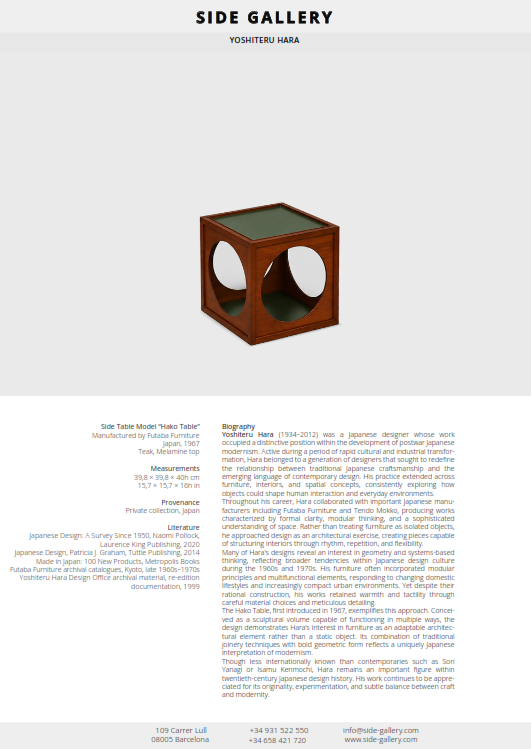
Side Table Model “Hako Table”
Manufactured by Futaba Furniture
Japan, 1967
Teak, Melamine top
Measurements
39,8 × 39,8 × 40h cm
15,7 × 15,7 × 16h in
Provenance
Private collection, Japan
Literature
Japanese Design: A Survey Since 1950, Naomi Pollock, Laurence King Publishing, 2020
Japanese Design, Patricia J. Graham, Tuttle Publishing, 2014
Made in Japan: 100 New Products, Metropolis Books
Futaba Furniture archival catalogues, Kyoto, late 1960s–1970s
Yoshiteru Hara Design Office archival material, re-edition documentation, 1999
About
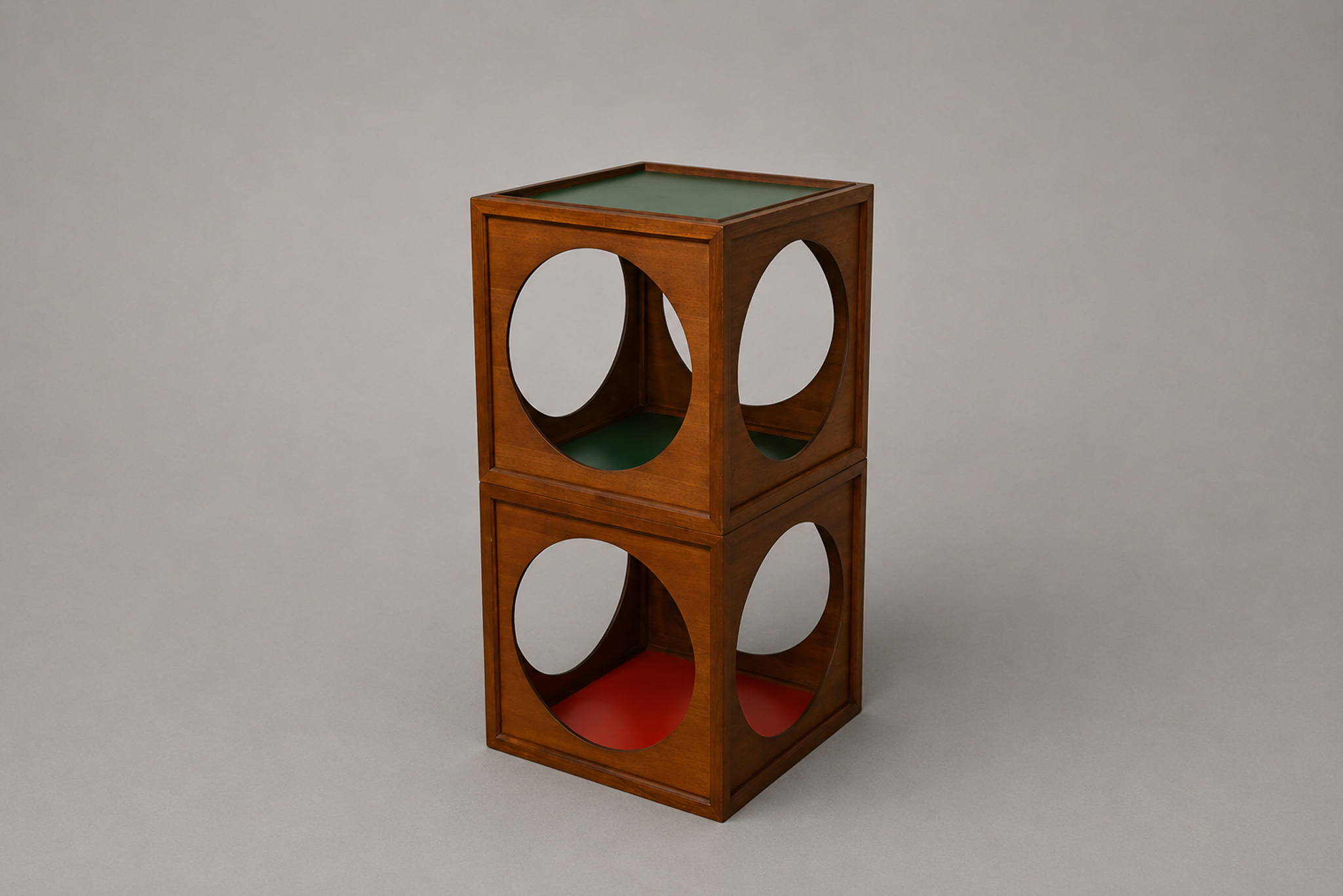
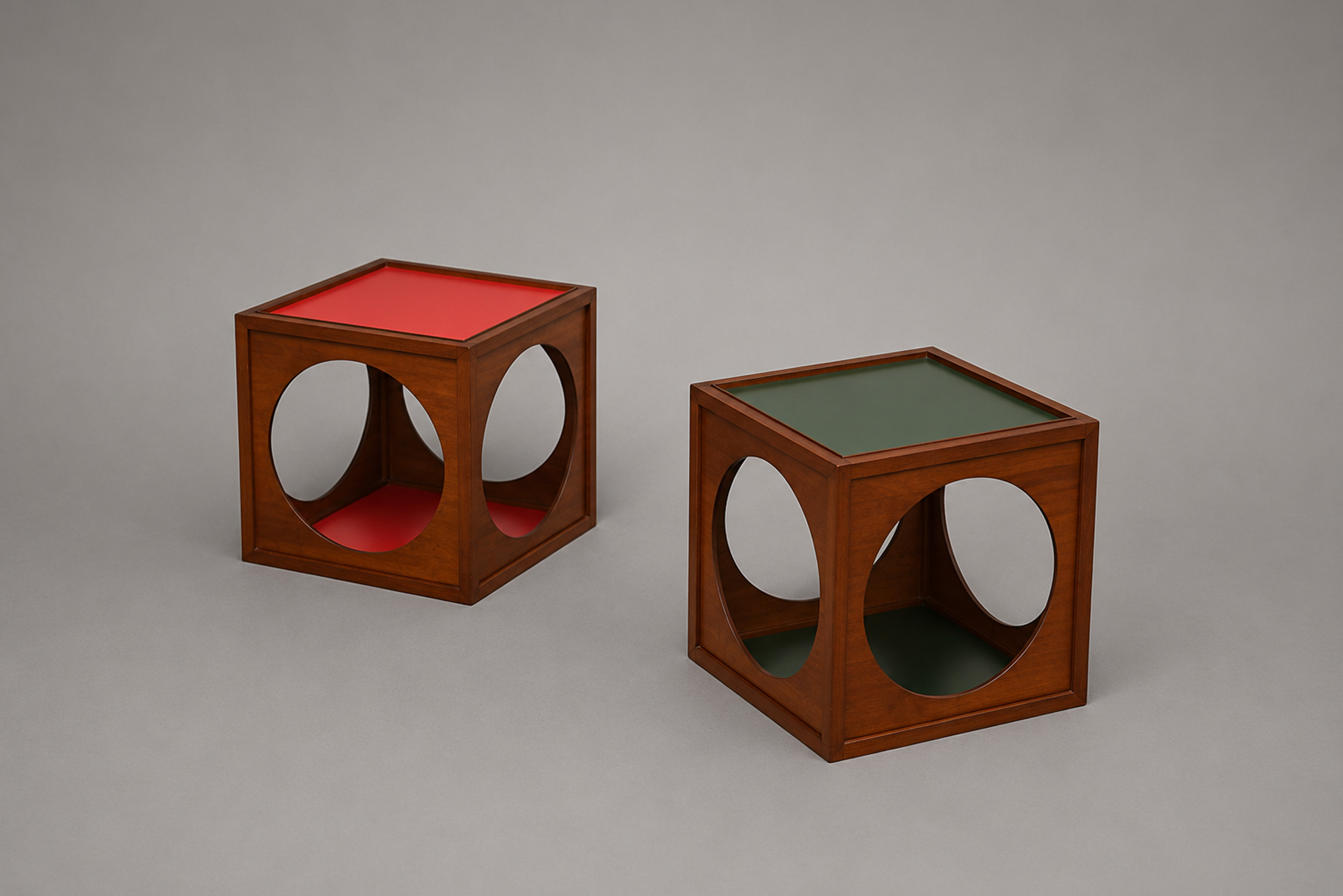
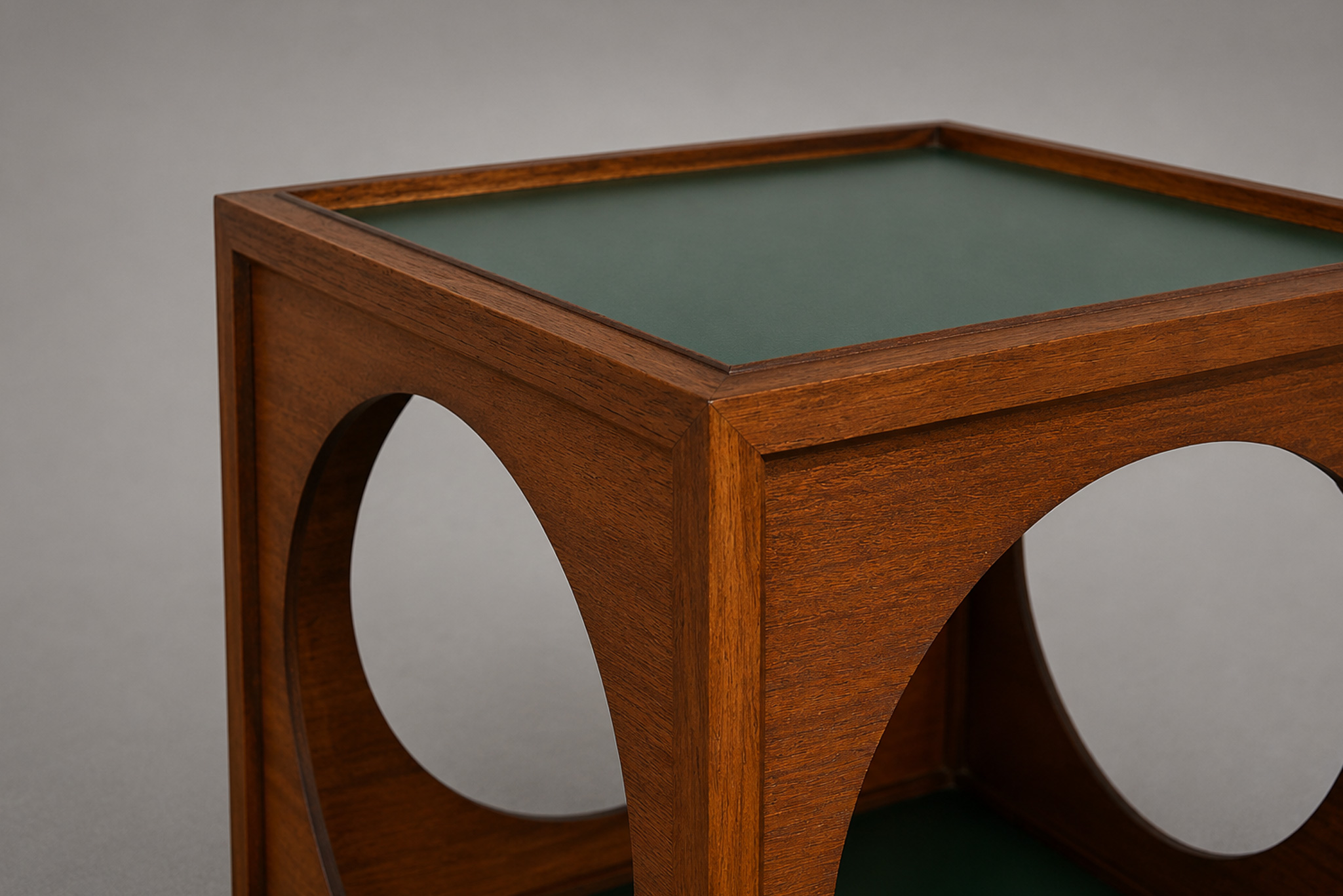
Designed by Yoshiteru Hara in 1967 for Futaba Furniture, the Hako Table is one of the most distinctive examples of Japanese modular furniture from the postwar period. Conceived according to Futaba Furniture’s philosophy of creating “Kyoto-style design,” the piece reflects a refined balance between traditional craftsmanship and modern experimentation.
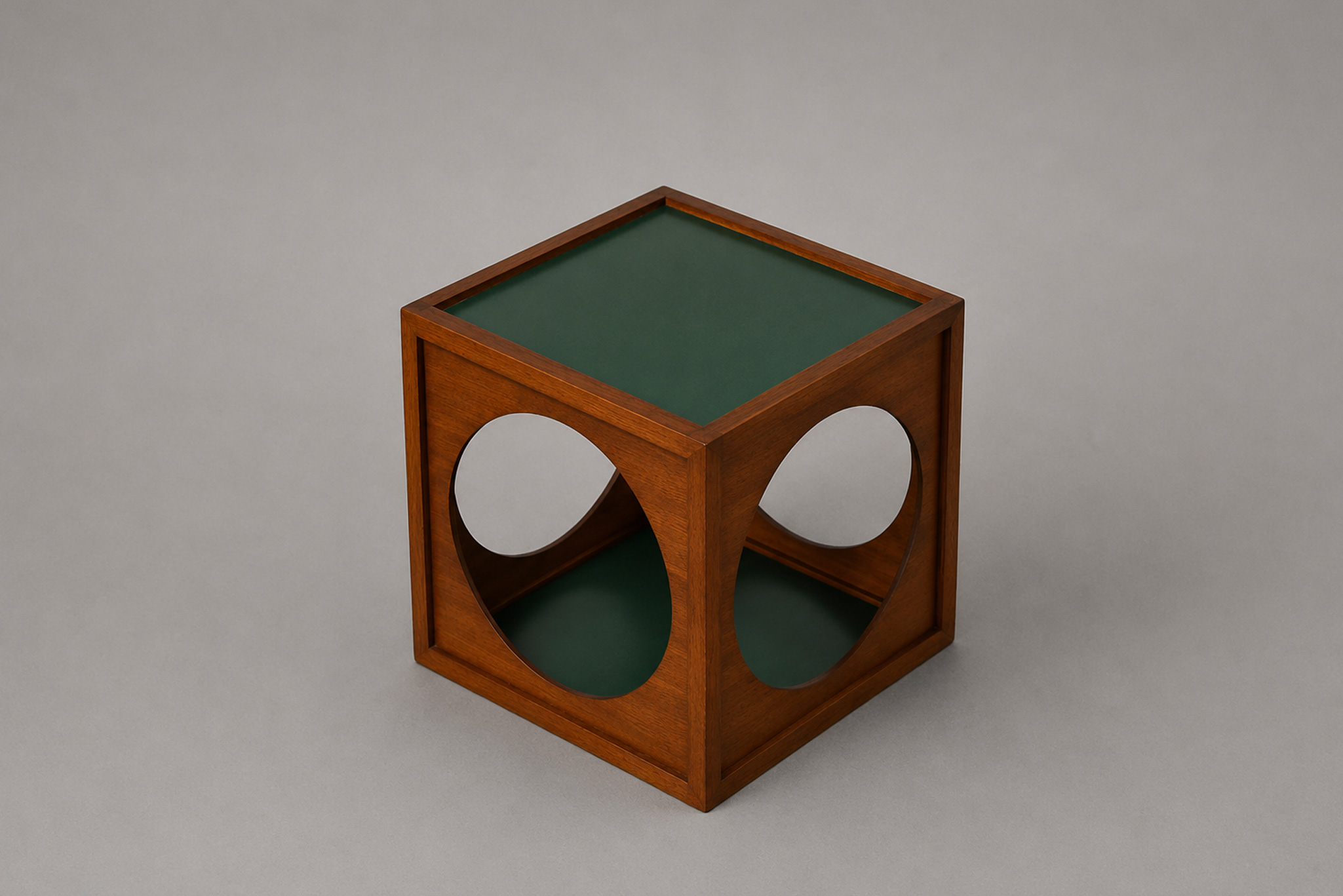
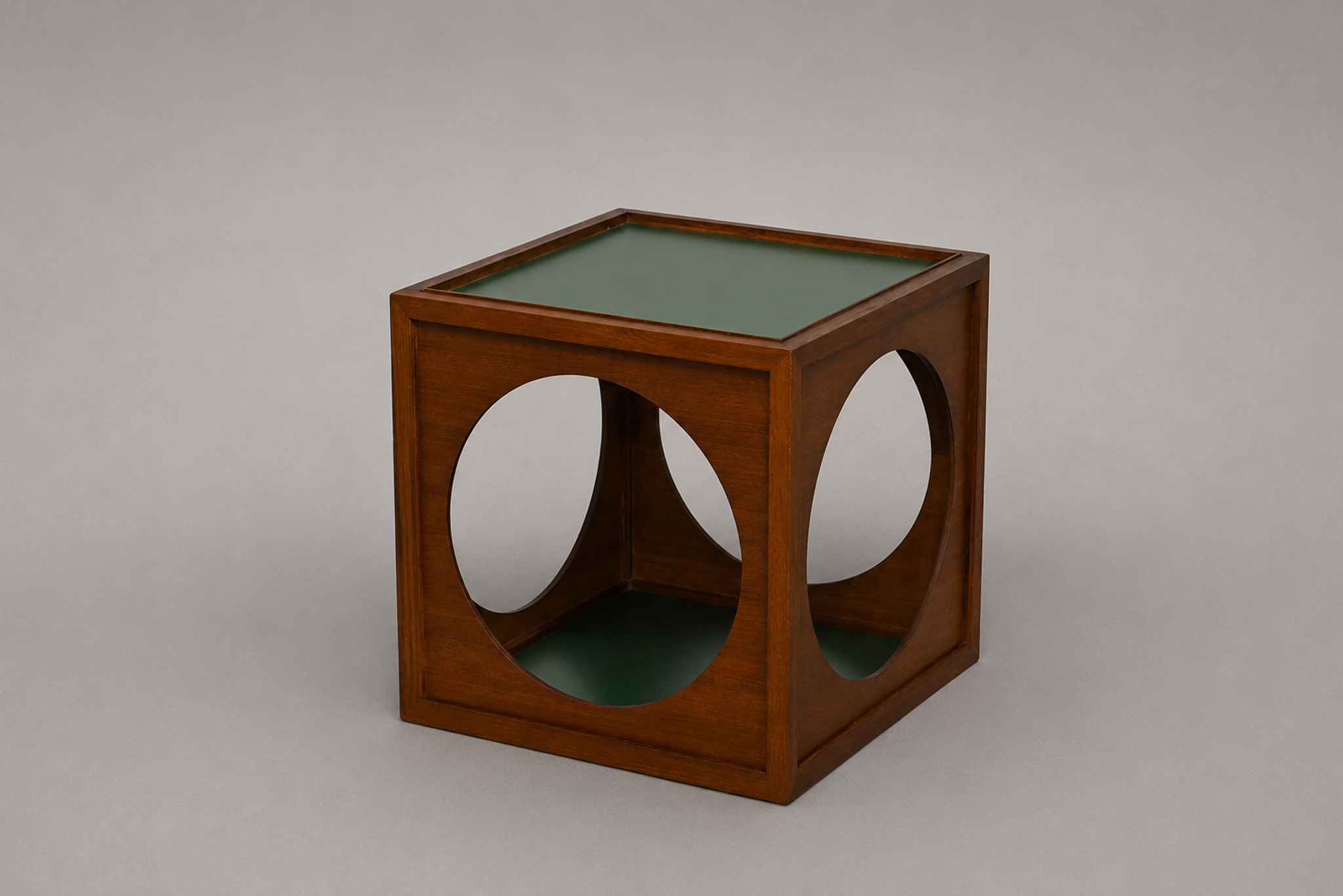
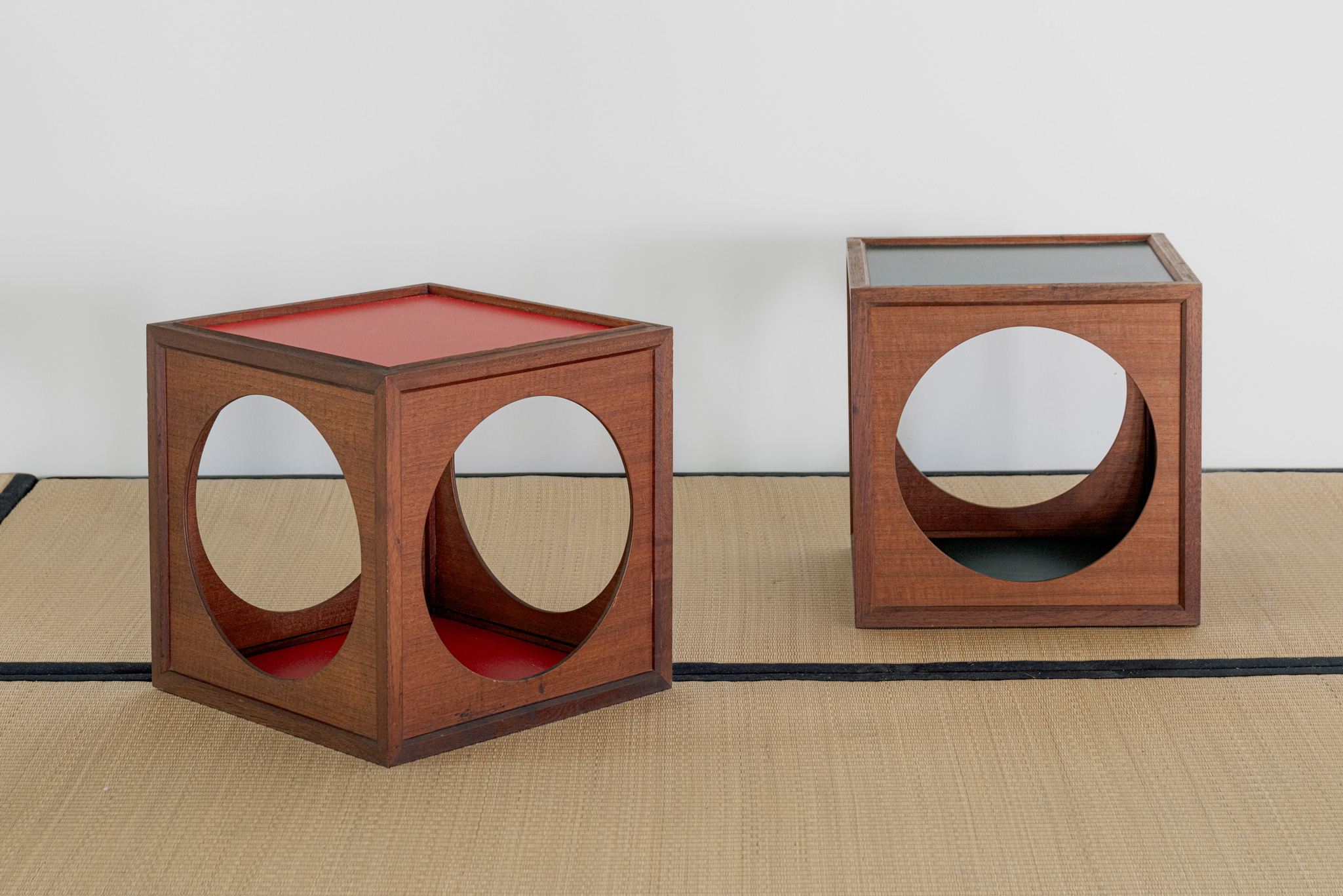
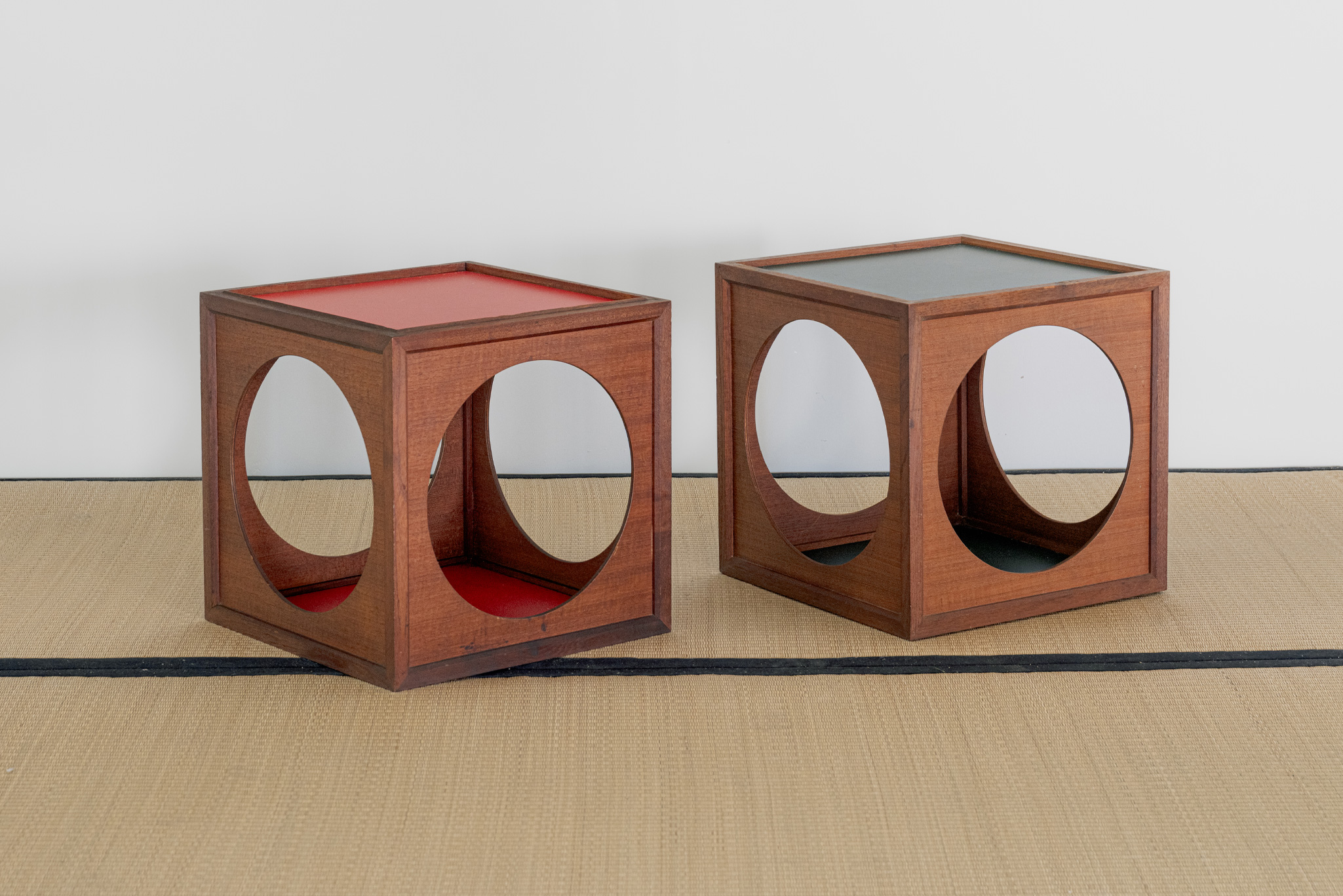
Executed in teak with deep green melamine surfaces, the table is immediately recognizable through its geometric cubic form punctuated by circular openings. These voids transform the object beyond simple function, creating changing relationships between light, shadow, and transparency. The design possesses a sculptural presence while maintaining an exceptional sense of utility and adaptability.
Its construction incorporates traditional sanpō tome-tsugi joinery techniques, demonstrating the precision and craftsmanship associated with Kyoto furniture making. Small protrusions integrated into the tabletop allow multiple units to be stacked securely, revealing the designer’s interest in modularity and flexible use. Depending on placement, the piece can function as a side table, display unit, sculptural object, or illuminated architectural element.
Produced during the height of Japanese modernism and later reissued in 1999, the Hako Table remains one of Yoshiteru Hara’s most celebrated designs. Rare in its original teak version, it stands as a remarkable synthesis of architecture, craft, and playfulness.
About Yoshiteru Hara
Yoshiteru Hara (1934–2012) was a Japanese designer whose work occupied a distinctive position within the development of postwar Japanese modernism. Active during a period of rapid cultural and industrial transformation, Hara belonged to a generation of designers that sought to redefine the relationship between traditional Japanese craftsmanship and the emerging language of contemporary design. His practice extended across furniture, interiors, and spatial concepts, consistently exploring how objects could shape human interaction and everyday environments.
Throughout his career, Hara collaborated with important Japanese manufacturers including Futaba Furniture and Tendo Mokko, producing works characterized by formal clarity, modular thinking, and a sophisticated understanding of space. Rather than treating furniture as isolated objects, he approached design as an architectural exercise, creating pieces capable of structuring interiors through rhythm, repetition, and flexibility.
Many of Hara’s designs reveal an interest in geometry and systems-based thinking, reflecting broader tendencies within Japanese design culture during the 1960s and 1970s. His furniture often incorporated modular principles and multifunctional elements, responding to changing domestic lifestyles and increasingly compact urban environments. Yet despite their rational construction, his works retained warmth and tactility through careful material choices and meticulous detailing.
The Hako Table, first introduced in 1967, exemplifies this approach. Conceived as a sculptural volume capable of functioning in multiple ways, the design demonstrates Hara’s interest in furniture as an adaptable architectural element rather than a static object. Its combination of traditional joinery techniques with bold geometric form reflects a uniquely Japanese interpretation of modernism.
Though less internationally known than contemporaries such as Sori Yanagi or Isamu Kenmochi, Hara remains an important figure within twentieth-century Japanese design history. His work continues to be appreciated for its originality, experimentation, and subtle balance between craft and modernity.