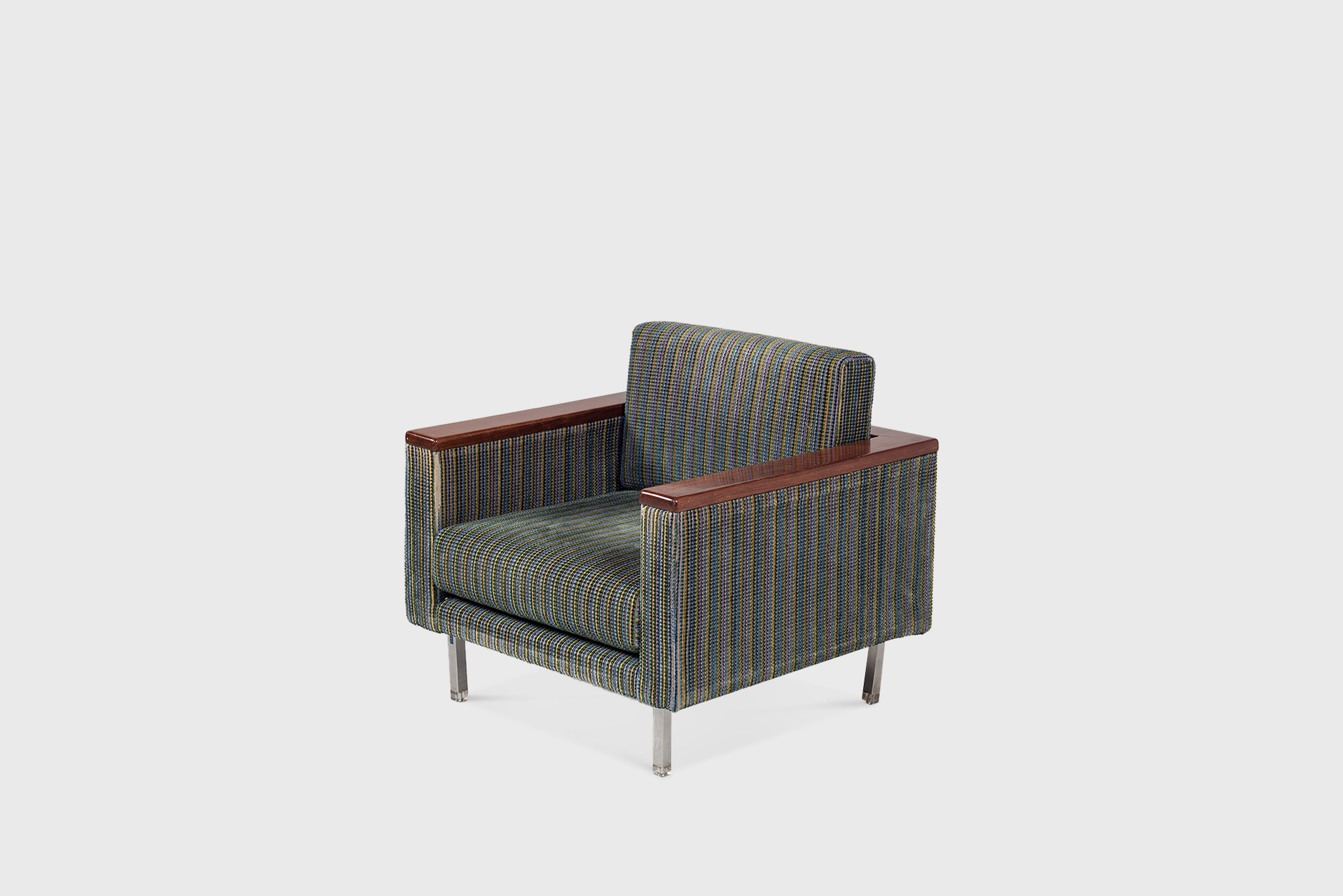
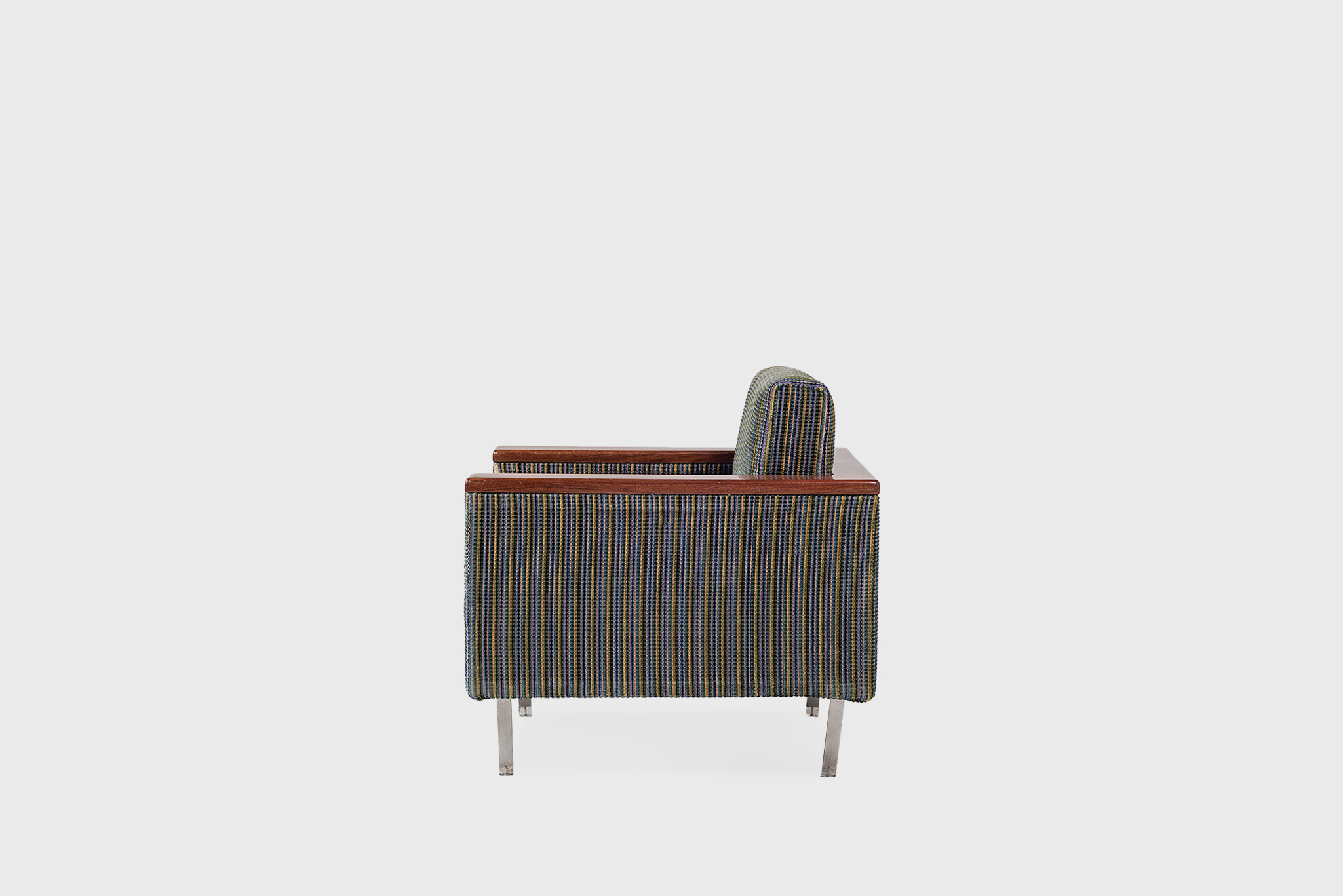
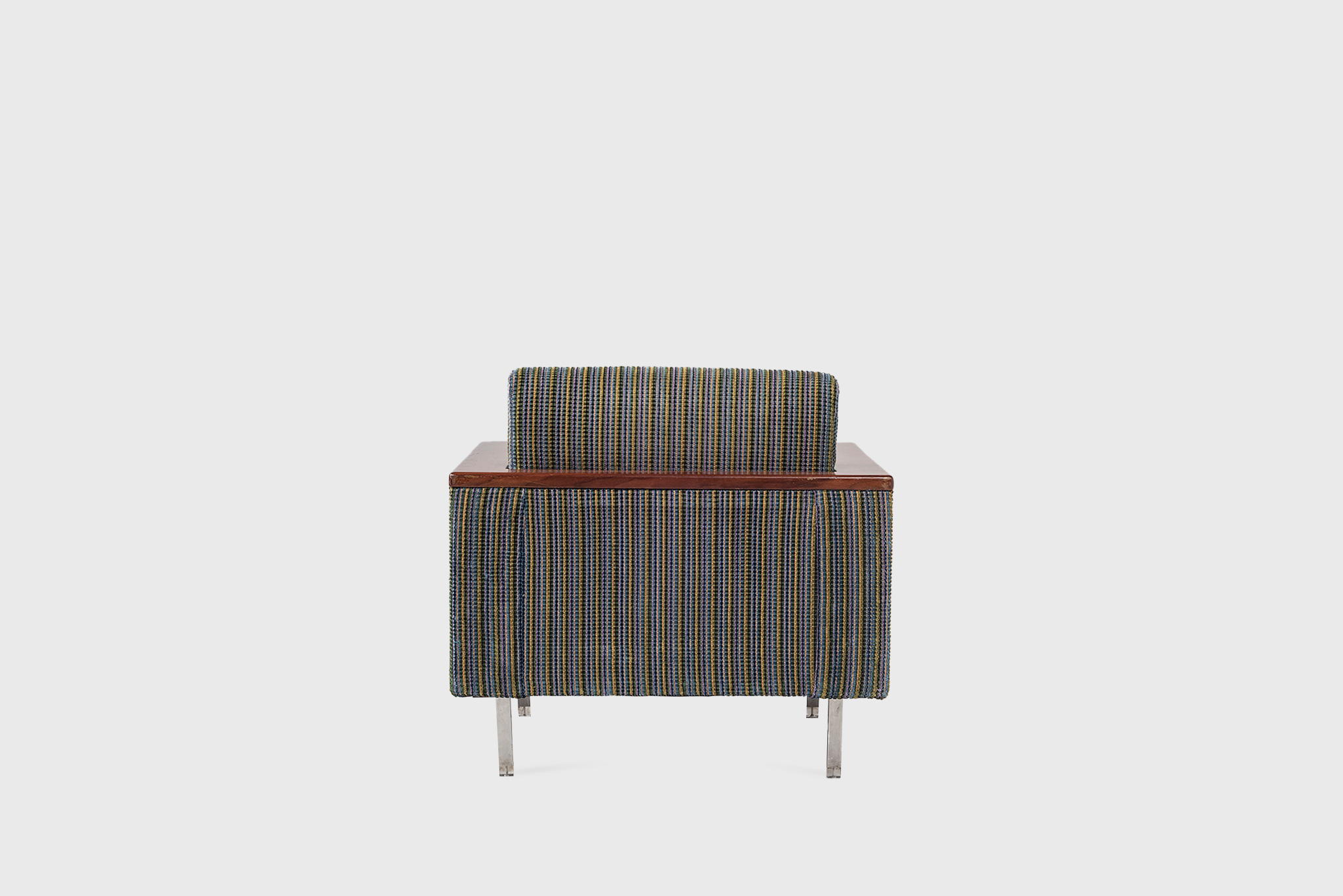
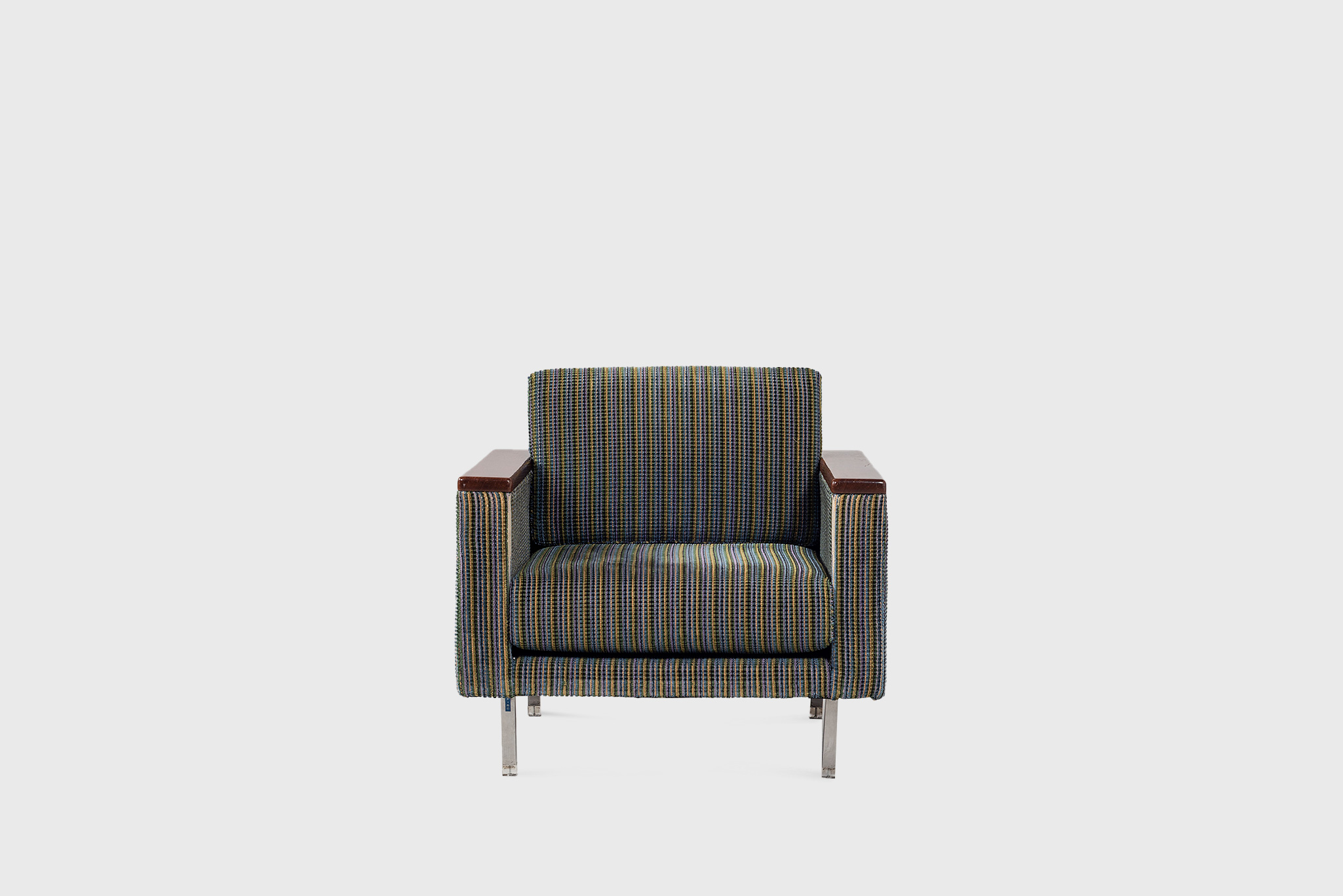
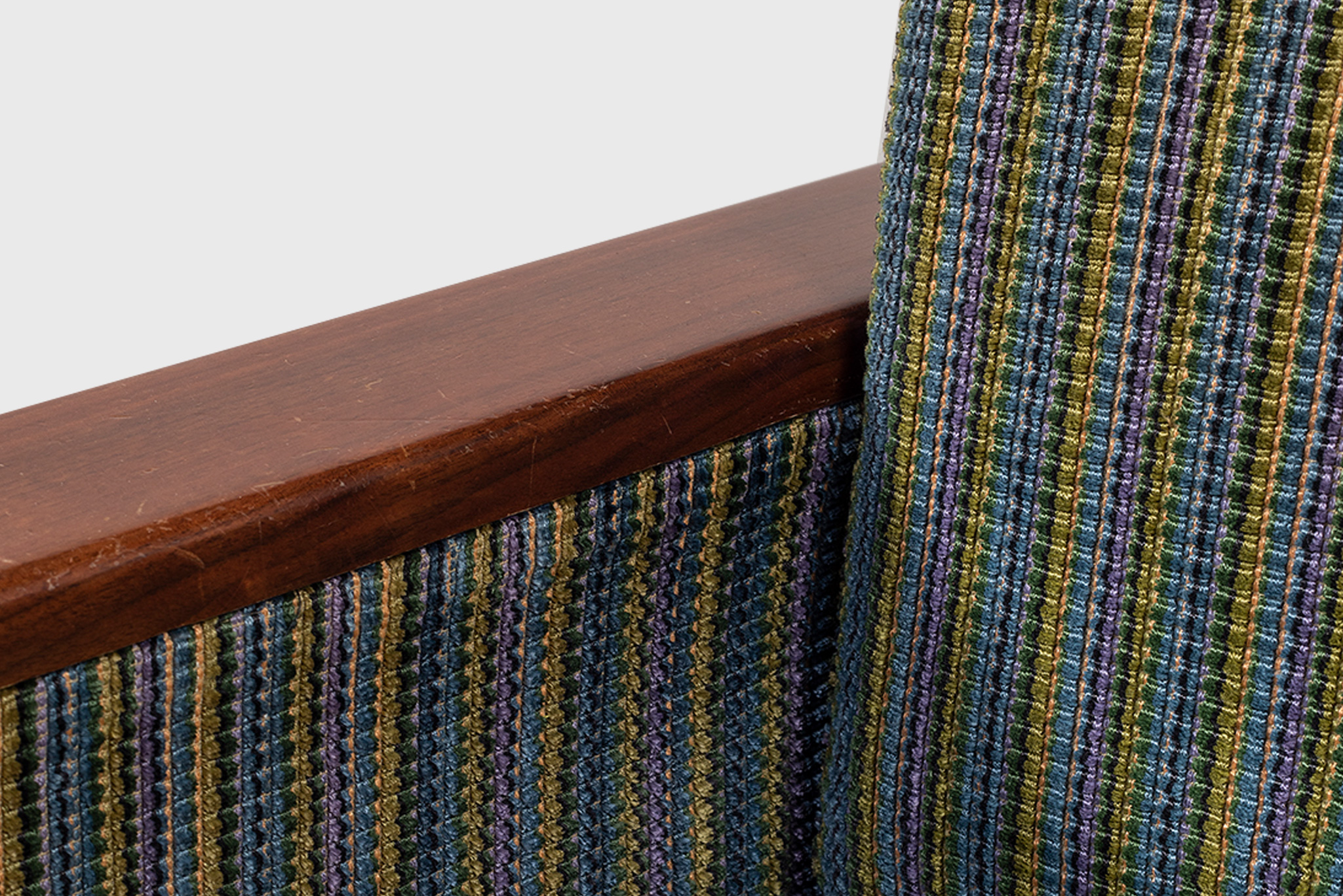
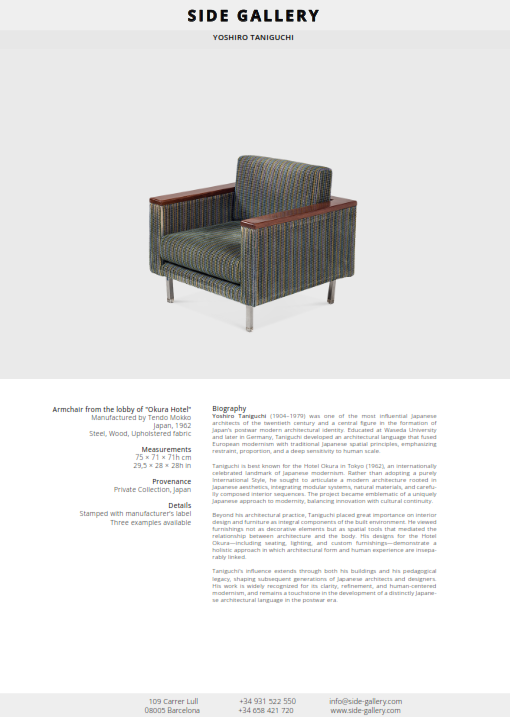
Armchair from the lobby of "Okura Hotel"
Manufactured by Tendo Mokko
Japan, 1962
Steel, Wood, Upholstered fabric
Measurements
75 × 71 × 71h cm
29,5 × 28 × 28h in
Provenance
Private Collection, Japan
Details
Stamped with manufacturer’s label
Three examples available
Notes
This armchair was designed by Yoshiro Taniguchi for the lobby of the Okura Hotel Annex in Tokyo, completed in 1973 as part of the landmark expansion of the original 1962 hotel. Conceived as an integral element of the hotel’s interior architecture, the chair reflects Taniguchi’s holistic approach to design, in which furniture, space, and visual culture form a unified aesthetic experience.
Placed within the lobby facing a monumental mural featuring an animal motif, the armchair was designed to mediate between the scale of architecture and the intimacy of the seated body. Its low, generous proportions and restrained geometric form echo the modernist clarity of the Okura interiors, while the combination of steel, wood, and fabric embodies the dialogue between industrial modernity and refined material culture that characterized Japanese high design of the postwar era.
The Okura Hotel was an international symbol of Japan’s rapid economic growth and cultural reemergence after World War II. It hosted global figures including President Gerald Ford, President Barack Obama, and Prince Charles and Princess Diana, serving as a diplomatic and cultural stage for Japan’s modern identity. Furniture such as this armchair was not conceived as a neutral accessory, but as part of a carefully curated environment intended to communicate elegance, technological progress, and cultural confidence.
The survival of these chairs—bearing their original editor’s label—offers a rare material link to one of the most important architectural interiors of twentieth-century Japan.
Biography
Yoshiro Taniguchi (1904–1979) was one of the most influential Japanese architects of the twentieth century and a central figure in shaping Japan’s postwar modern architectural identity. Educated at Waseda University and later in Germany, Taniguchi developed a design philosophy that combined European modernism with traditional Japanese spatial principles, creating a uniquely restrained and human-centered architectural language.
Taniguchi is best known as the architect of the Hotel Okura in Tokyo (1962), a project that became an international icon of Japanese modernism. Unlike many contemporaries who adopted a purely International Style, Taniguchi sought to create a modern architecture that preserved the spirit of Japanese aesthetics: proportion, rhythm, and material subtlety. The Okura Hotel achieved this through its integration of modular geometry, natural materials, and carefully orchestrated interior spaces, making it one of the most celebrated buildings of postwar Japan.
Beyond architecture, Taniguchi was deeply invested in interior design and furniture as extensions of architectural thinking. He believed that chairs, tables, and lighting were not secondary objects but spatial instruments that shaped how architecture was experienced by the body. His designs for the Okura Hotel, including lobby seating, guest-room furniture, and lighting systems, reflect a commitment to coherence between macro-scale architecture and micro-scale human interaction.
Taniguchi’s legacy extends through both his buildings and his influence on subsequent generations of Japanese architects and designers, including his son Yoshio Taniguchi, the architect of the Museum of Modern Art’s major renovation in New York. Today, Yoshiro Taniguchi is recognized as a key architect in the creation of a distinctly Japanese modernism—one that balanced technological progress with cultural continuity, and global ambition with quiet refinement.