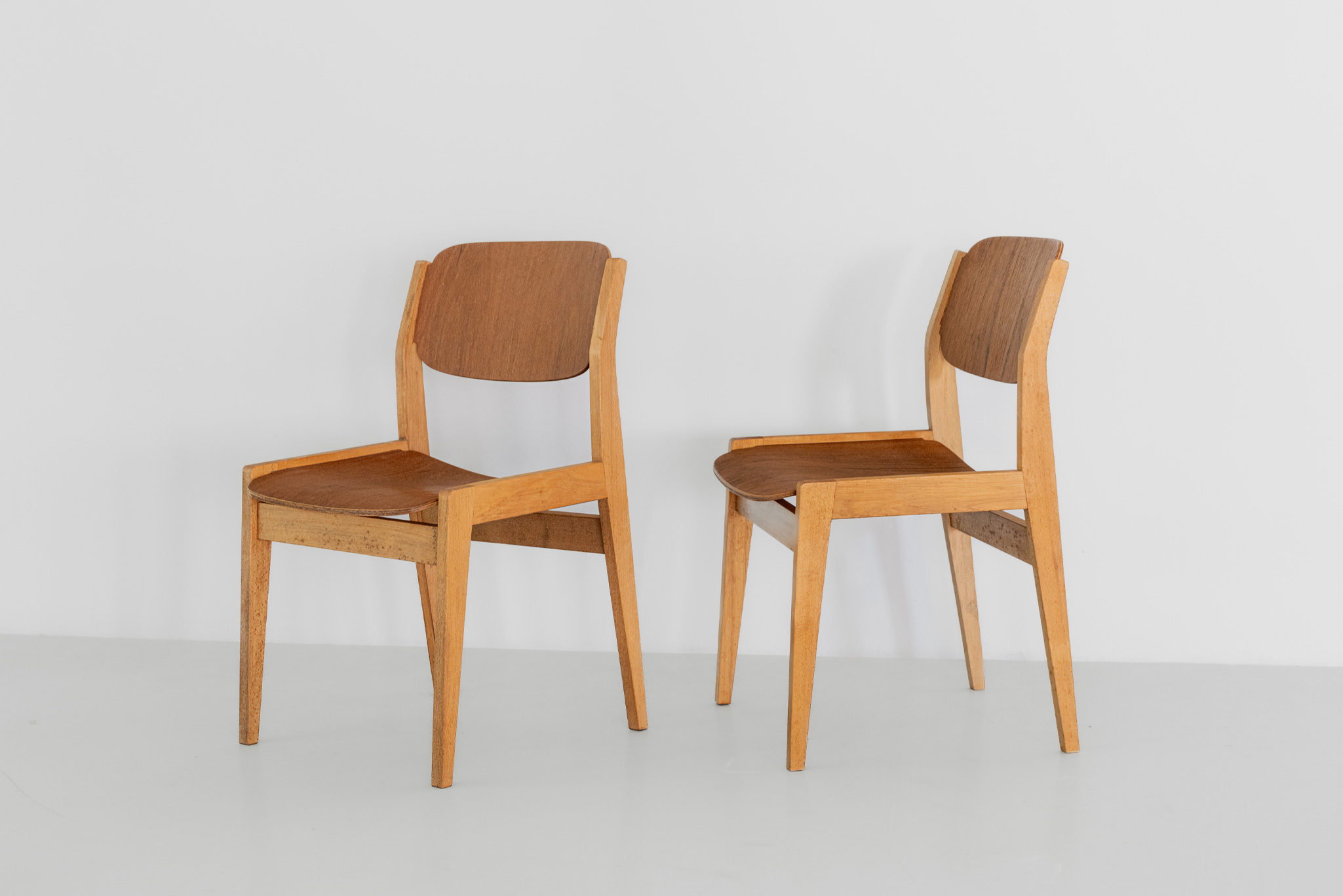
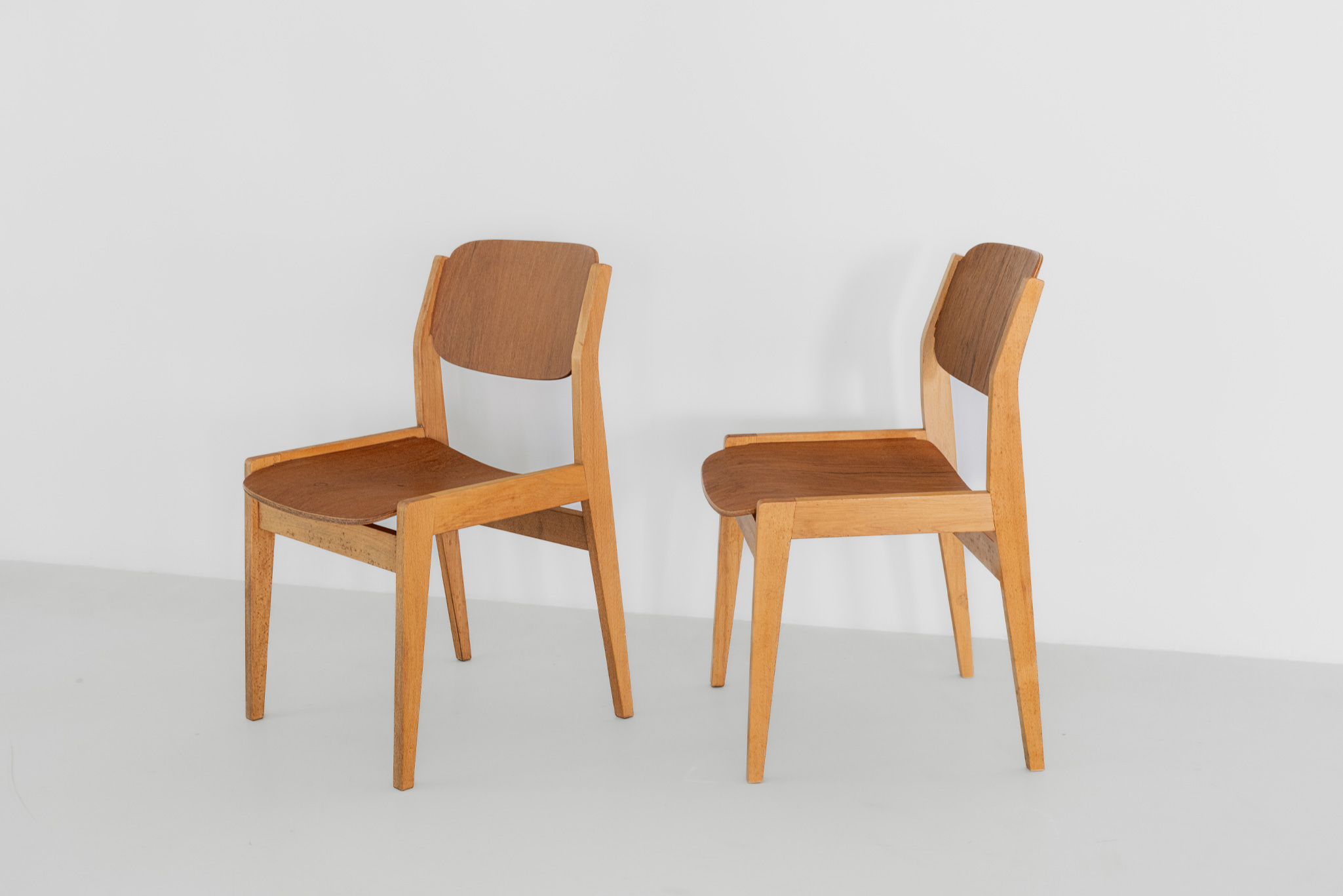
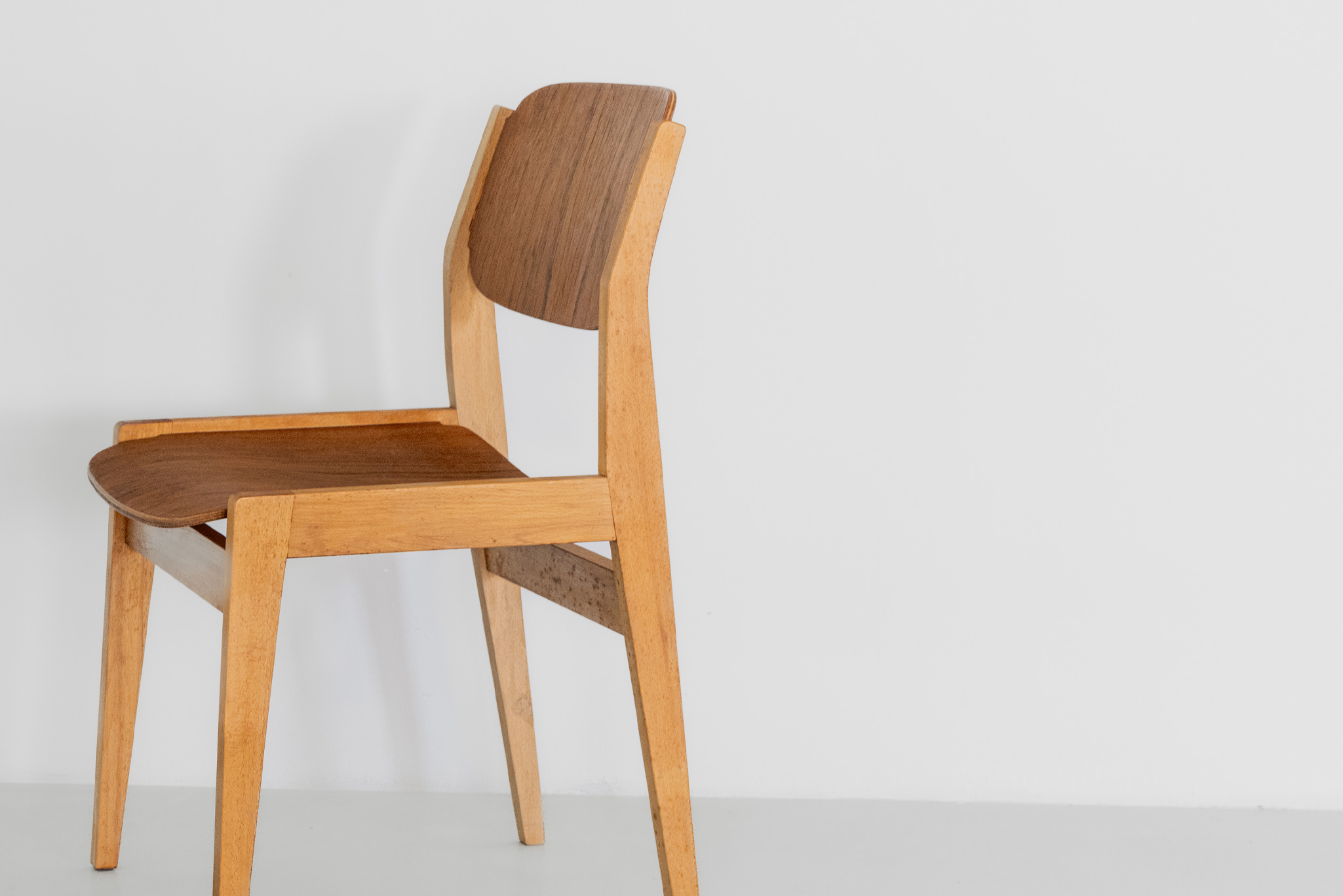
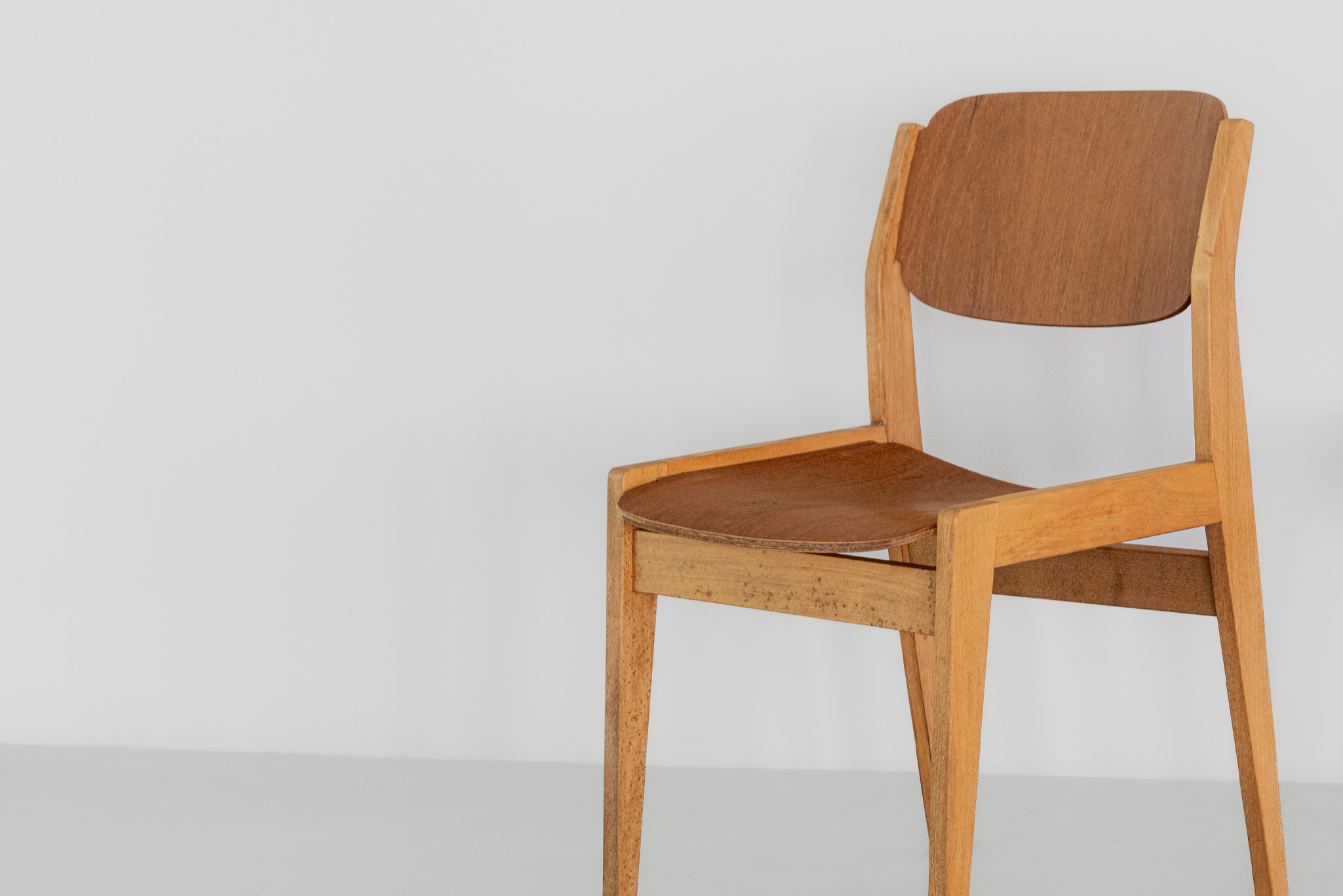
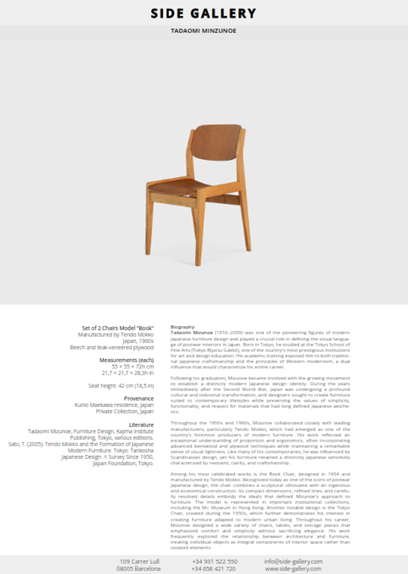
Set of 2 Chairs Model "Book"
Manufactured by Tendo Mokko
Japan, 1960s
Beech and teak-veneered plywood
Measurements (each)
55 × 55 × 72h cm
21,7 × 21,7 × 28,3h in
Seat height: 42 cm (16,5 in)
Provenance
Kunio Maekawa residence, Japan
Private Collection, Japan
Literature
Tadaomi Mizunoe, Furniture Design, Kajima Institute Publishing, Tokyo, various editions.
Sato, T. (2005). Tendo Mokko and the Formation of Japanese Modern Furniture. Tokyo: Tankosha
Japanese Design: A Survey Since 1950, Japan Foundation, Tokyo.
About
The Book Chair is one of the most distinctive designs by Tadaomi Mizunoe, one of the leading figures in postwar Japanese furniture design. Created during the 1960s, the chair embodies the principles that guided Mizunoe throughout his career: simplicity, functionality, and a profound respect for craftsmanship.
Its restrained form and carefully balanced proportions reveal the influence of Scandinavian modernism while remaining deeply rooted in Japanese traditions of woodworking and spatial harmony. The design emphasizes visual lightness and comfort, reducing the chair to its essential elements without sacrificing elegance or usability.
Like many of Mizunoe's works, the Book Chair reflects the optimism and experimentation that characterized Japanese design during the decades following the Second World War. Designers sought to establish a modern identity while preserving the values of material honesty and artisanal skill. The result is a piece that feels both timeless and unmistakably representative of Japanese modernism.
Biography
Tadaomi Mizunoe (1916–2009) was one of the pioneering figures of modern Japanese furniture design and played a crucial role in defining the visual language of postwar interiors in Japan. Born in Tokyo, he studied at the Tokyo School of Fine Arts (Tokyo Bijutsu Gakkō), one of the country's most prestigious institutions for art and design education. His academic training exposed him to both traditional Japanese craftsmanship and the principles of Western modernism, a dual influence that would characterize his entire career.
Following his graduation, Mizunoe became involved with the growing movement to establish a distinctly modern Japanese design identity. During the years immediately after the Second World War, Japan was undergoing a profound cultural and industrial transformation, and designers sought to create furniture suited to contemporary lifestyles while preserving the values of simplicity, functionality, and respect for materials that had long defined Japanese aesthetics.
Throughout the 1950s and 1960s, Mizunoe collaborated closely with leading manufacturers, particularly Tendo Mokko, which had emerged as one of the country's foremost producers of modern furniture. His work reflected an exceptional understanding of proportion and ergonomics, often incorporating advanced bentwood and plywood techniques while maintaining a remarkable sense of visual lightness. Like many of his contemporaries, he was influenced by Scandinavian design, yet his furniture retained a distinctly Japanese sensitivity characterized by restraint, clarity, and craftsmanship.
Among his most celebrated works is the Book Chair, designed in 1954 and manufactured by Tendo Mokko. Recognized today as one of the icons of postwar Japanese design, the chair combines a sculptural silhouette with an ingenious and economical construction. Its compact dimensions, refined lines, and carefully resolved details embody the ideals that defined Mizunoe's approach to furniture. The model is represented in important institutional collections, including the M+ Museum in Hong Kong.
Another notable design is the Tokyo Chair, created during the 1950s, which further demonstrates his interest in creating furniture adapted to modern urban living. Throughout his career, Mizunoe designed a wide variety of chairs, tables, and storage pieces that emphasized comfort and simplicity without sacrificing elegance. His work frequently explored the relationship between architecture and furniture, treating individual objects as integral components of interior space rather than isolated elements.
Beyond his achievements as a designer, Mizunoe was an influential educator, writer, and advocate for industrial design in Japan. Through his lectures and publications, he contributed to the dissemination of modern design principles and helped establish a generation of designers who would continue to shape Japanese furniture in the decades that followed.