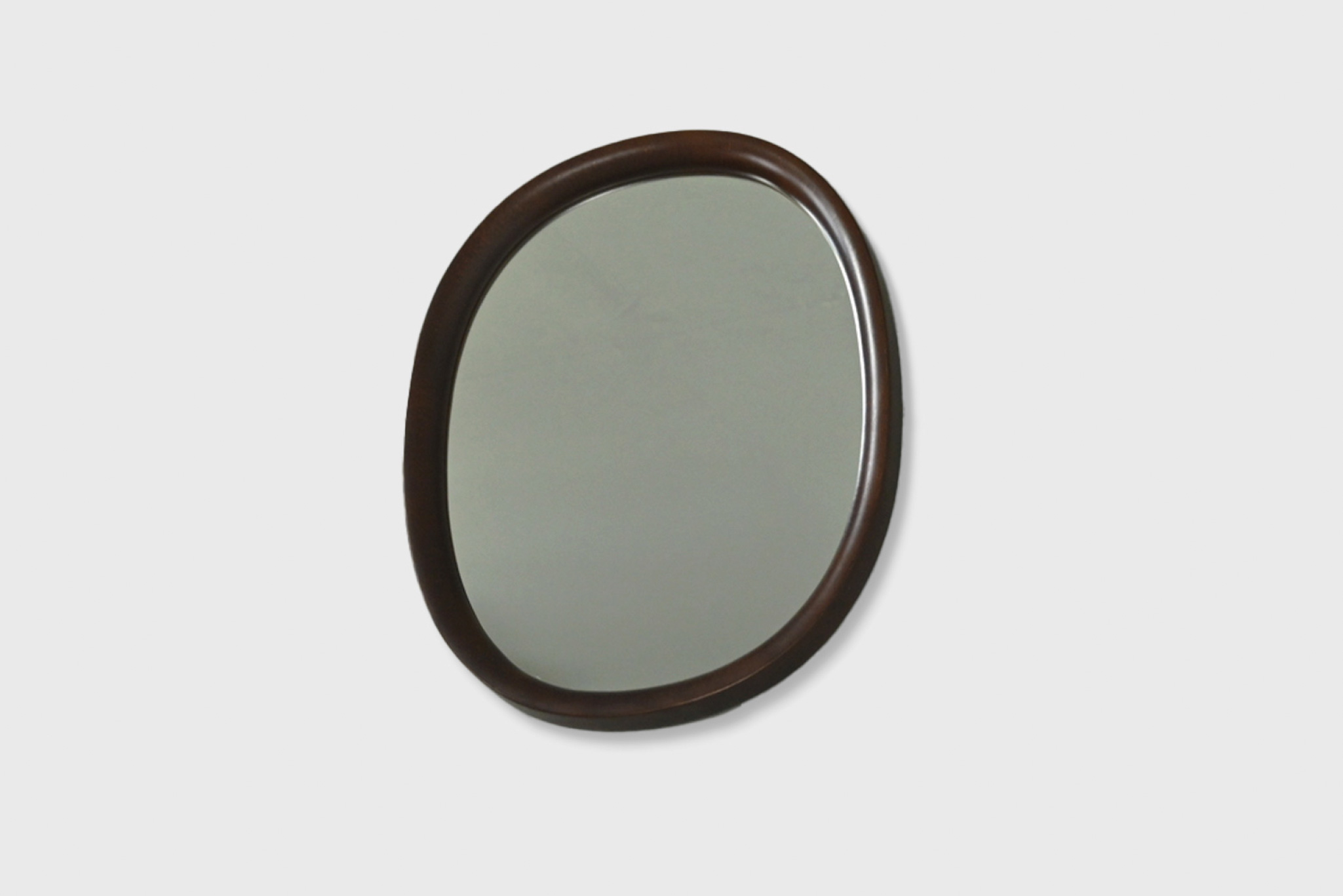
Oval Wall Mirror (Medium Size)
Manufactured by Akita Mokko
Japan, 1977
Bent beech wood, Lauan plywood, Glass
Measurements
40 × 3 × 50h cm
15,8 × 1,2 × 19,7h in
Provenance
Private Collection, Japan
Details
Stamped with manufacturer’s label
Notes
Designed by Sōri Yanagi in 1977, the Oval Wall Mirror embodies the designer’s lifelong pursuit of harmony between form, material, and function. Produced by Akita Mokko, a workshop renowned for its technical excellence in bentwood craftsmanship, the mirror’s frame demonstrates a level of precision that merges structural integrity with visual continuity.
By cutting both ends of the bent beech wood at precise angles and seamlessly joining them, Yanagi achieved a continuous, flowing grain — a gesture of refined simplicity that renders the joint nearly invisible. The polyurethane-coated surface enhances the tactile warmth of the wood while protecting its natural texture, reflecting Yanagi’s philosophy of functional beauty (yo no bi).
This mirror stands as an understated yet perfect example of Japanese modern design, where craft tradition and industrial precision coexist in quiet equilibrium.
About Sōri Yanagi
Sōri Yanagi (1915–2011) was one of Japan’s most influential postwar designers, celebrated for bridging the gap between modern industrial design and traditional Japanese craft. A graduate of the Tokyo Art School, Yanagi initially studied under Charlotte Perriand and absorbed the principles of European modernism, later merging them with Japanese aesthetic sensibilities.
Among his most iconic creations are the Butterfly Stool (1956) for Tendo Mokko, now part of the permanent collections of the Museum of Modern Art, New York, and the Victoria & Albert Museum, London; the Yanagi cutlery series (1958); and the Yanagi kettle (1953) for Nihon Yoshokki. His designs are characterized by organic curves, ergonomic functionality, and an appreciation for the beauty of everyday objects.
In recognition of his contributions, Yanagi received the Good Design Award, the Mainichi Industrial Design Award, and the Medal with Purple Ribbon from the Japanese government. His work continues to embody the essence of Japanese modernism — humble, human-centered, and timeless.