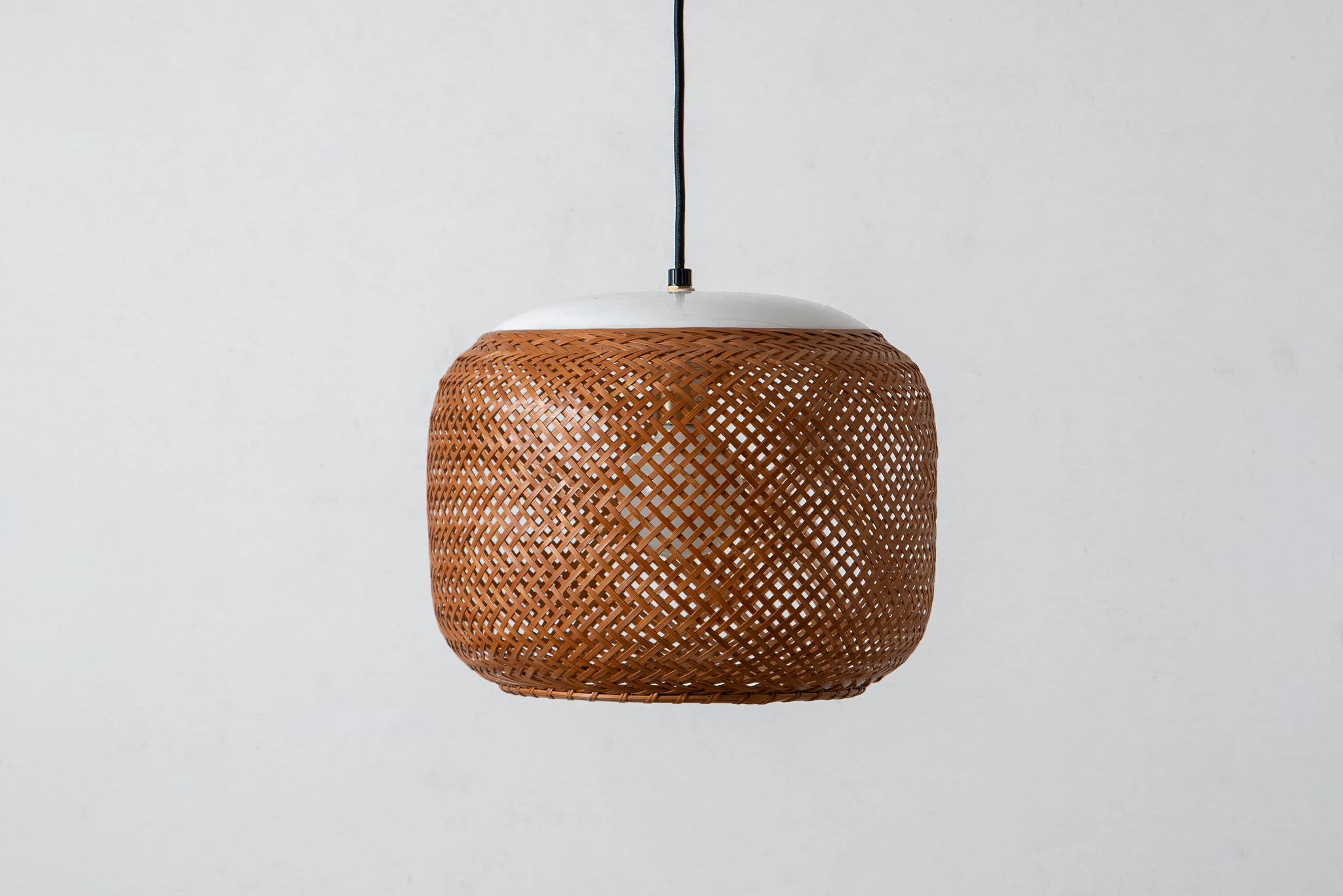
Pendant Lamp model "Take no Akari"
Manufactured by Yamagiwa
Japan, 1970s
Woven bamboo, white diffuser and metal fittings
Measurements
37 cm diameter × 32h cm
14,6 in diameter × 12,6h in
Cord Length (Approx.)
80 cm | 1,5 in
Details
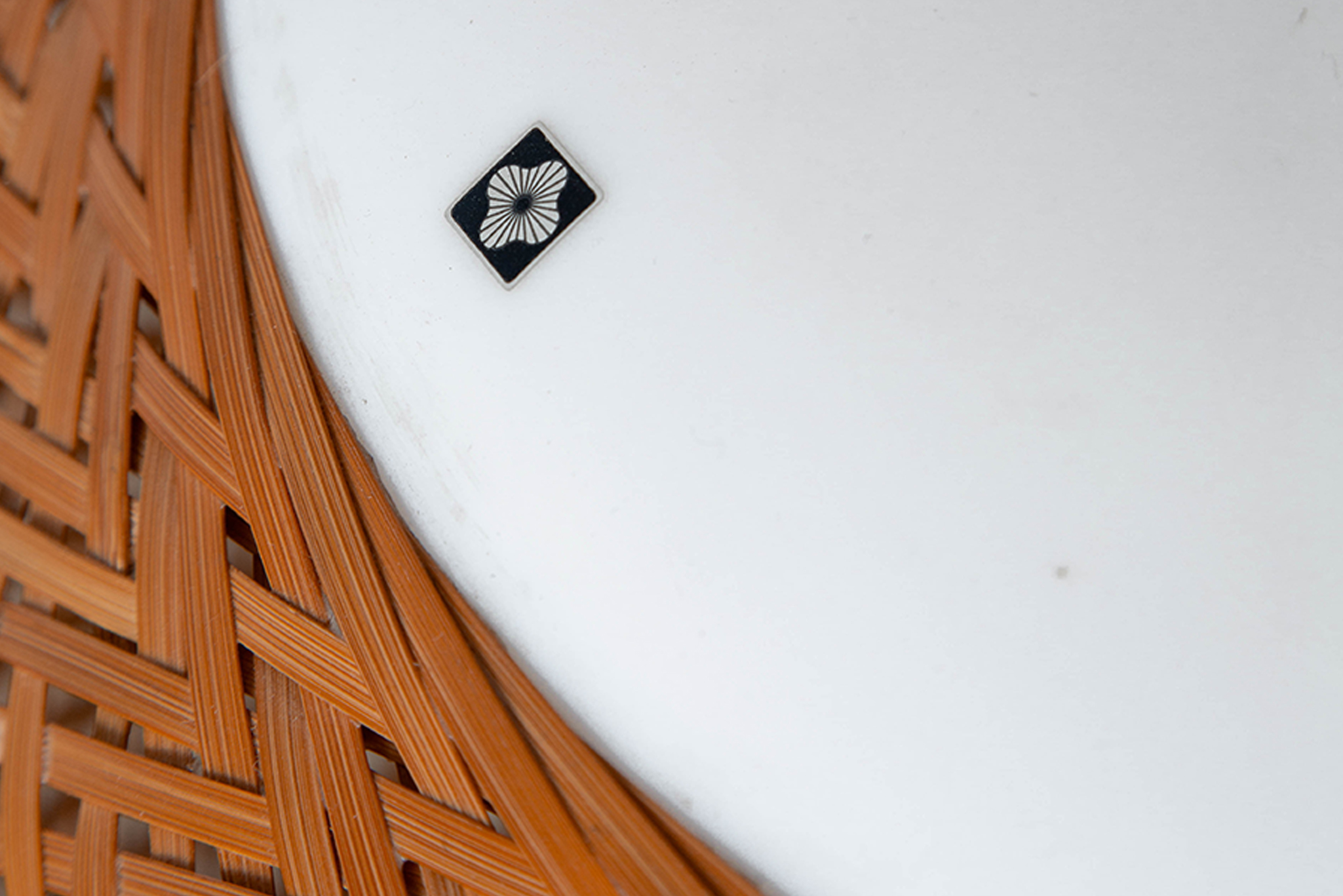
Manufacturer's Label
Provenance
Private collection, Japan
Literature
METROCS, Take no Akari Pendant – Yotsume Natsume Type / Shosaku Kondo, vintage design catalogue, illustrated.
About
The Take no Akari Pendant Lamp – Yotsume Natsume Type, designed by Shosaku Kondo during the 1960s, represents an important development in Japanese modern lighting through the reinterpretation of traditional bamboo craftsmanship. Part of the celebrated Take no Akari series, the lamp combines the material sensitivity of Japanese weaving traditions with the functional principles of industrial design. Its rounded cylindrical silhouette and intricate openwork construction reflect Kondo's interest in transforming established craft techniques into contemporary lighting objects.
The shade is composed of finely woven bamboo strips arranged in a diagonal lattice pattern, creating a rhythmic geometric surface that allows light to filter through its openings. Its softly curved profile is complemented by a white upper diffuser, introducing a contrast between the natural texture of bamboo and the smooth surface of the lighting element. When illuminated, the woven structure produces a delicate interplay of light and shadow, emphasizing the relationship between material, craftsmanship, and atmosphere.
Developed during a period of significant transformation in Japanese design, the Take no Akari series demonstrated how traditional bamboo lighting could be adapted to modern interiors through improvements in production techniques and structural refinement. Kondo's approach combined artisanal knowledge with industrial design principles, allowing greater consistency in manufacturing while preserving the expressive qualities of handmade objects. The resulting lamps became representative of Japanese modernism, embodying a balance between technical innovation, material authenticity, and understated elegance.
Biography
Shosaku Kondo (born 1927 in Niigata Prefecture, Japan) is a Japanese bamboo craftsman and designer recognized for his pioneering contribution to modern lighting design. His work developed through the exploration of traditional bamboo-working techniques and their application to contemporary functional objects. Combining the perspectives of an artisan, industrial designer, and craft practitioner, Kondo established a distinctive approach to lighting characterized by material experimentation, geometric refinement, and structural simplicity.
During the postwar period, Kondo began developing bamboo lighting that reinterpreted established Japanese craft traditions through modern manufacturing principles. His Take no Akari series, introduced during the 1960s and associated with Yamagiwa, became an important example of the integration of traditional weaving with contemporary lighting technology. Influenced by the simplicity of Isamu Noguchi's Akari lighting sculptures, Kondo sought to refine bamboo lighting through reduced forms and carefully controlled construction.
Throughout his career, Kondo has continued to investigate the expressive and structural possibilities of bamboo, developing designs that demonstrate the material's flexibility, resilience, and visual delicacy. His work occupies a significant position within the history of Japanese craft and industrial design, illustrating how traditional techniques can be transformed into enduring modern objects without losing their cultural and material identity.