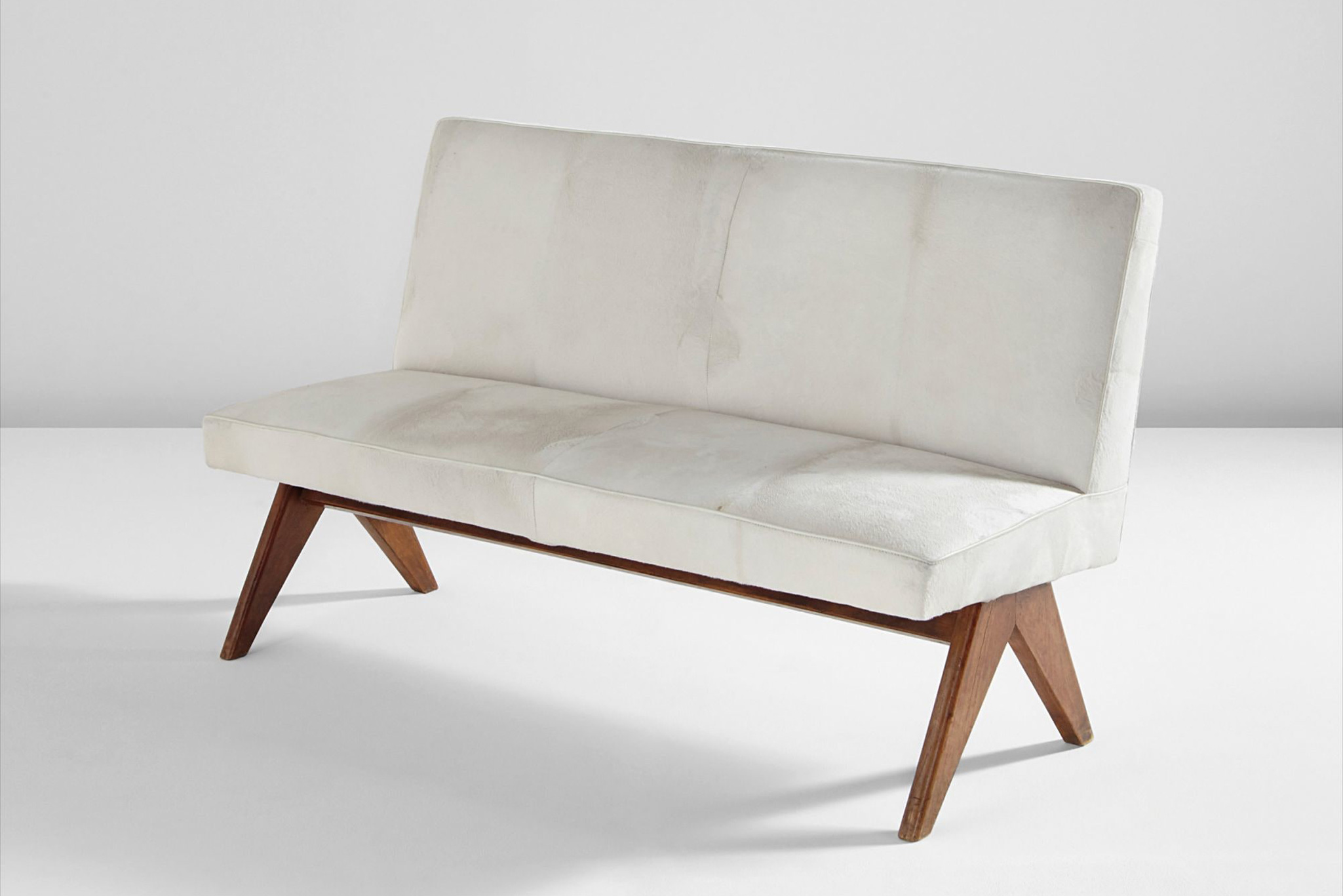
Public Bench — Model PJ-SI-37-B
Manufactured by Government Workshops, Chandigarh
India, 1960s
Teak, hide
Measurements
141 × 66 × 83,8h cm
55,5 × 26 × 33h in
Provenance
High Court, Chandigarh
Details
Manufacturer’s Label
Literature
Touchaleaume, E., & Moreau, G. (2010). Le Corbusier Pierre Jeanneret: The Indian Adventure, pp. 162–163, 566.
About
This public bench was designed by Pierre Jeanneret for the High Court building in Chandigarh as part of the furniture developed for the city’s judicial institutions.
Constructed in teak with hide seating, the bench features a robust structure intended to withstand heavy public use. The design combines functionality with a strong architectural presence, reflecting the monumental character of the High Court complex designed by Le Corbusier.
Biography
Pierre Jeanneret (1896–1967) was a Swiss architect and designer and a key collaborator of his cousin Le Corbusier. Working mainly in Paris during the early decades of his career, he co-founded an architectural studio with Le Corbusier in 1922, where they developed influential modernist ideas in architecture, urban planning, and furniture design, often collaborating with Charlotte Perriand.
Jeanneret played an important role in the development of modern furniture and architecture associated with their studio, contributing to projects presented at the Salon d'Automne and to many of the architectural works that defined the modern movement.
Later in his career he moved to India, where he worked closely with Le Corbusier on the planning and construction of Chandigarh. There he served as the city’s chief architect for several years, designing numerous public buildings, housing projects, and furniture pieces that became emblematic of the city’s modernist identity.