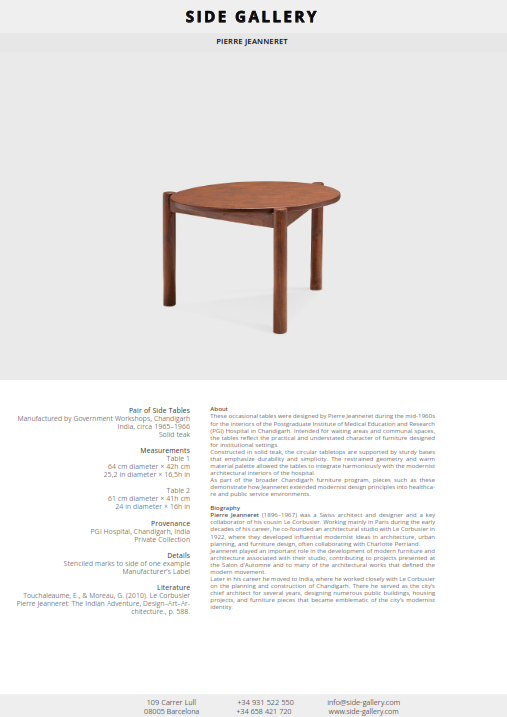
Pair of Side Tables
Manufactured by Government Workshops, Chandigarh
India, circa 1965–1966
Solid teak
Measurements
Table 1
64 cm diameter × 42h cm
25,2 in diameter × 16,5h in
Table 2
61 cm diameter × 41h cm
24 in diameter × 16h in
Provenance
PGI Hospital, Chandigarh, India
Private Collection
Details
Stenciled marks to side of one example
Manufacturer’s Label
Literature
Touchaleaume, E., & Moreau, G. (2010). Le Corbusier Pierre Jeanneret: The Indian Adventure, Design–Art–Architecture., p. 588.
About
These occasional tables were designed by Pierre Jeanneret during the mid-1960s for the interiors of the Postgraduate Institute of Medical Education and Research (PGI) Hospital in Chandigarh. Intended for waiting areas and communal spaces, the tables reflect the practical and understated character of furniture designed for institutional settings.
Constructed in solid teak, the circular tabletops are supported by sturdy bases that emphasize durability and simplicity. The restrained geometry and warm material palette allowed the tables to integrate harmoniously with the modernist architectural interiors of the hospital.
As part of the broader Chandigarh furniture program, pieces such as these demonstrate how Jeanneret extended modernist design principles into healthcare and public service environments.
Biography
Pierre Jeanneret (1896–1967) was a Swiss architect and designer and a key collaborator of his cousin Le Corbusier. Working mainly in Paris during the early decades of his career, he co-founded an architectural studio with Le Corbusier in 1922, where they developed influential modernist ideas in architecture, urban planning, and furniture design, often collaborating with Charlotte Perriand.
Jeanneret played an important role in the development of modern furniture and architecture associated with their studio, contributing to projects presented at the Salon d'Automne and to many of the architectural works that defined the modern movement.
Later in his career he moved to India, where he worked closely with Le Corbusier on the planning and construction of Chandigarh. There he served as the city’s chief architect for several years, designing numerous public buildings, housing projects, and furniture pieces that became emblematic of the city’s modernist identity.