Vase Model “Inborn Ott-017”
Manufactured by Park Sung-Youl
South Korea, 2024
Ottchil lacquer, pigment, Hanji, charcoal powder
Measurements
50 cm diameter × 30h cm
19,7 in diameter × 11,8h in
Edition
Unique piece
About
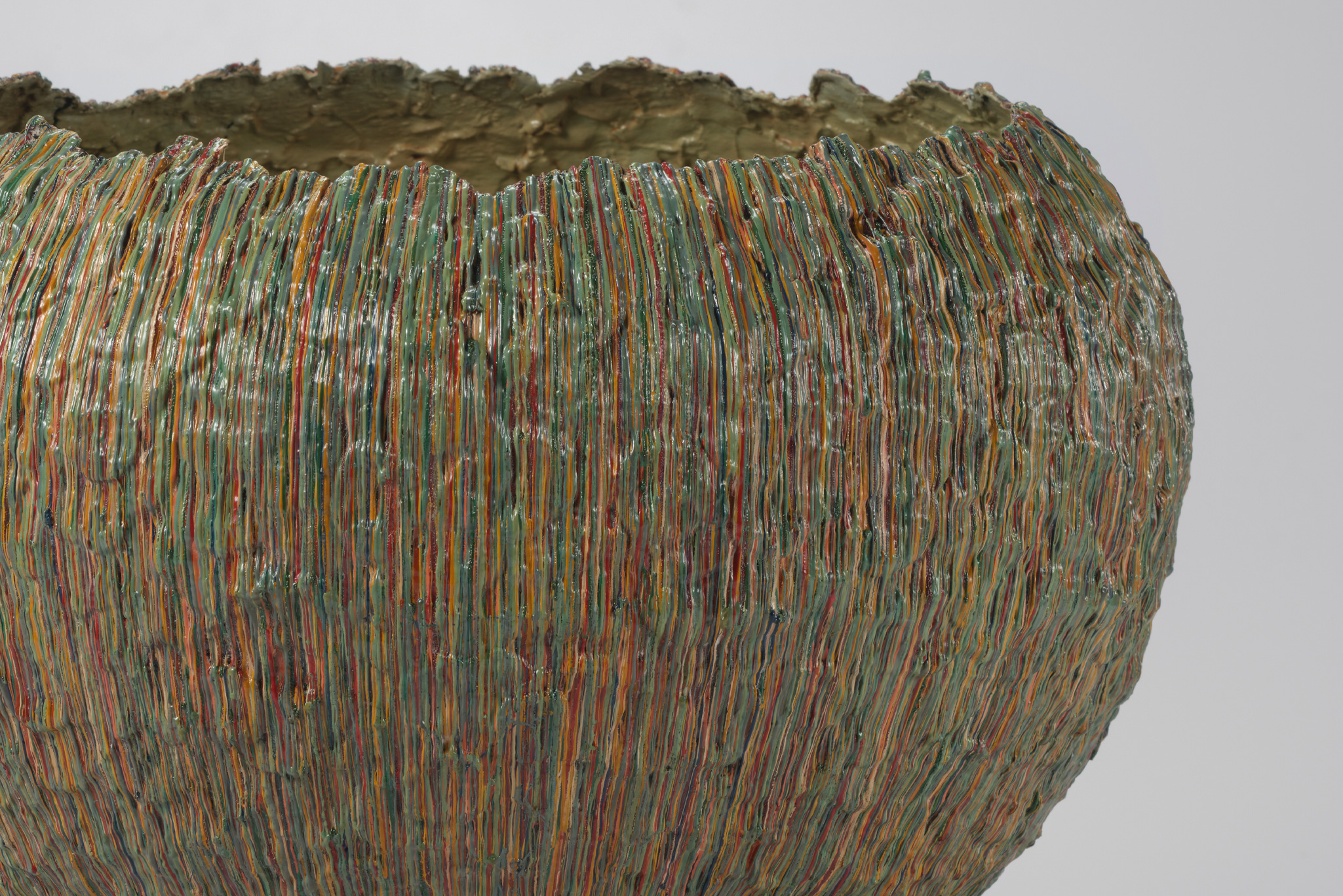
Inborn Ott-017 belongs to Park Sung-Youl’s INBORN series, an exploration of form, surface, and material transformation through the traditional Korean practice of ottchil, or natural lacquer. Rather than treating lacquer simply as a decorative finish, Park approaches it as a material capable of generating the physical and visual identity of the object itself.
The work is characterized by the relationship between its restrained geometric volume and the depth of its lacquered surface. Layers of ottchil and pigment create subtle variations in color and texture, allowing the exterior to register the accumulated traces of an intensive making process. The resulting surface appears simultaneously controlled and organic, changing in character according to light and viewing angle.
Through this process, Park brings a centuries-old Korean material tradition into a contemporary sculptural context. Inborn Ott-017 emphasizes the inherent qualities of lacquer—its density, luminosity, and capacity to preserve traces of successive layers—while reducing the object to an elemental form in which material and structure become inseparable.
Biography
Park Sung-Youl (Seoul, South Korea, 1978) is a Korean artist and craftsman whose practice centers on ottchil, the traditional Korean technique of natural lacquer. Trained in lacquer at Pai Chai University in Daejeon, Park combines an extensive knowledge of traditional craftsmanship with an experimental approach to material and form.
His work challenges the conventional understanding of lacquer as a surface treatment applied to materials such as wood, metal, or ceramics. Through sustained experimentation, Park developed his own “lacquer stretching” technique, transforming ottchil into an autonomous structural material capable of generating sculptural forms. Through repeated processes of stretching, layering, and curing, he creates objects in which delicate individual lines accumulate to produce surprisingly resilient structures.
Nature plays a central role in Park’s practice, particularly the way lacquer sap emerges from the wounds of the lacquer tree, gradually accumulating and solidifying over time. This process informs his exploration of growth, resilience, and transformation, allowing traditional material knowledge to acquire a distinctly contemporary sculptural language.
Park was awarded the Grand Prize at the Cheongju Craft Biennale Competition in 2019 and was a finalist for the Loewe Foundation Craft Prize in 2020. His work is represented in collections including the LOEWE Foundation and the Seoul Museum of Craft Art.