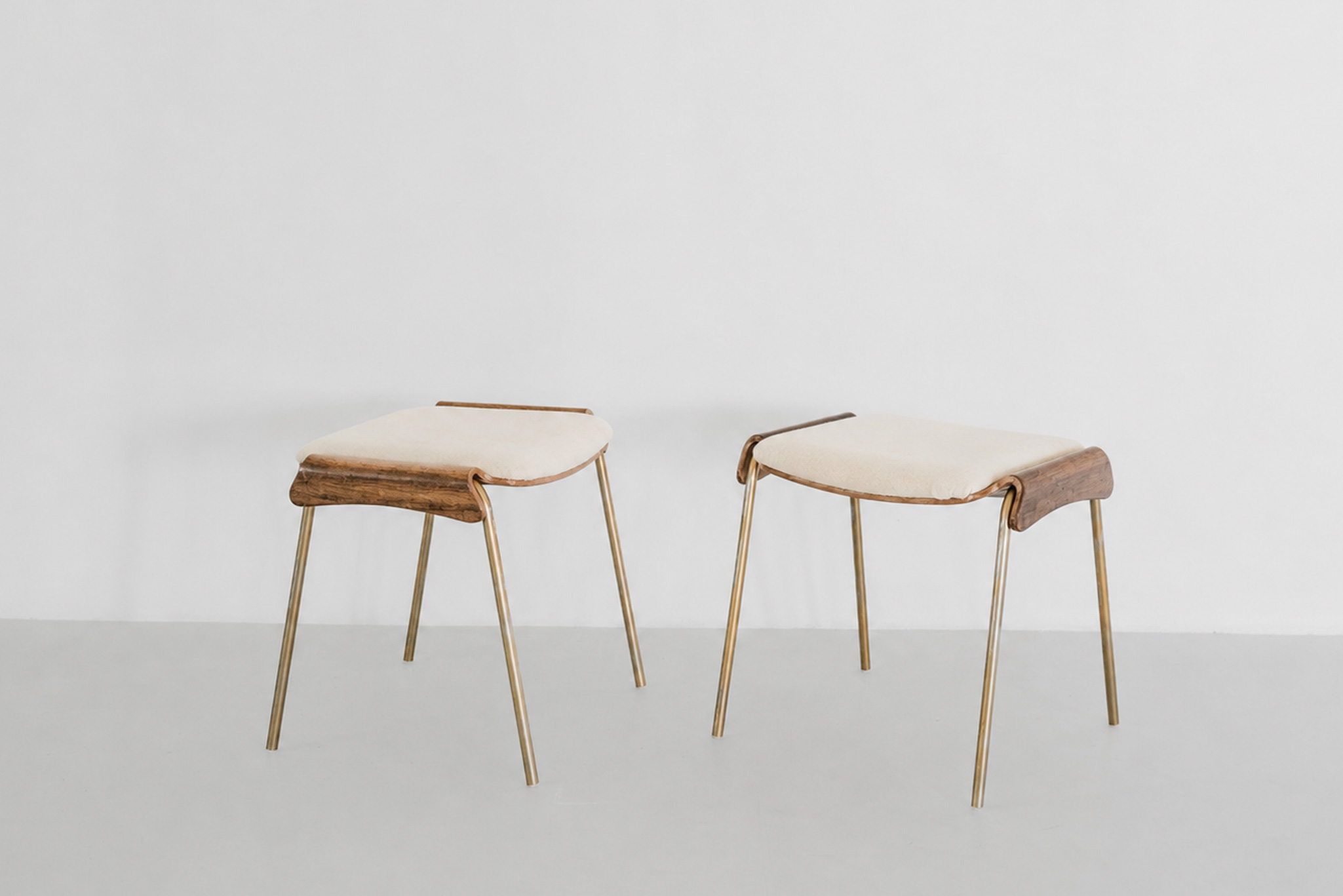
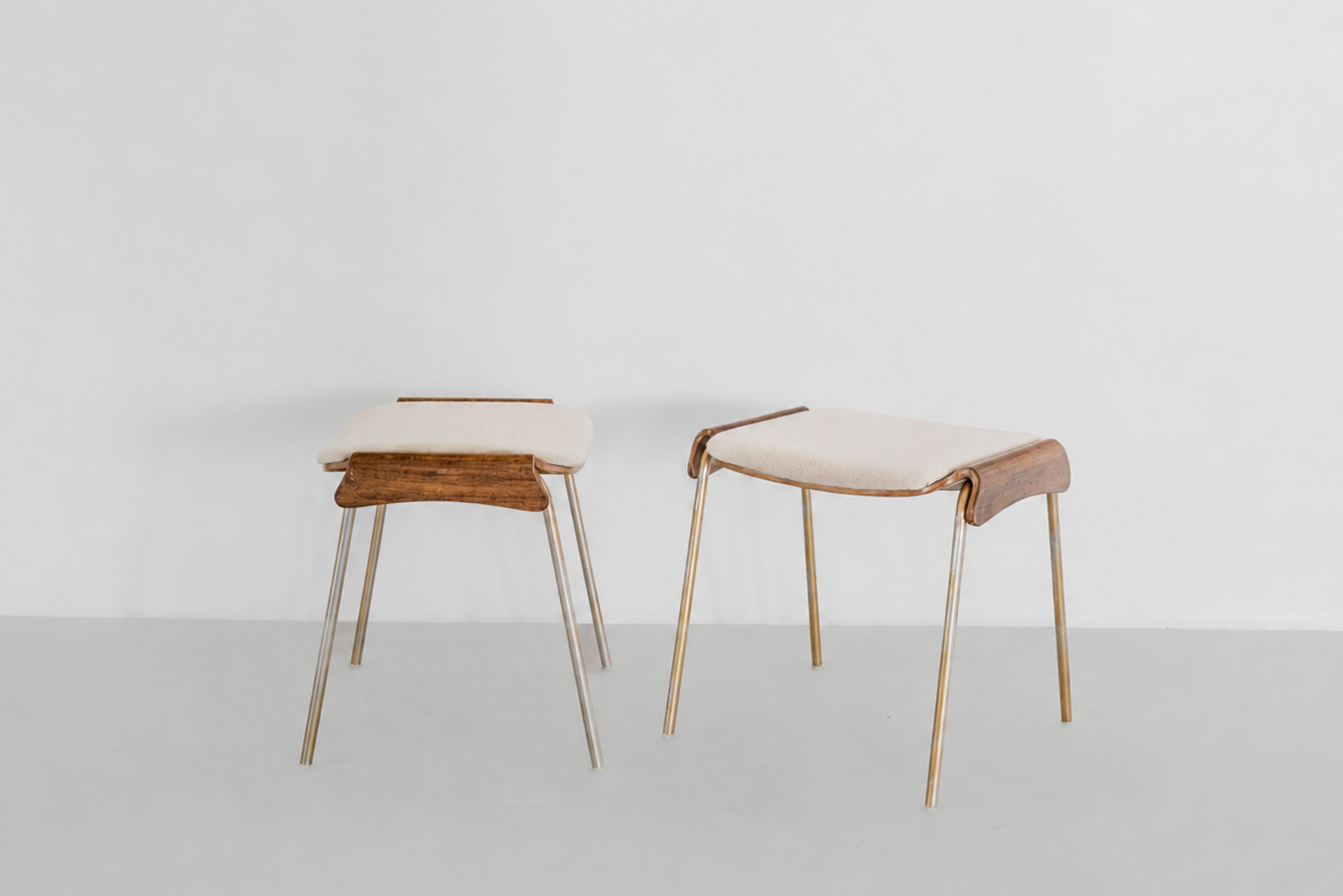
Stacking Stools
Manufactured by Nisso Hi-Mold
Japan, 1950s
Solid hardwood, Brass, Upholstered seat
Measurements (each)
45 × 38 × 45h cm
17,7 × 15 × 17,7h in
Provenance
Sogetsu Plaza Ikebana Center, Tokyo
About Nisso Hi-Mold
Nisso Hi-Mold emerged during the rapid expansion of Japanese furniture manufacturing that accompanied the country's economic growth in the 1960s and 1970s. Operating in the context of what is often regarded as the golden age of Japanese modern design, the company belonged to a generation of manufacturers that adopted molded plywood techniques and sought to translate the ideas of leading designers such as Isamu Kenmochi, Riki Watanabe, and Sori Yanagi into furniture adapted to contemporary Japanese life.
Although considerably less documented than companies such as Tendo Mokko or Akita Mokko, Nisso Hi-Mold developed a distinctive body of work characterized by sculptural plywood forms, slender metal structures, and ingenious stacking systems. Many of its products reveal affinities with the visual language of postwar Japanese modernism, combining Scandinavian influences with the economy of means and material sensitivity traditionally associated with Japanese craftsmanship.
Particularly notable are the company's seating designs, which often explored the expressive possibilities of molded wood while emphasizing flexibility and efficient use of space. Some examples display formal similarities to Isamu Kenmochi's celebrated No. 202 chair and other icons of the period, yet they retain a distinct identity marked by elegant proportions and subtle material contrasts.
Following the decline of many medium-sized Japanese manufacturers during the late twentieth century, Nisso Hi-Mold eventually ceased operations. As a result, surviving examples have become increasingly scarce. Today, their furniture provides valuable insight into the broader network of manufacturers that contributed to the development of Japanese modern design beyond its most widely recognized protagonists, illustrating how innovation and craftsmanship extended far beyond the canonical names of the period.