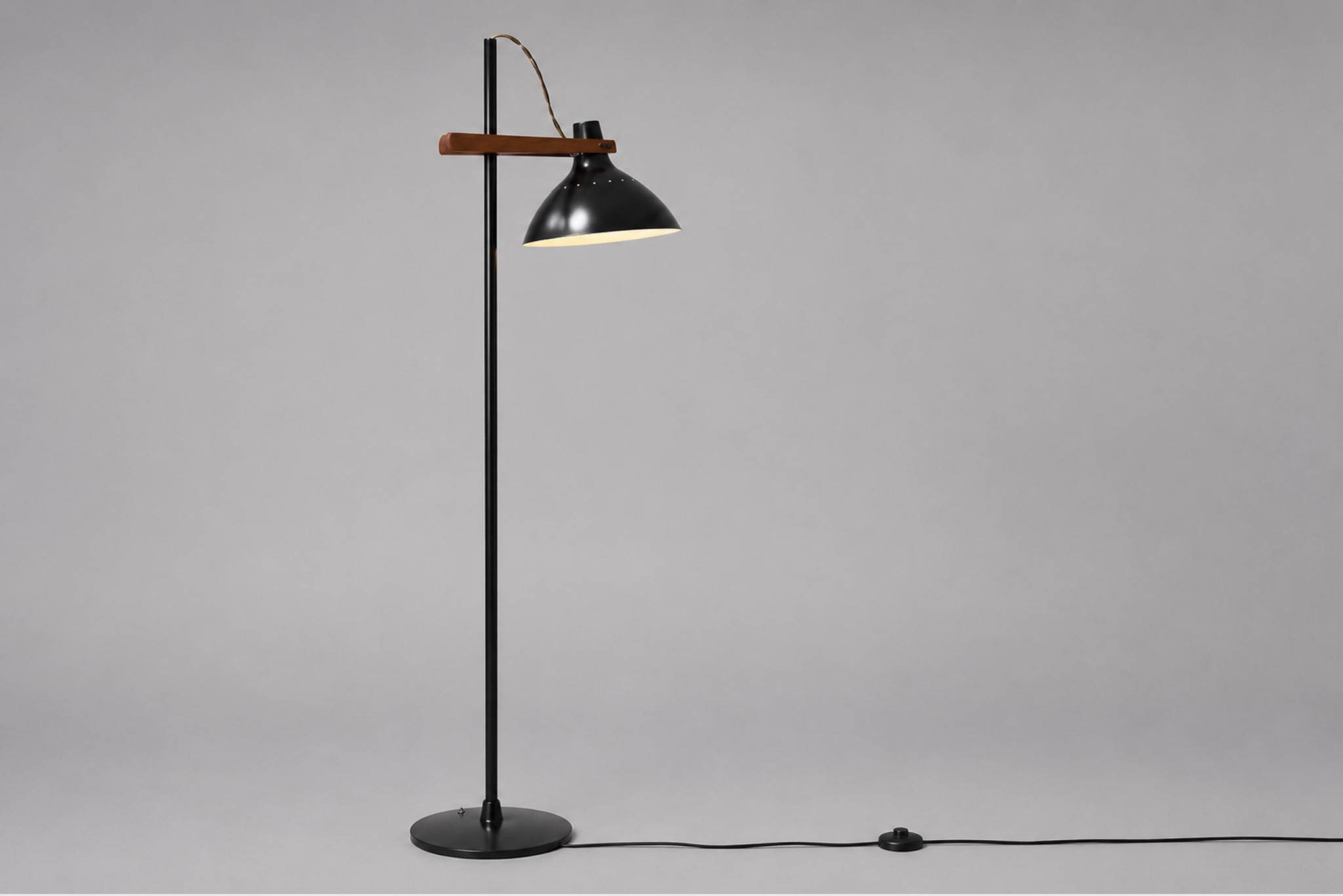
Floor Lamp
Manufactured by Nissho Electric Co., Ltd.
Japan, 1962
Black painted steel, teak and aluminum
Measurements
60 × 30 × 172h cm
23,6 × 11,8 × 67,7h in
Details
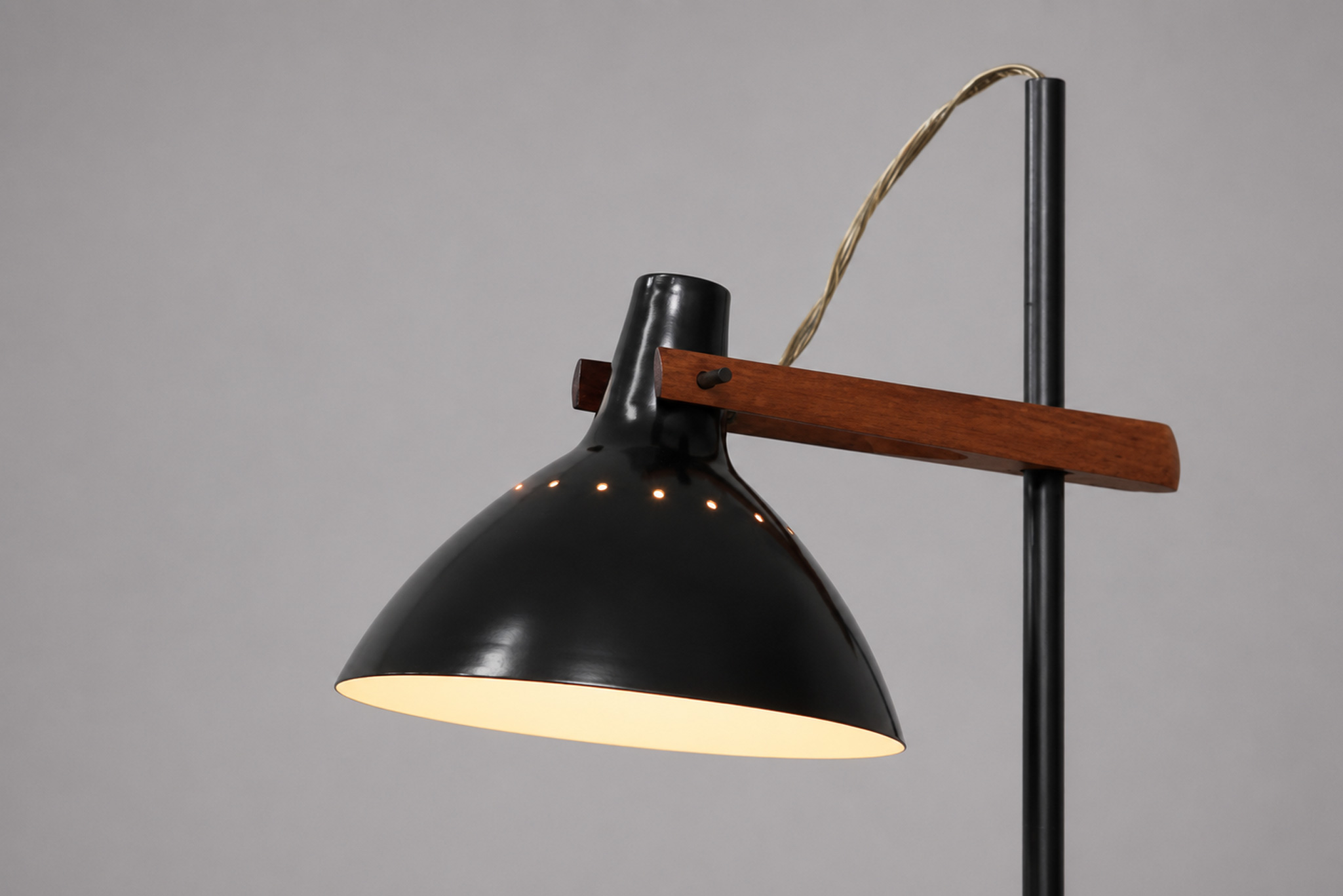
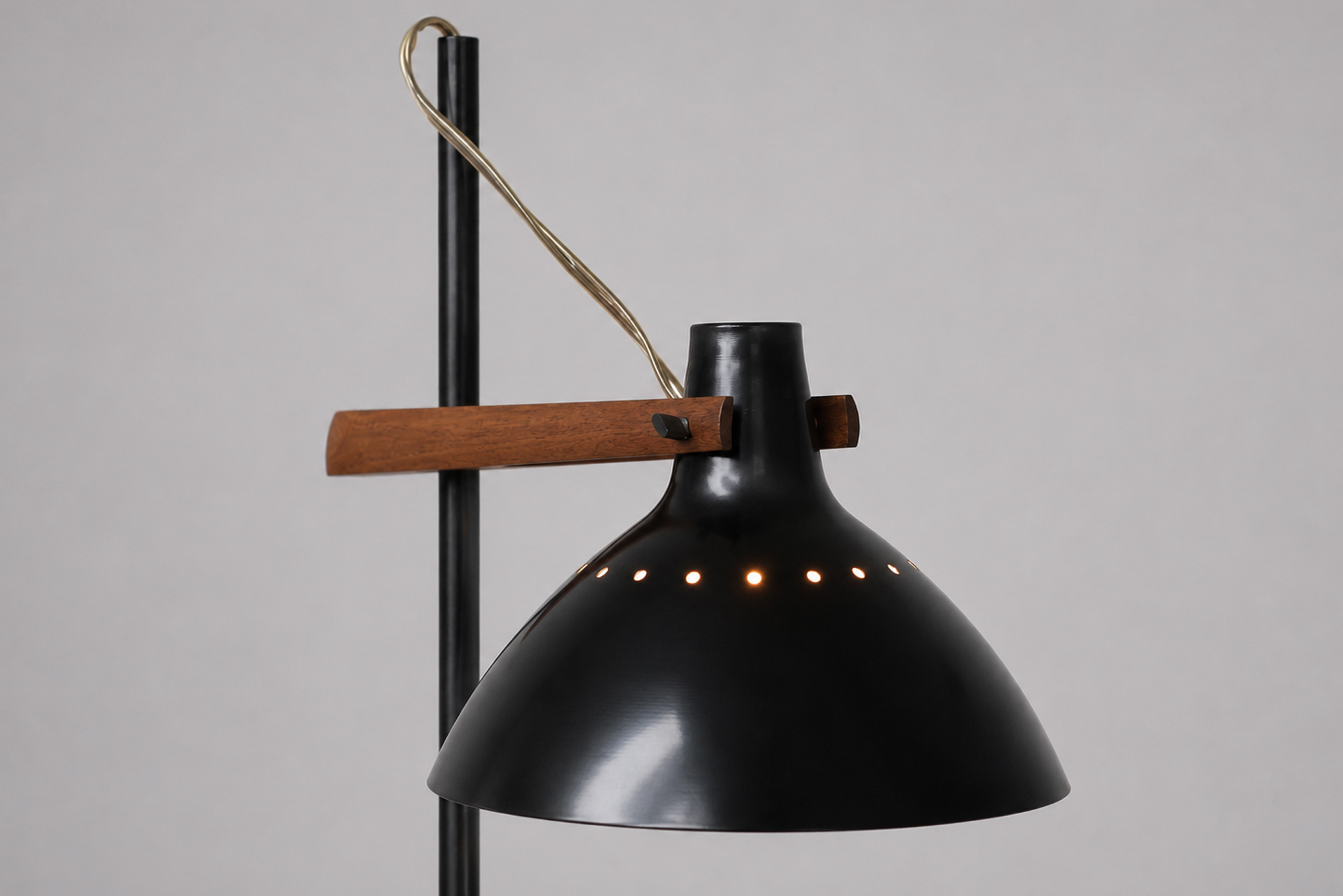
Original black version. Adjustable shade. E26 socket.
Provenance
Private Collection, Japan
Literature
Japanese Modern Lighting Design, Nissho Electric Co., Ltd., 1962.
Design: Isamu Noguchi and Isamu Kenmochi, Bonnie Rychlak, Dakin Hart, Mutsuko Mori, Masayo Murayama and Kengo Matsumoto, The Isamu Noguchi Foundation and Garden Museum, New York, 2022.
About
Designed by Kenjiro Ikeda for Nissho Electric in 1962, this floor lamp is one of the most accomplished examples of Japanese modern lighting. The present example corresponds to the same model used in the private residence of architect Kunio Maekawa, today preserved at the Edo-Tokyo Open Air Architectural Museum.
The design is distinguished by its elegant contrast between a black painted steel shade and base and a sculptural teak support, whose warm reddish tones soften the industrial character of the metal components. The gently curved wooden element is not merely decorative; it forms the structural connection between the base and the adjustable shade, expressing the balance between craftsmanship and engineering that defines postwar Japanese design.
The shade can be freely adjusted to direct the light, while the understated silhouette allows the lamp to function equally as a lighting object and as an architectural element within an interior. Its restrained material palette and carefully resolved proportions reflect the influence of Japanese modernism, where functionality was enriched through precision, simplicity, and respect for natural materials.
Produced by Nissho Electric during Japan's period of rapid economic growth, the lamp exemplifies the dialogue between industrial production and traditional craftsmanship that characterized the country's design culture throughout the 1960s.
Biography
Kenjiro Ikeda was a Japanese industrial designer active during the postwar decades, when Japan emerged as one of the world's leading centers of modern industrial design. Closely associated with Nissho Electric Co., Ltd., Ikeda specialized in lighting design, developing products that combined mechanical ingenuity with the restrained aesthetic of Japanese modernism.
Among his best-known works is the adjustable Floor Lamp designed in 1962, distinguished by its innovative height-adjustment mechanism inspired by the traditional Japanese jizaikagi, the suspended hook historically used above the irori hearth. This design became one of Nissho Electric's most sophisticated lighting products and was notably used by architect Kunio Maekawa in the study of his private residence.
Ikeda's work reflects the broader ambitions of Japanese design during the period of rapid economic growth, when designers sought to reconcile traditional craftsmanship with modern industrial production. His lighting designs employed carefully balanced combinations of aluminum, steel, and natural wood, emphasizing precision engineering, functional clarity, and timeless simplicity.
Although his career has received less international attention than contemporaries such as Isamu Kenmochi, Sori Yanagi, or Riki Watanabe, Ikeda's work represents an important chapter in the history of Japanese postwar lighting design. His designs demonstrate how everyday functional objects could embody both technological innovation and a deep respect for Japanese cultural traditions.