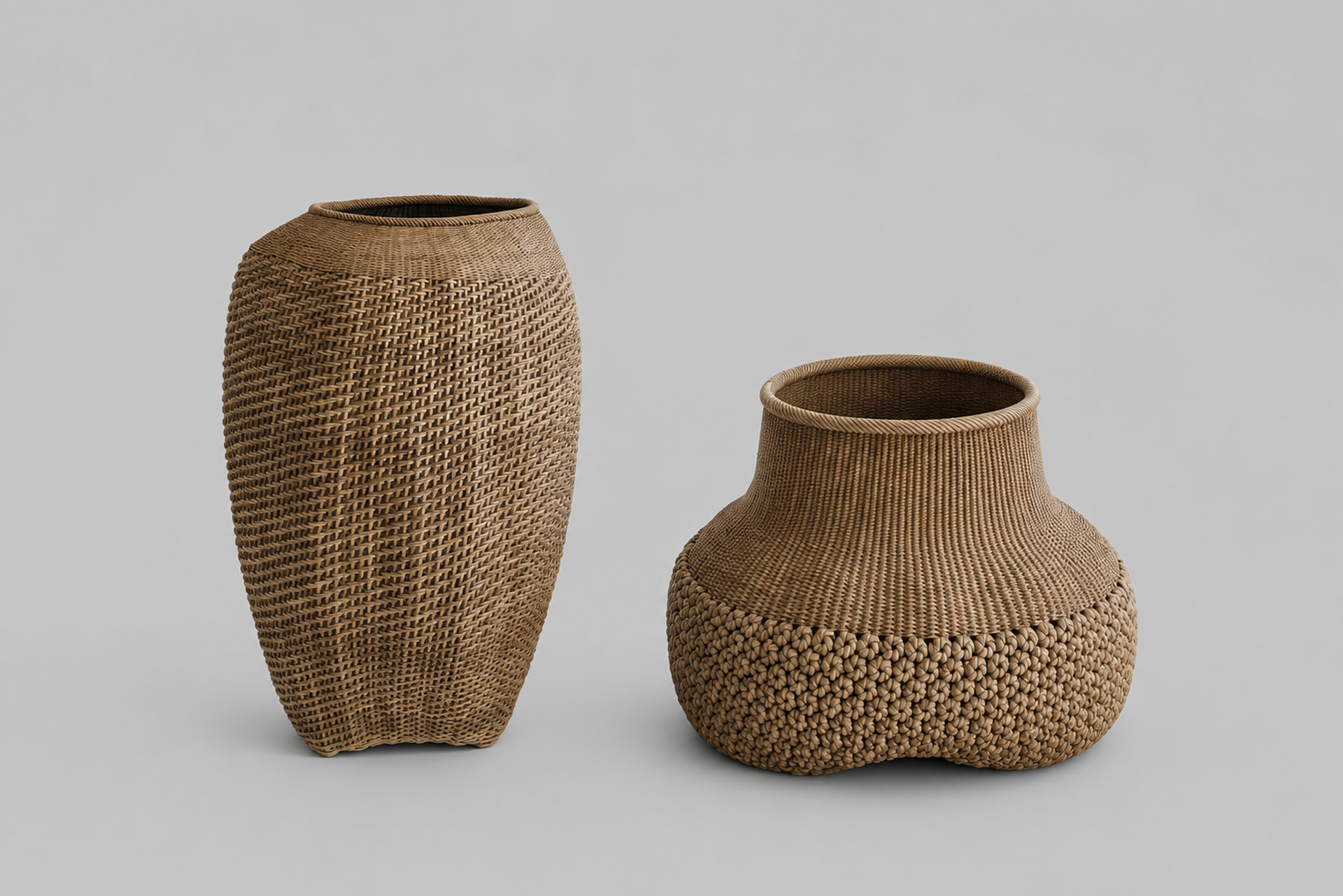
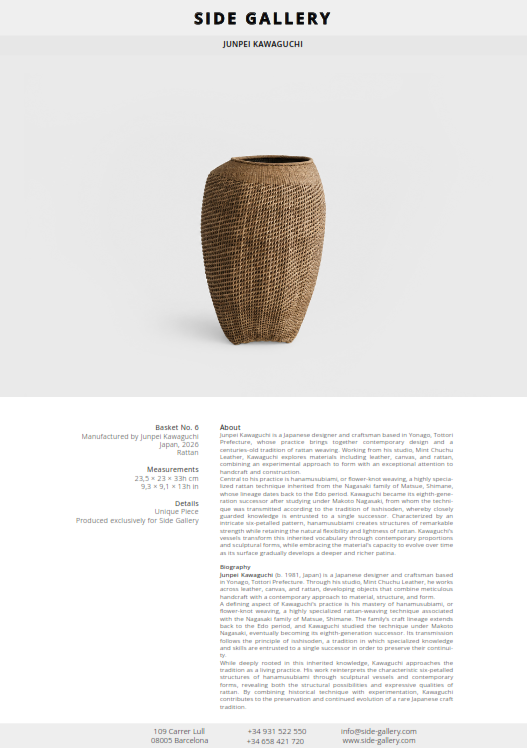
Basket No. 6
Manufactured by Junpei Kawaguchi
Japan, 2026
Rattan
Measurements
23,5 × 23 × 33h cm
9,3 × 9,1 × 13h in
Details
Unique Piece
Produced exclusively for Side Gallery
About
Junpei Kawaguchi is a Japanese designer and craftsman based in Yonago, Tottori Prefecture, whose practice brings together contemporary design and a centuries-old tradition of rattan weaving. Working from his studio, Mint Chuchu Leather, Kawaguchi explores materials including leather, canvas, and rattan, combining an experimental approach to form with an exceptional attention to handcraft and construction.
Central to his practice is hanamusubiami, or flower-knot weaving, a highly specialized rattan technique inherited from the Nagasaki family of Matsue, Shimane, whose lineage dates back to the Edo period. Kawaguchi became its eighth-generation successor after studying under Makoto Nagasaki, from whom the technique was transmitted according to the tradition of isshisoden, whereby closely guarded knowledge is entrusted to a single successor.
Characterized by an intricate six-petalled pattern, hanamusubiami creates structures of remarkable strength while retaining the natural flexibility and lightness of rattan. Kawaguchi’s vessels transform this inherited vocabulary through contemporary proportions and sculptural forms, while embracing the material’s capacity to evolve over time as its surface gradually develops a deeper and richer patina.
Biography
Junpei Kawaguchi (b. 1981, Japan) is a Japanese designer and craftsman based in Yonago, Tottori Prefecture. Through his studio, Mint Chuchu Leather, he works across leather, canvas, and rattan, developing objects that combine meticulous handcraft with a contemporary approach to material, structure, and form.
A defining aspect of Kawaguchi’s practice is his mastery of hanamusubiami, or flower-knot weaving, a highly specialized rattan-weaving technique associated with the Nagasaki family of Matsue, Shimane. The family’s craft lineage extends back to the Edo period, and Kawaguchi studied the technique under Makoto Nagasaki, eventually becoming its eighth-generation successor. Its transmission follows the principle of isshisoden, a tradition in which specialized knowledge and skills are entrusted to a single successor in order to preserve their continuity.
While deeply rooted in this inherited knowledge, Kawaguchi approaches the tradition as a living practice. His work reinterprets the characteristic six-petalled structures of hanamusubiami through sculptural vessels and contemporary forms, revealing both the structural possibilities and expressive qualities of rattan. By combining historical technique with experimentation, Kawaguchi contributes to the preservation and continued evolution of a rare Japanese craft tradition.