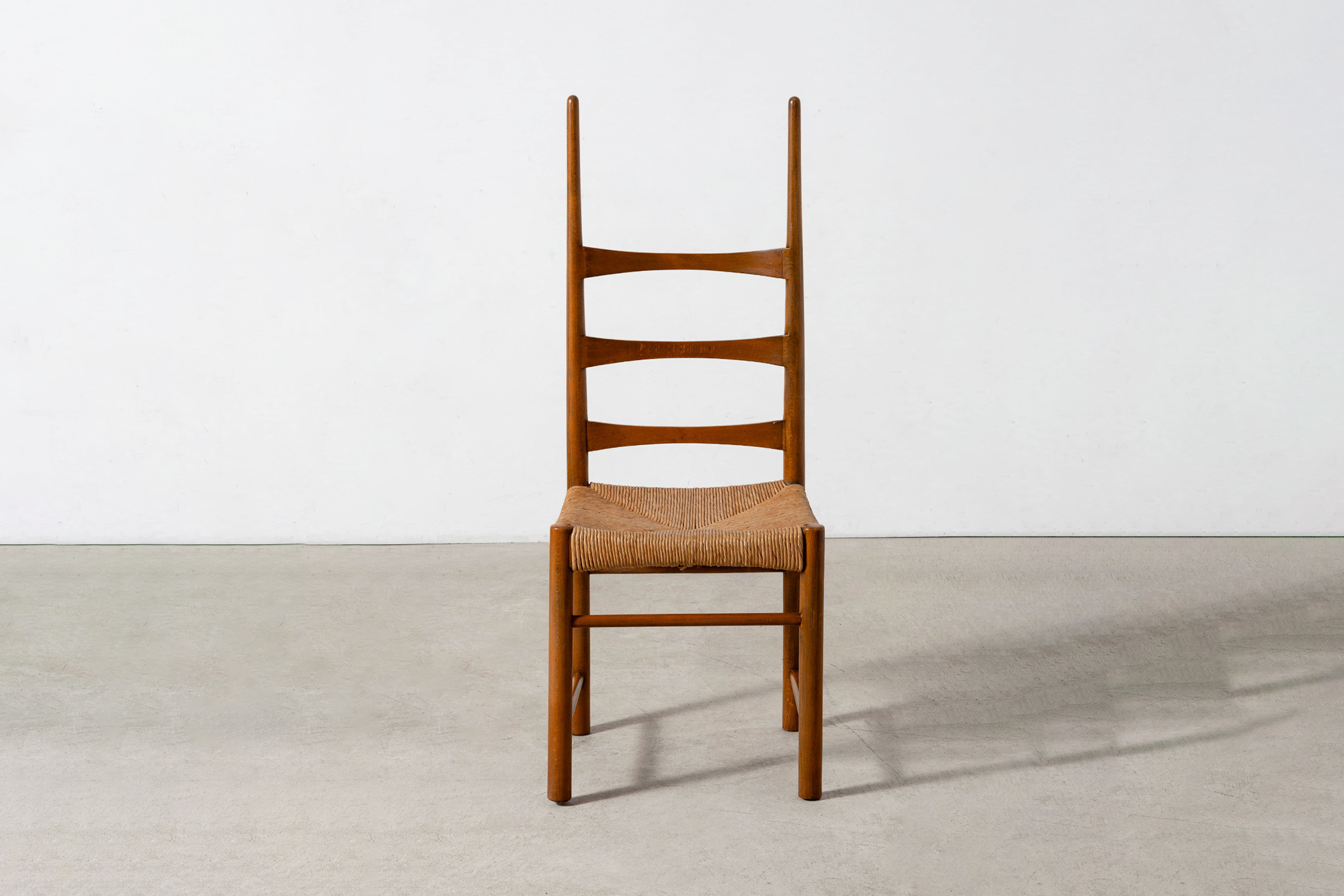
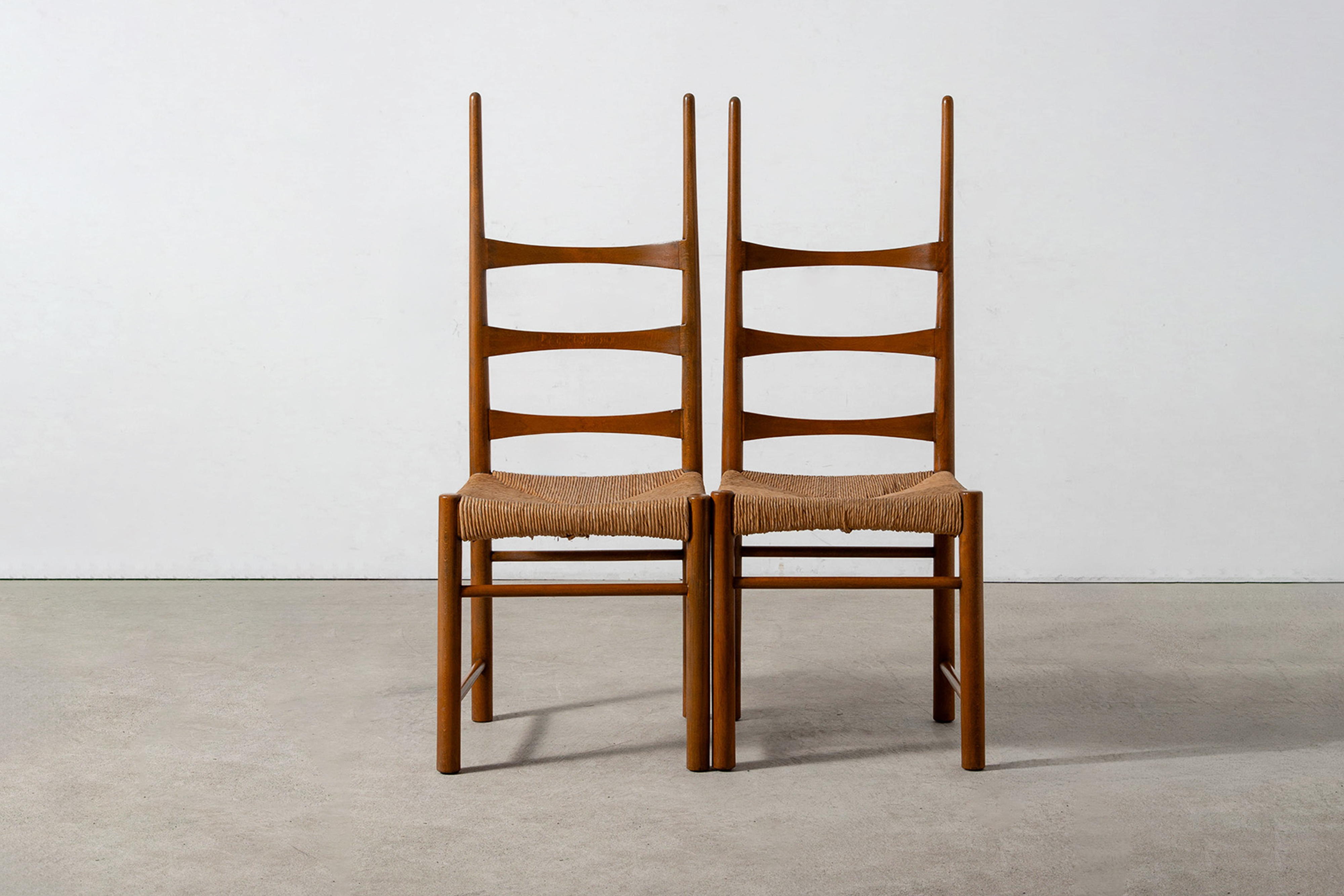
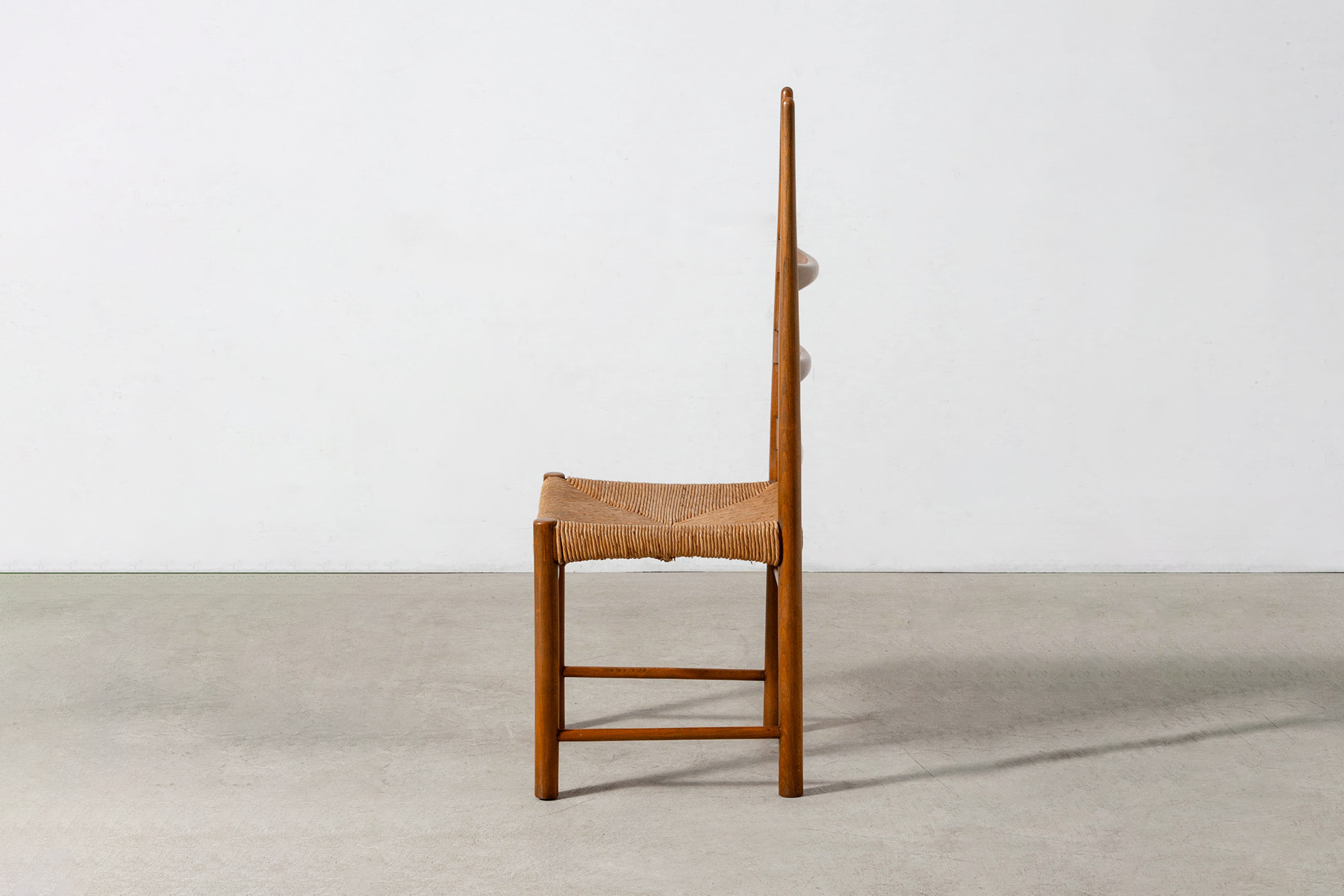
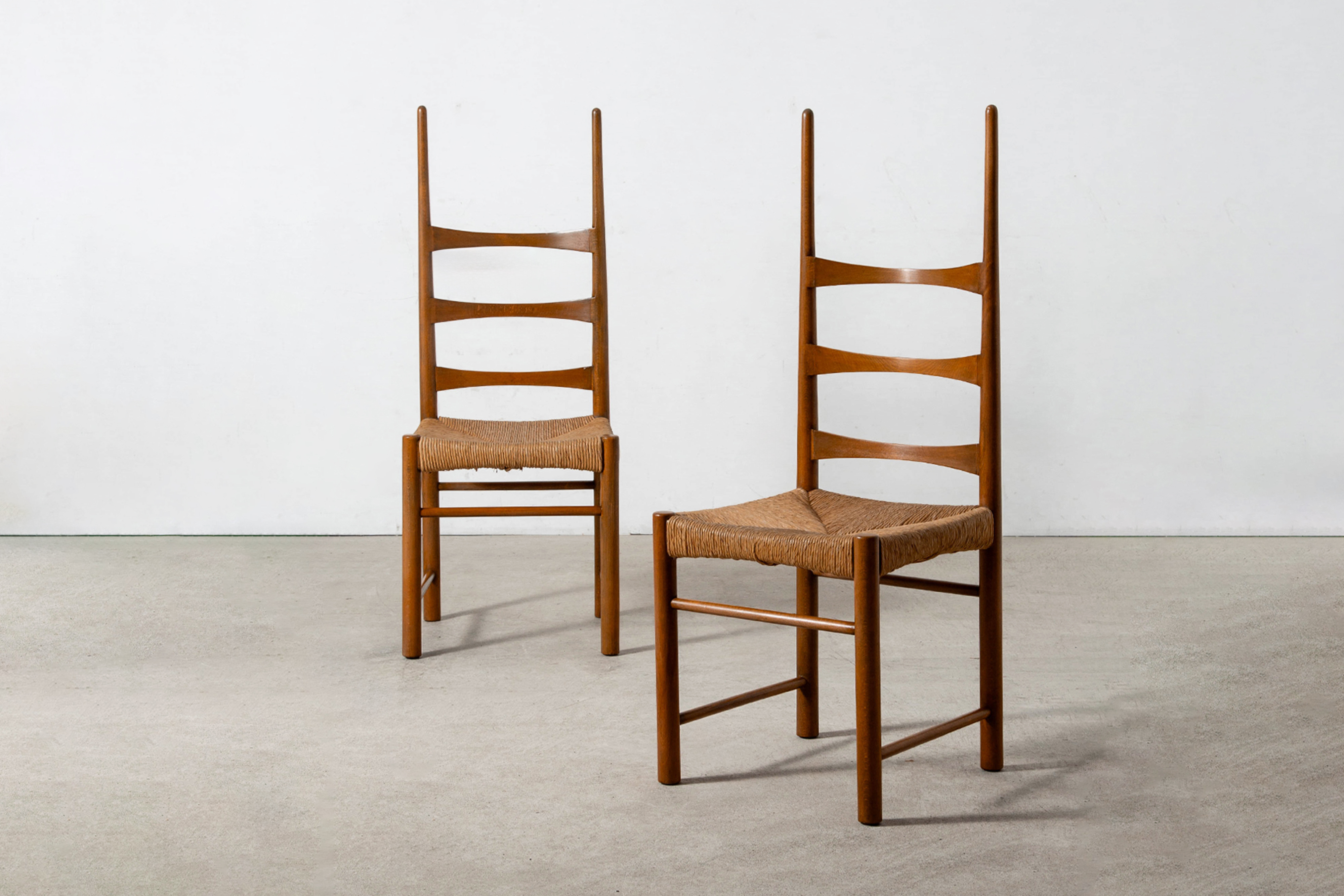
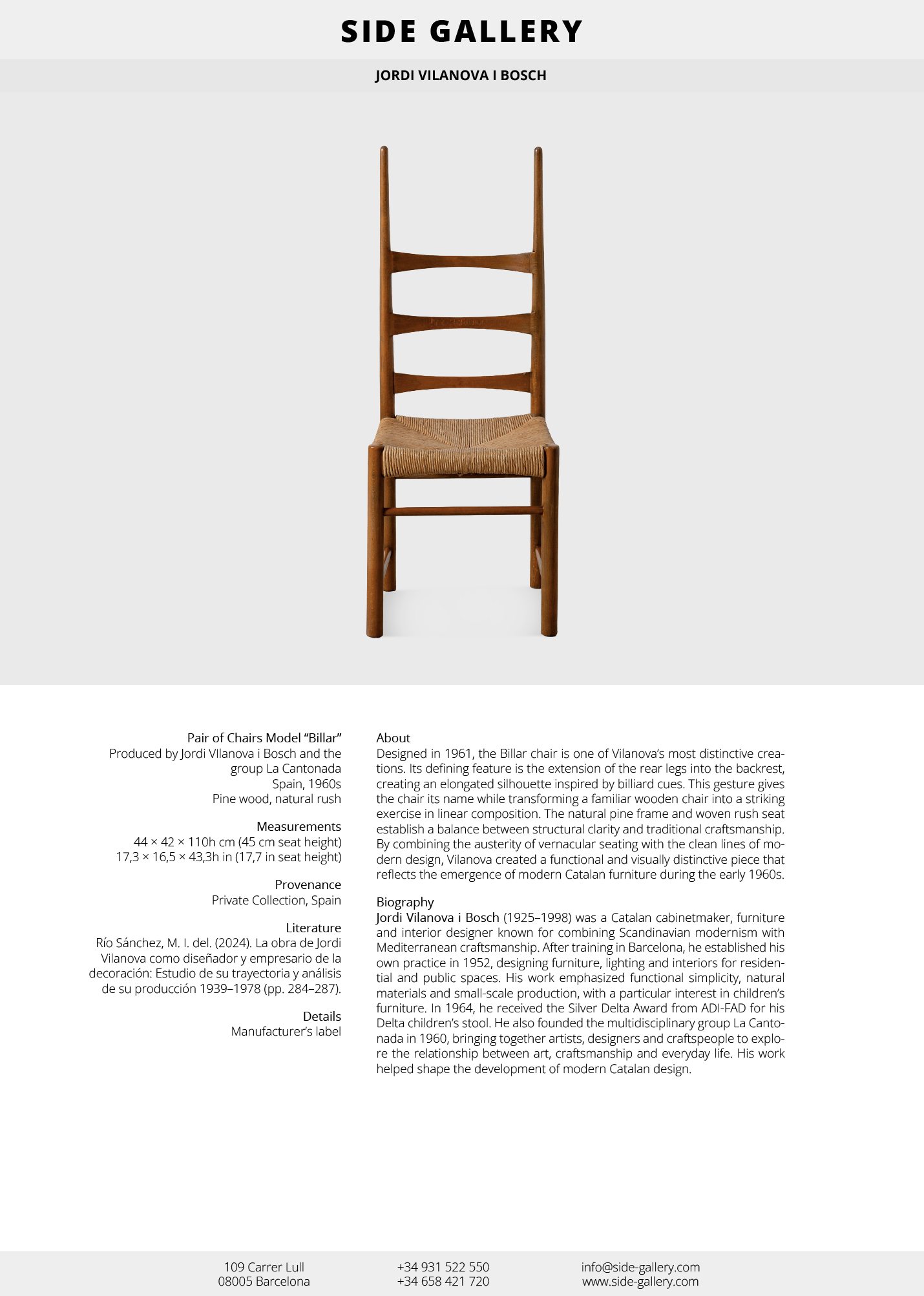
Pair of Chairs Model “Billar”
Produced by Jordi VIlanova i Bosch and the group La Cantonada
Spain, 1960s
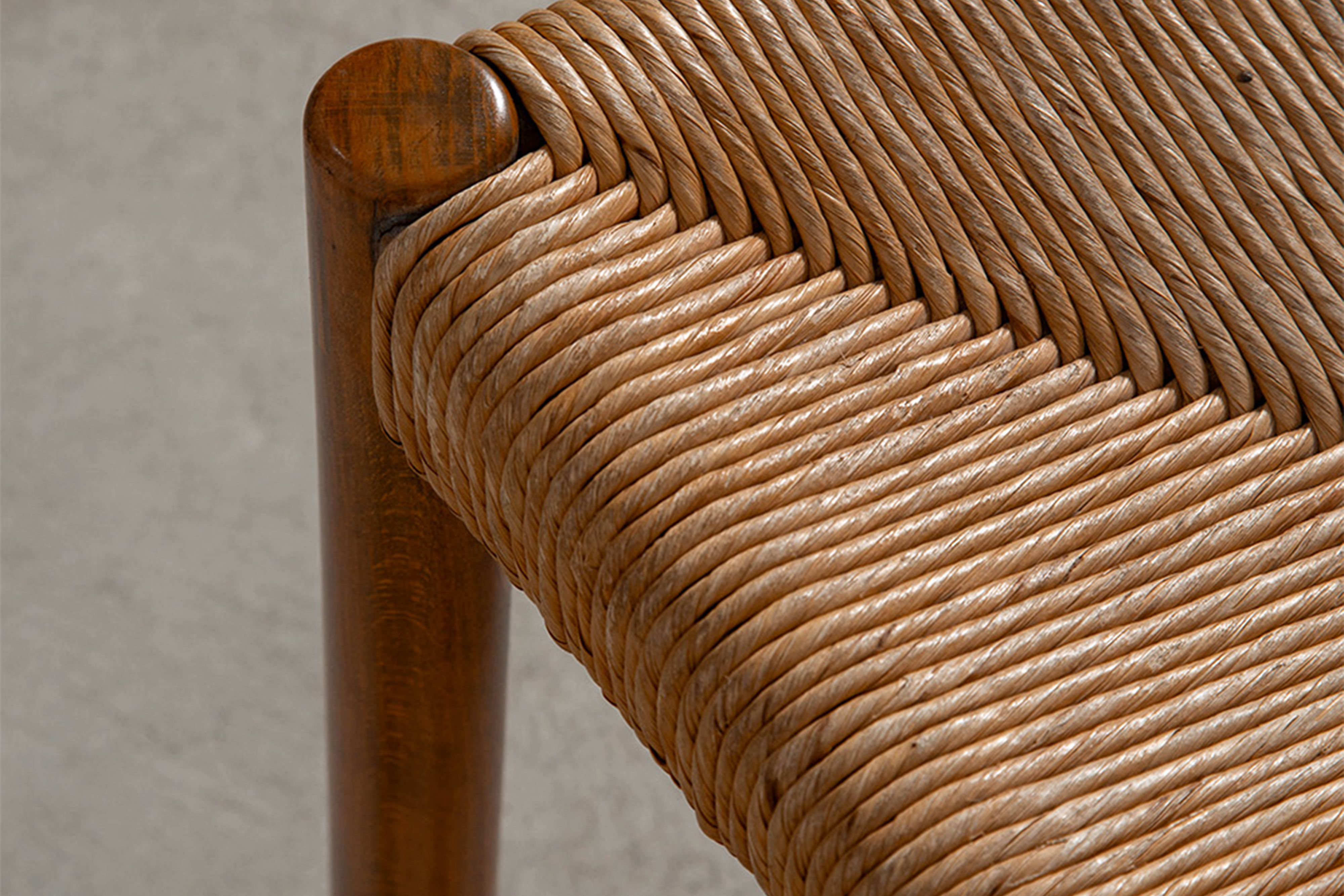
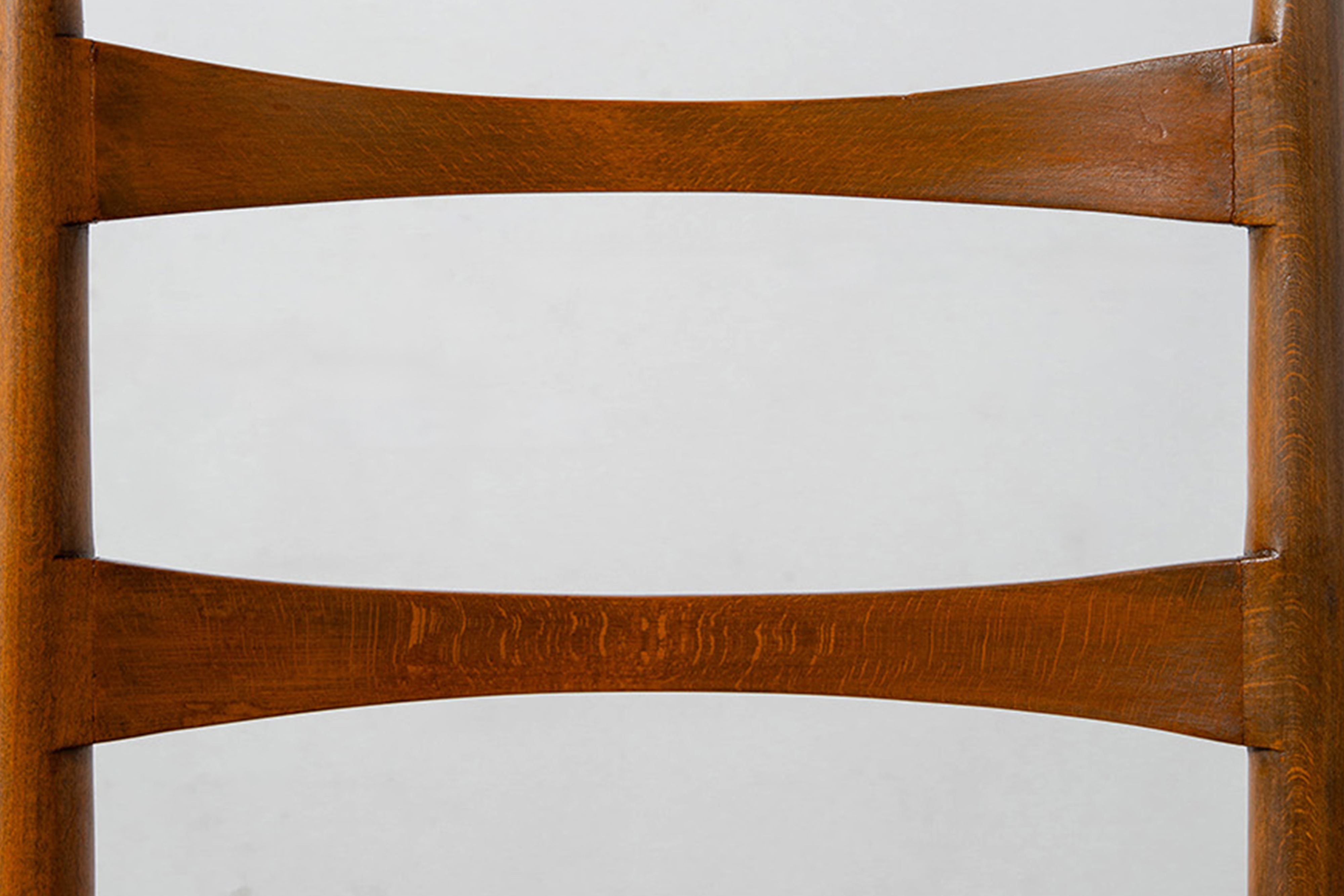
Pine wood, natural rush
Measurements
44 × 42 × 110h cm (45 cm seat height)
17,3 × 16,5 × 43,3h in (17,7 in seat height)
Provenance
Private Collection, Spain
Literature
Río Sánchez, M. I. del. (2024). La obra de Jordi Vilanova como diseñador y empresario de la decoración: Estudio de su trayectoria y análisis de su producción 1939–1978 (pp. 284–287).
Details
Manufacturer’s label
About
Designed in 1961, the Billar chair is one of Vilanova’s most distinctive creations. Its defining feature is the extension of the rear legs into the backrest, creating an elongated silhouette inspired by billiard cues. This gesture gives the chair its name while transforming a familiar wooden chair into a striking exercise in linear composition. The natural pine frame and woven rush seat establish a balance between structural clarity and traditional craftsmanship. By combining the austerity of vernacular seating with the clean lines of modern design, Vilanova created a functional and visually distinctive piece that reflects the emergence of modern Catalan furniture during the early 1960s.
Biography
Jordi Vilanova i Bosch (1925–1998) was a Catalan cabinetmaker, furniture designer and interior designer born in Rubí, Catalonia, Spain. He began his training in 1939 at the Escola del Treball i Oficis Artístics and the Escola de la Llotja in Barcelona, studying technical and artistic drawing, cabinetmaking and furniture design. He subsequently gained practical experience at Casa Busquets and in the workshop of cabinetmaker Lluís Gili. In 1952, he established his own practice in Barcelona, working across furniture, lighting and interior design for private residences, commercial spaces, offices, schools and public institutions.
From the mid-1950s, Vilanova became particularly interested in children’s and youth furniture, developing innovative designs that responded to changing domestic needs and the limited space of modern homes. His furniture combined Scandinavian influences with Mediterranean traditions and Catalan vernacular craftsmanship, emphasising functional forms, natural materials and carefully considered construction. Rather than following industrial standardisation, he favoured small-scale production and designs that respected the qualities of wood, textiles, metal, glass and ceramics. Among his notable works is the Delta children’s stool, for which he received the Silver Delta Award from ADI-FAD in 1964. His wider furniture production included chairs, tables, storage pieces, beds and lighting, characterised by formal simplicity and a balance between practicality and material warmth.
In 1960, Vilanova opened a studio and showroom on Carrer de Freixa in Barcelona, where he presented furniture, lighting, rugs and accessories of his own design. The space also served as a meeting point for artists and designers, leading to the formation of La Cantonada, a multidisciplinary group active from 1960 to 1975. Its members included ceramist Jordi Aguadé, jeweller and goldsmith Aureli Bisbe, painter and stained-glass artist Joan Vila-Grau, and architect Jordi Bonet. The group explored the relationship between art, craftsmanship and everyday life through both civil and sacred art projects. From 1962 to 1974, Vilanova also managed Ars Sacra, contributing to the creation of contemporary liturgical objects and church interiors. The group later founded the art magazine Qüestions d’Art, published between 1967 and 1974. Vilanova regularly participated in the Hogarotel trade fairs and other design events that helped introduce modern furniture and interior design to Catalonia. In 1974, he inaugurated a larger permanent showroom dedicated to his furniture, lighting, textiles and carpets. He was also an active member of ADI-FAD and professional associations for interior designers. Through his furniture and interiors, Vilanova helped establish a distinctive approach to Catalan modern design, bringing together Nordic functionalism, Mediterranean sensibility and the enduring value of artisanal production.