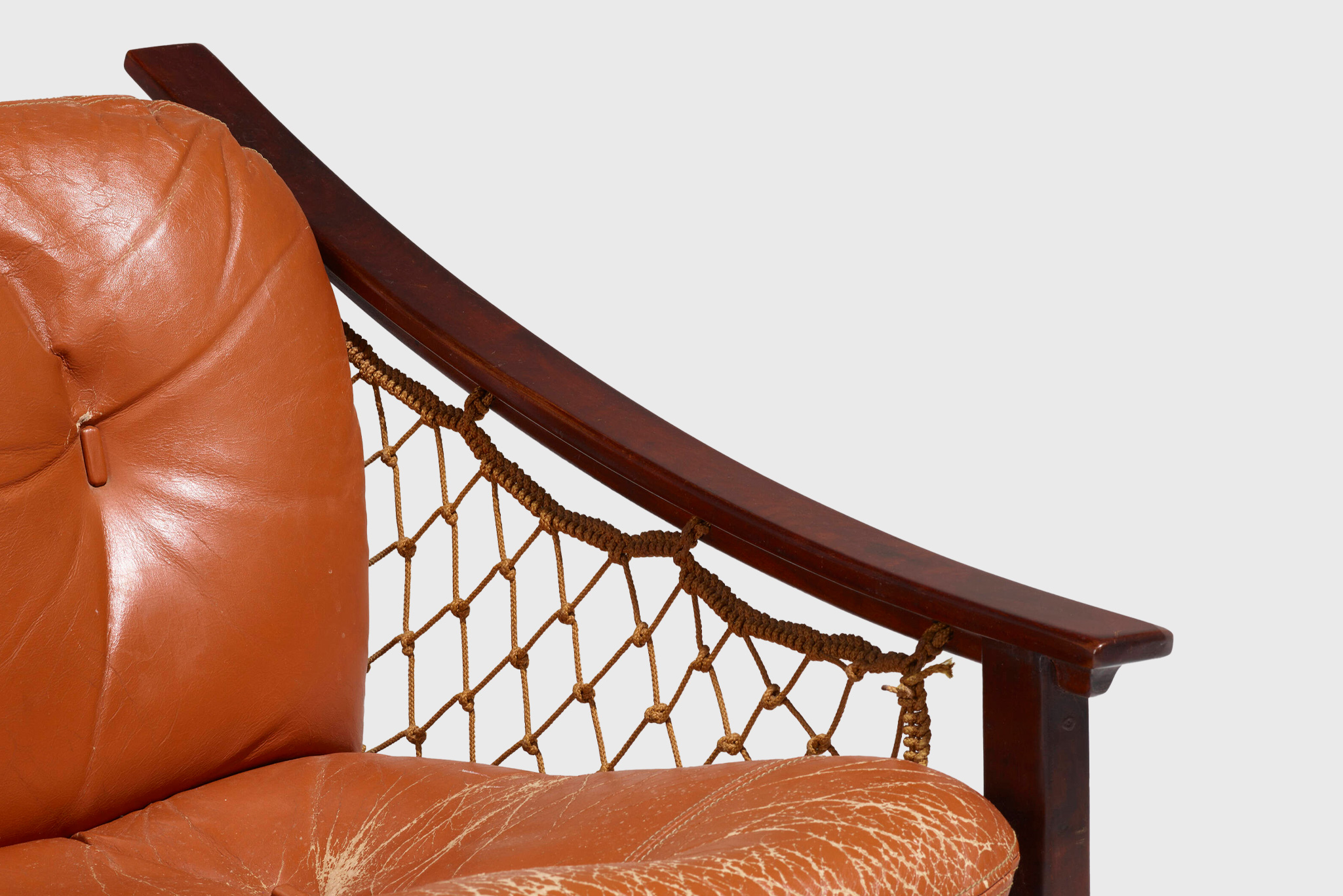
Pair of Lounge Chairs
Manufactured by Italma Wood Art
Brazil, 1965
Wood, Leather
Measurements
76 × 76 × 71h cm
29,9 × 29,9 × 28h in
Details
Stamped with the manufacturer’s label
Provenance
Private collection, Brazil
Biography
Jean Gillon was a Romanian‑born architect, artist, and furniture designer whose work became a defining expression of Brazilian modernism in the 20th century. Born in Iași, Romania, in 1919, Gillon was educated in both architecture and fine arts at the George Enescu National University of Arts and Architecture, grounding his creative approach in a rigorous understanding of structural and visual design.
In his early adulthood, Gillon lived and worked across Europe, including Paris, where he studied tapestry and worked as a cartoonist for Le Monde and as a set designer for the Paris Opera Ballet. He later continued architectural studies at Vienna’s Kunstgewerbschule (now the University of Applied Arts) and served as a visiting lecturer at London’s Central School of Arts & Crafts.
In 1956, Gillon relocated with his wife Edith and their daughters to São Paulo, Brazil, drawn by the dynamic modern architecture and design culture emerging there, influenced by figures such as Lina Bo Bardi and José Zanine Caldas. Initially engaged in interior architecture and decorative projects, he soon turned his attention fully to furniture design.
By 1961, Gillon had founded his first furniture workshop, Fábrica de Móveis Cidam, which would evolve into Italma WoodArt (often simply WoodArt), the Brazilian design and manufacturing company for which he is best known. Through this enterprise, Gillon designed and oversaw the production of a wide range of furniture characterized by the use of Brazilian hardwoods such as jacaranda/rosewood, supple leather upholstery, and innovative structural details.
Gillon’s designs gained national and international recognition throughout the 1960s and 1970s. His furniture—especially lounge chairs, ottomans, sofas, and occasional pieces—was crafted with meticulous attention to form, material, and comfort. By 1964, his work was being exported to more than twenty‑two countries, establishing his reputation beyond Brazil’s borders.
Among his most iconic designs is the Jangada Chair (1968) and its matching ottoman—a lounge chair featuring a frame of richly grained Brazilian hardwood, leather upholstery, and a support system of knotted nylon netting evocative of traditional Brazilian fishing rafts (jangadas). This piece became emblematic of Gillon’s ability to blend organic form, technical innovation, and cultural reference. For its originality and design excellence, the Jangada earned distinctions such as recognition from the Brazilian furniture association MOVESP in 1991.
Throughout his career, Gillon also collaborated with other Brazilian manufacturers such as Probel and Village, which produced additional ranges of his furniture designs.
In addition to furniture, Gillon was a prolific creator in other disciplines, including tapestry, sculpture, painting, and architectural interiors, and participated in numerous exhibitions both in Brazil and internationally, reflecting his multifaceted artistic practice. After a long and influential career, Gillon retired in 2003 and passed away in São Paulo in 2007. His work continues to be celebrated in museum collections, design exhibitions, and among global collectors of mid‑century modern design.