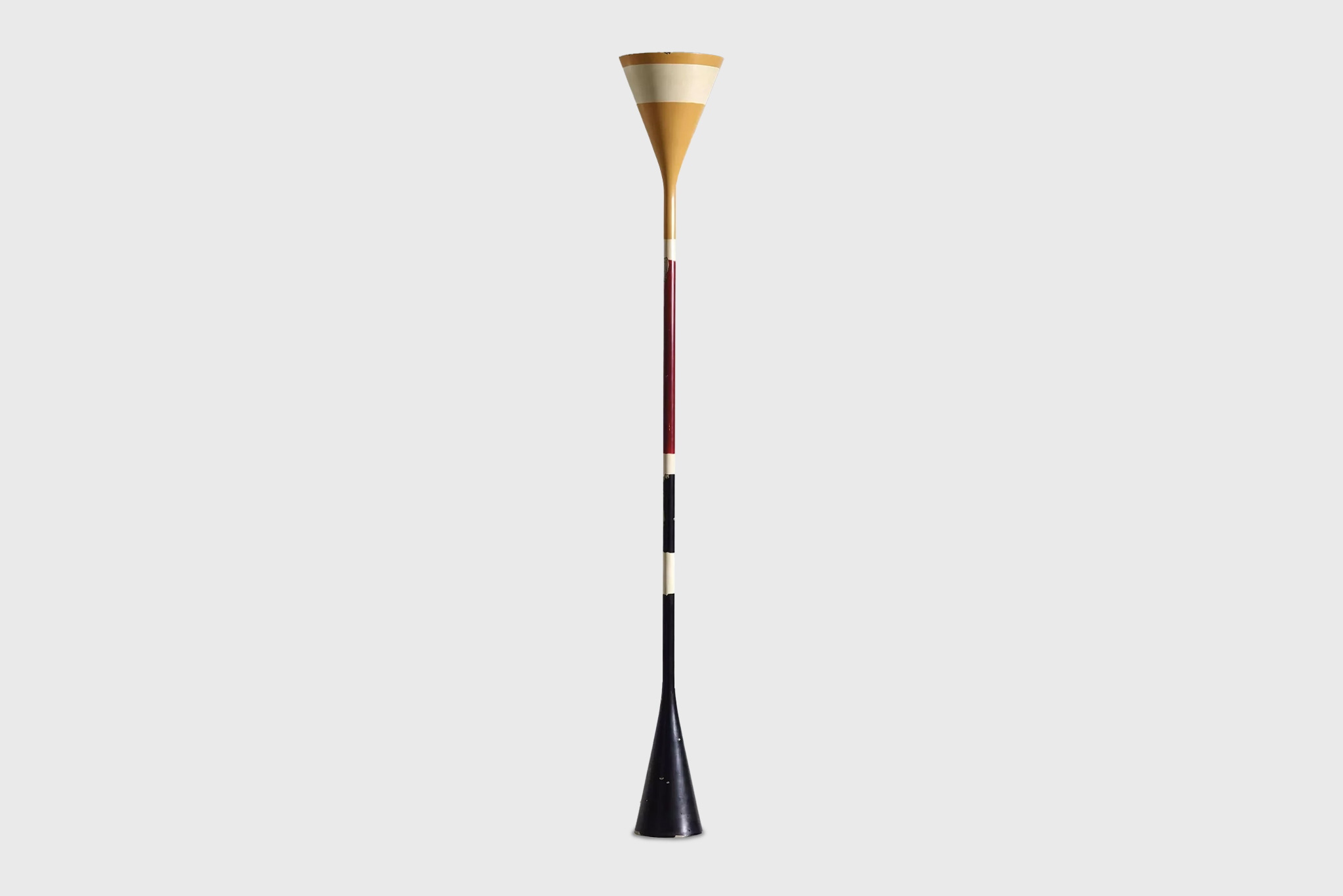
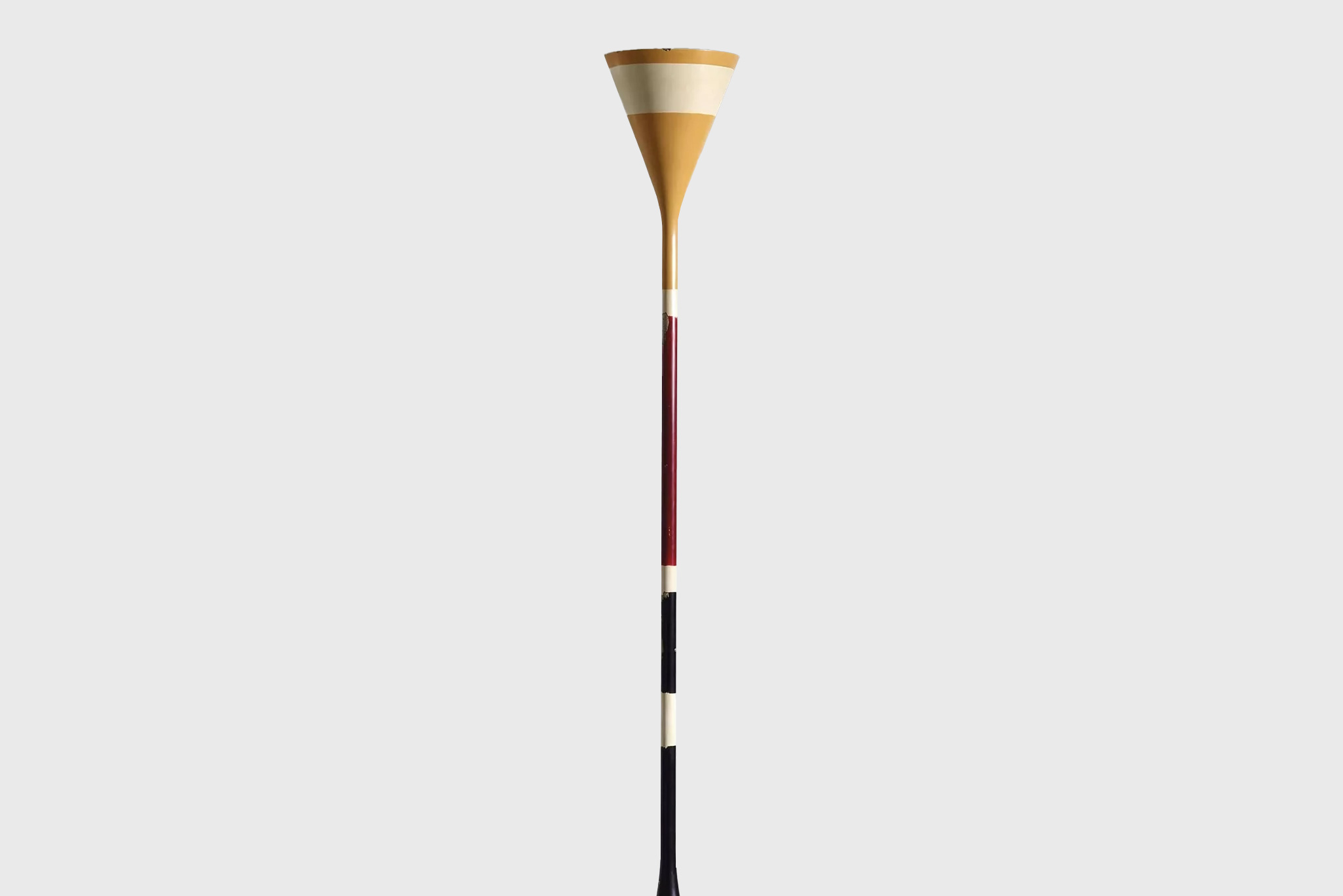
Floor Lamp
Manufactured by Arredoluce
Italy, 1956
Enameled brass, lead
Measurements
18,5h cm
7,3h in
Provenance
Private collection
Literature
Radice, B. (2017). Ettore Sottsass and the Poetics of Materials. Milan: Electa.
Pansera, A., Padoan, A., & Palmaghini, A. (2018). Arredoluce: Catalogo ragionato 1943–1987 (p. 320). Cinisello Balsamo: Silvana Editoriale.
About
This rare standing lamp represents an early experimental phase in Ettore Sottsass’s career, dating to circa 1956, a period marked by material research and a departure from strict functionalism. Executed in enameled brass with lead elements, the lamp reflects Sottsass’s interest in the tactile and symbolic qualities of metal, emphasizing weight, surface, and color rather than industrial repetition.
Compact in scale yet sculptural in presence, the piece reads as an object poised between lighting design and small architectural form. Its material honesty and restrained geometry anticipate Sottsass’s later investigations into emotional and ritualistic dimensions of domestic objects. Works from this early period are rare and highly sought after, as they document the origins of his radical design language.
Biography
Ettore Sottsass (1917–2007) was one of the most influential figures in 20th-century design and architecture. Born in Innsbruck and educated at the Politecnico di Torino, he established his studio in Milan after World War II. During the 1950s, Sottsass explored ceramics, glass, metal, and furniture as expressive media, developing a design philosophy that challenged orthodox modernism.
His long collaboration with Olivetti, beginning in 1958, produced landmark designs such as the Elea 9003 computer and the Valentine typewriter, redefining corporate and industrial aesthetics. In the late 1970s and early 1980s, Sottsass became a leading voice of postmodern design with the founding of the Memphis Group, whose bold use of color and geometry reshaped global design culture.
Through Sottsass Associati, he later expanded into architecture and large-scale projects worldwide. His work is represented in major museum collections including MoMA (New York), Centre Pompidou (Paris), and the Vitra Design Museum. Sottsass remains celebrated for introducing emotion, symbolism, and cultural narrative into modern design.