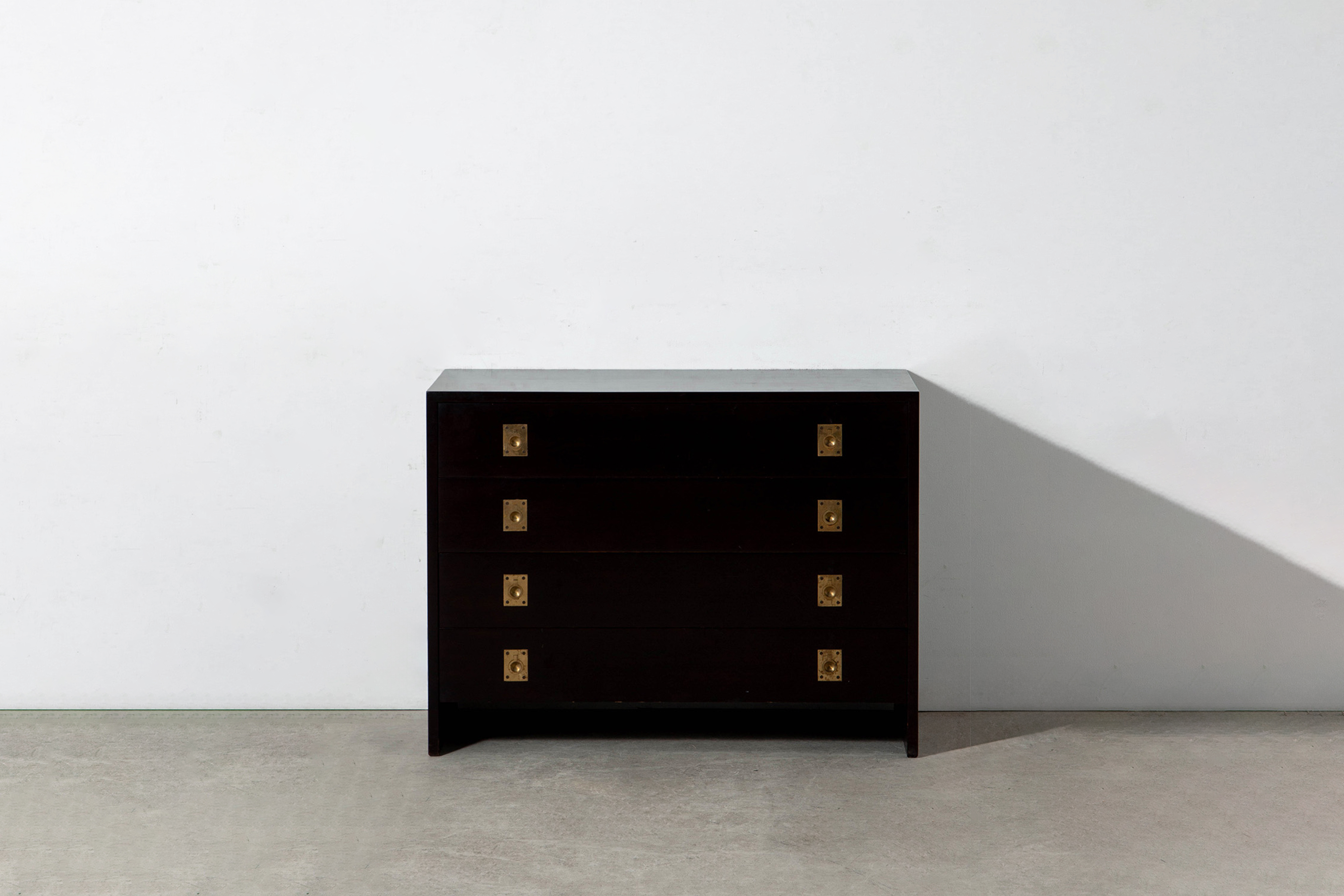
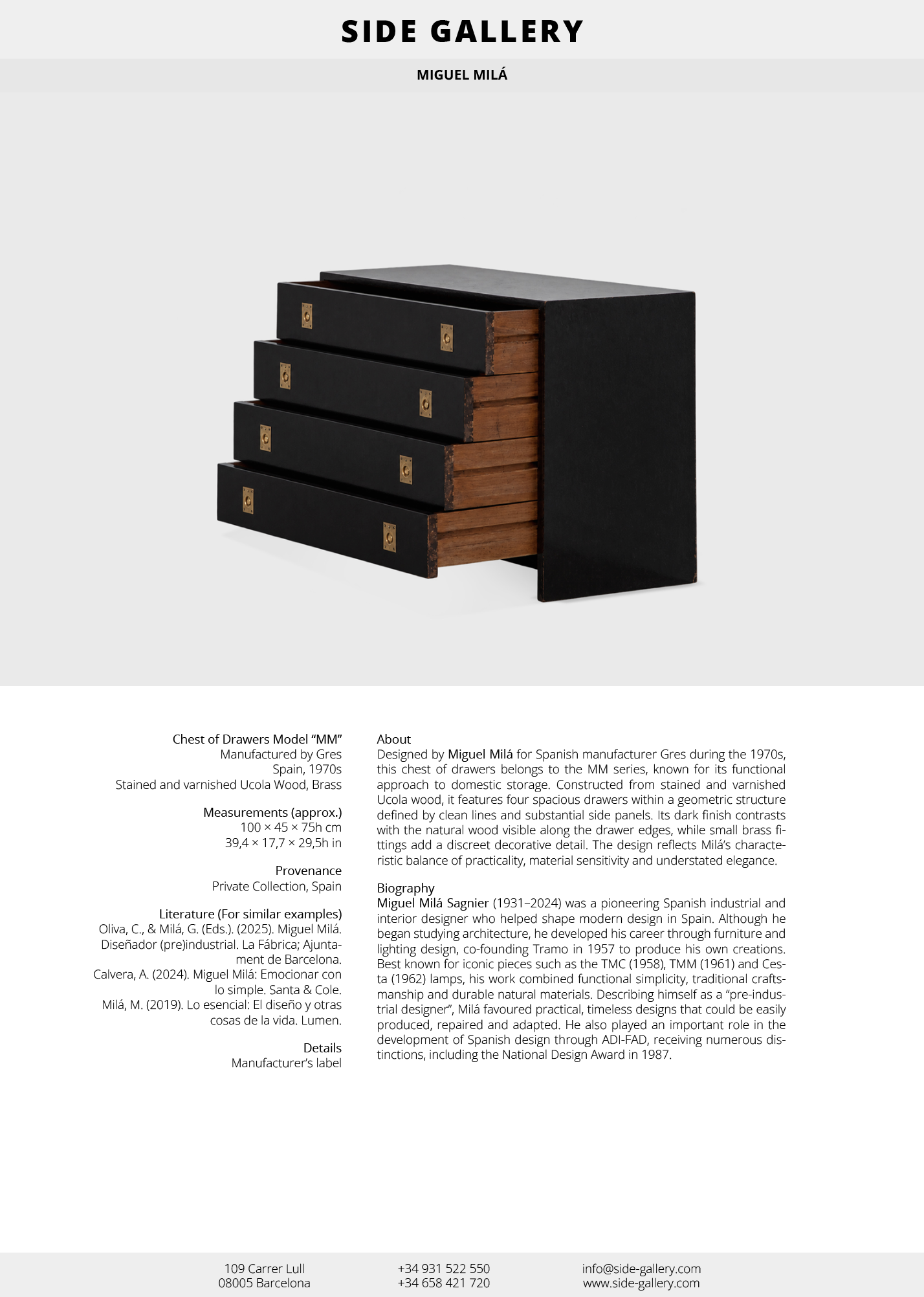
Chest of Drawers Model "MM"
Manufactured by Gres
Spain, 1970s
Stained and varnished Ucola Wood, Brass
Measurements (approx.)
100 × 45 × 75h cm
39,4 × 17,7 × 29,5h in
Provenance
Private Collection, Spain
Literature (For similar examples)
Oliva, C., & Milá, G. (Eds.). (2025). Miguel Milá. Diseñador (pre)industrial. La Fábrica; Ajuntament de Barcelona.
Calvera, A. (2024). Miguel Milá: Emocionar con lo simple. Santa & Cole.
Milá, M. (2019). Lo esencial: El diseño y otras cosas de la vida. Lumen.
Details
Manufacturer’s label
About
Designed by Miguel Milá for the Spanish furniture manufacturer Gres in the 1970s, the MM series reflects the designer’s functional and restrained approach to domestic storage. The collection comprises cabinets, chests of drawers and chiffoniers, manufactured in stained and varnished Ucola wood with a variety of finishes and handle materials, including porcelain, leather and brass.
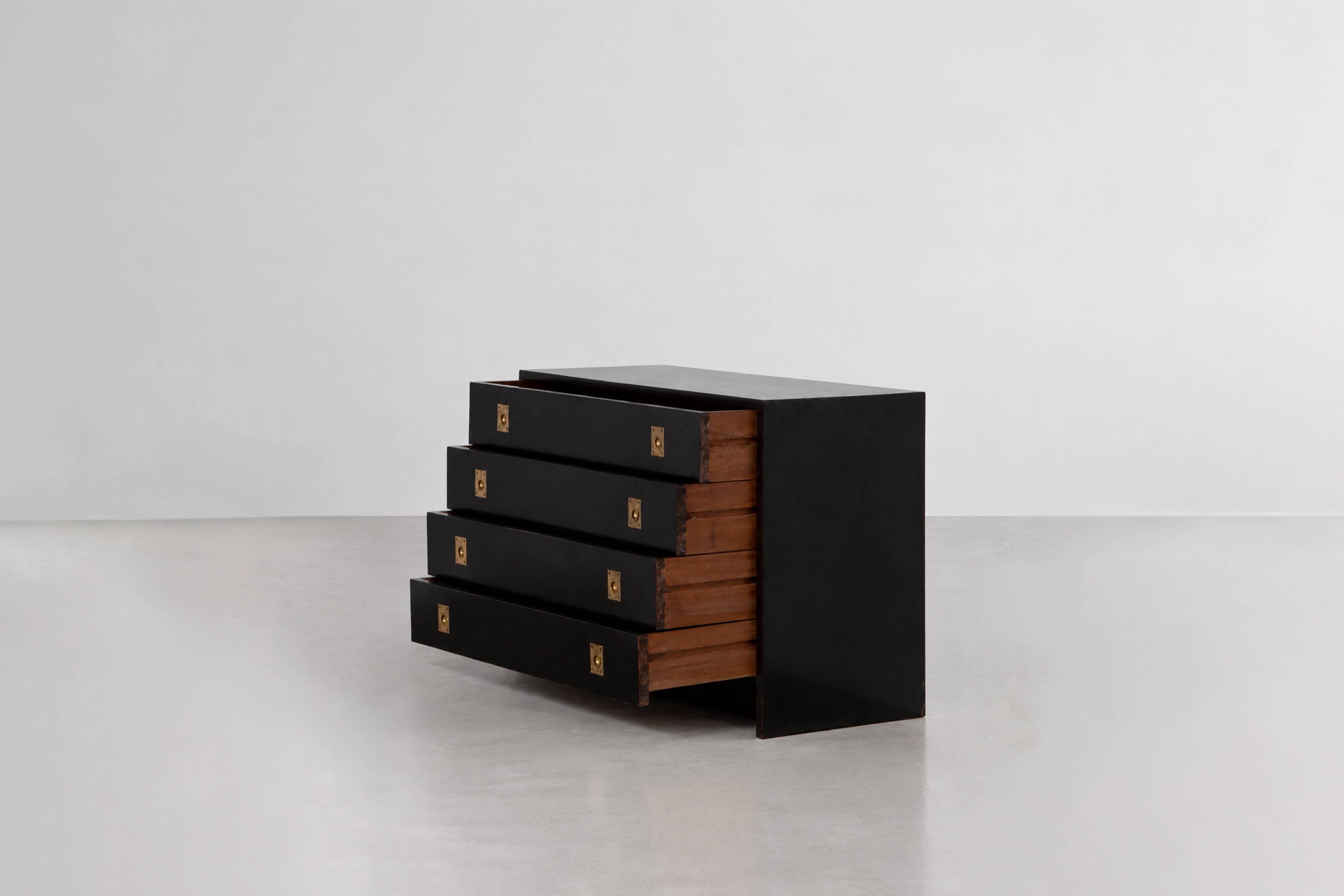
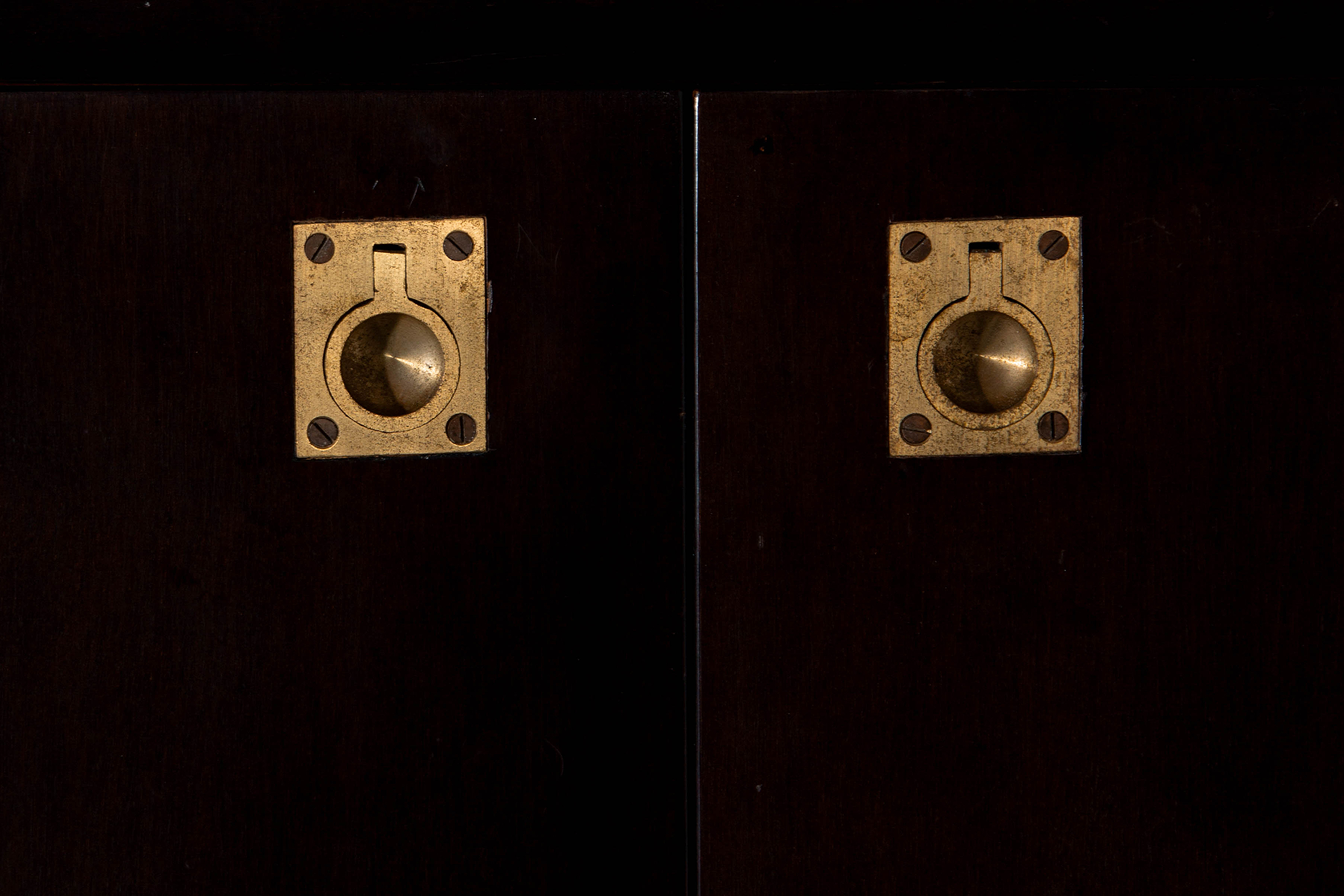
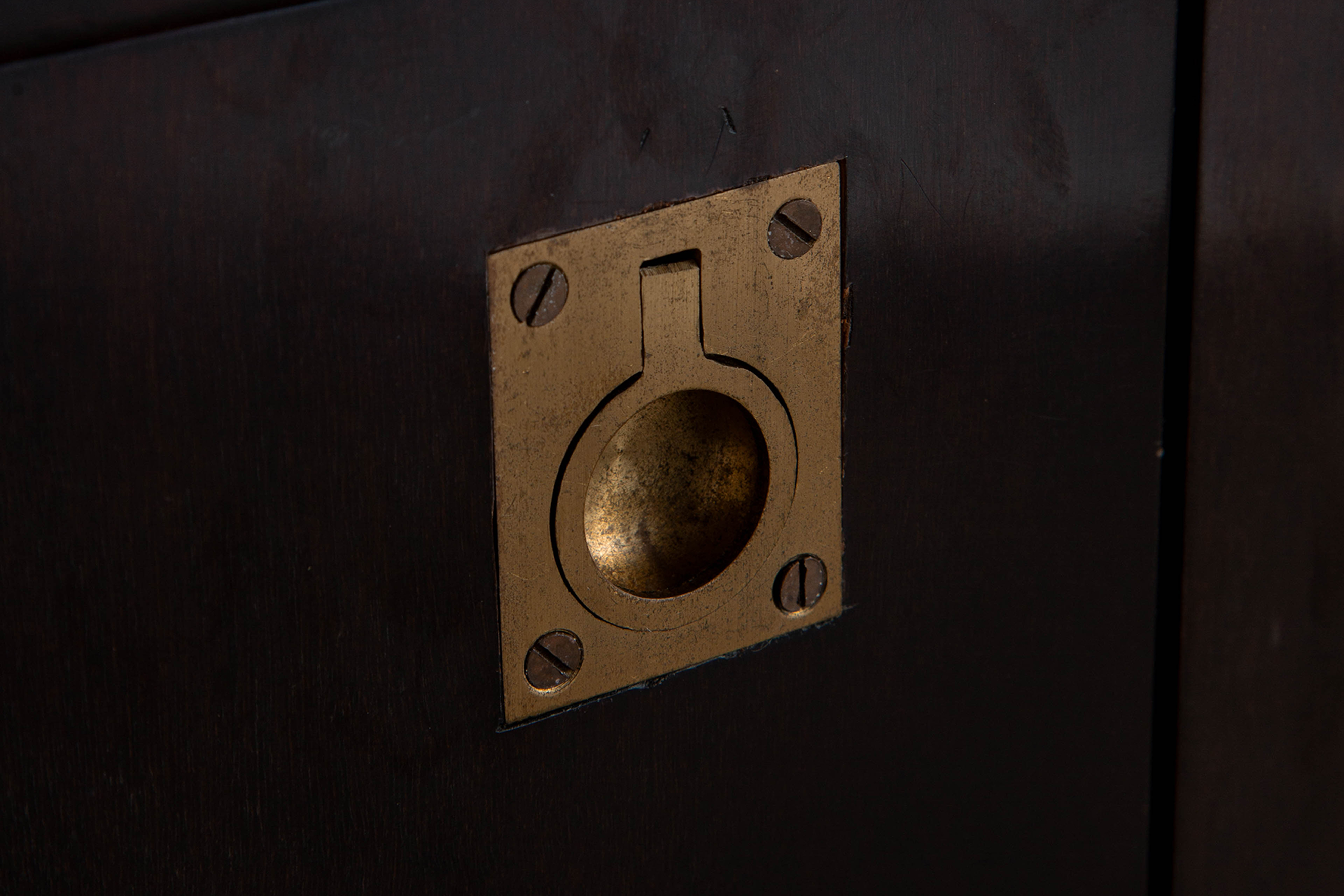
This chest of drawers features four generously proportioned drawers enclosed within a rectilinear wooden structure. Its architectural composition is defined by flat surfaces, clean geometric lines and substantial side panels extending to the floor. The deep, almost black finish contrasts with the warm natural wood visible along the sides of the drawers, revealing the material qualities and construction of the piece. Small rectangular brass fittings, arranged symmetrically across the drawer fronts, introduce a subtle decorative element while maintaining the overall simplicity of the design.
The chest exemplifies Milá’s ability to combine practical functionality with refined material contrasts and carefully considered proportions. Its understated appearance and robust construction reflect his broader design philosophy, in which traditional craftsmanship, natural materials and rational forms come together to create enduring objects for everyday use.
Biography
Miguel Milá Sagnier (1931–2024) was a pioneering Spanish industrial and interior designer born in Barcelona, Spain. He began studying architecture at the Barcelona School of Architecture but did not complete his degree. In the late 1950s, he joined the architecture studio of his brother Alfonso Milá and Federico Correa, where he started working on interior design projects and developing furniture and lighting to meet the practical needs of the spaces they created.
At a time when Spain had limited industrial infrastructure and a shortage of materials and manufactured products, Milá developed a design approach rooted in craftsmanship, technical ingenuity and the careful use of available resources. In 1957, he co-founded Tramo (Trabajos Molestos) with architects Francisco Ribas Barangé and Eduardo Pérez Ullibarri, establishing a company through which he could manufacture his own designs. It was here that he developed the early versions of two of his most celebrated lighting designs: the TMC floor lamp (1958) and the TMM floor lamp (1961). These pieces established his characteristic language of functional simplicity, mechanical clarity and timeless proportions.
Other iconic designs followed, including the Cesta lamp (1962/1964), the Manila lamp (1961), the M68 pendant lamp (1968), and the A14 fireplace (1977). His furniture designs also extended into public spaces, with works such as the NeoRomántico bench (1995), while his contributions to Barcelona included the design of urban furniture and the interiors of the city's metro carriages.
Milá's work was guided by a belief in updating traditional techniques rather than abandoning them in favour of industrial complexity. He preferred natural and durable materials, simple construction methods and designs that could be repaired, adapted and produced with precision. Often describing himself as a “pre-industrial designer”, he combined the sensibility of a craftsman with the functional principles of modern industrial design. His work brought together architecture, furniture, lighting and interior design, creating a coherent body of work in which practical requirements and formal elegance were closely connected.
He was also an important figure in the institutional development of Spanish design. In 1960, he helped establish the industrial design association ADI-FAD alongside André Ricard, Antoni de Moragas, Oriol Bohigas and other leading figures, later serving as its president from 1974 to 1984. He taught at Elisava and Eina in Barcelona and contributed to the recognition of industrial design as a professional discipline in Spain.
His work received six Delta Awards, including the first Delta de Oro in 1961 for the TMC lamp and the Special Delta de Oro in 1986. In 1987, he became the first recipient of Spain's National Design Award. Further distinctions included the Creu de Sant Jordi in 1993, the Compasso d'Oro Internazionale for his career in 2008, the National Culture Award of Catalonia in 2010 and the Gold Medal for Merit in Fine Arts in 2016.
His designs remain central to the history of modern Spanish design, with many continuing to be manufactured and used decades after their creation.