Saburo Inui 1960s Side Table Model “Zataku”

Side Gallery

Side Gallery

Wishlist

Follow

WORKS

SABURO INUI

Request Pricing Share
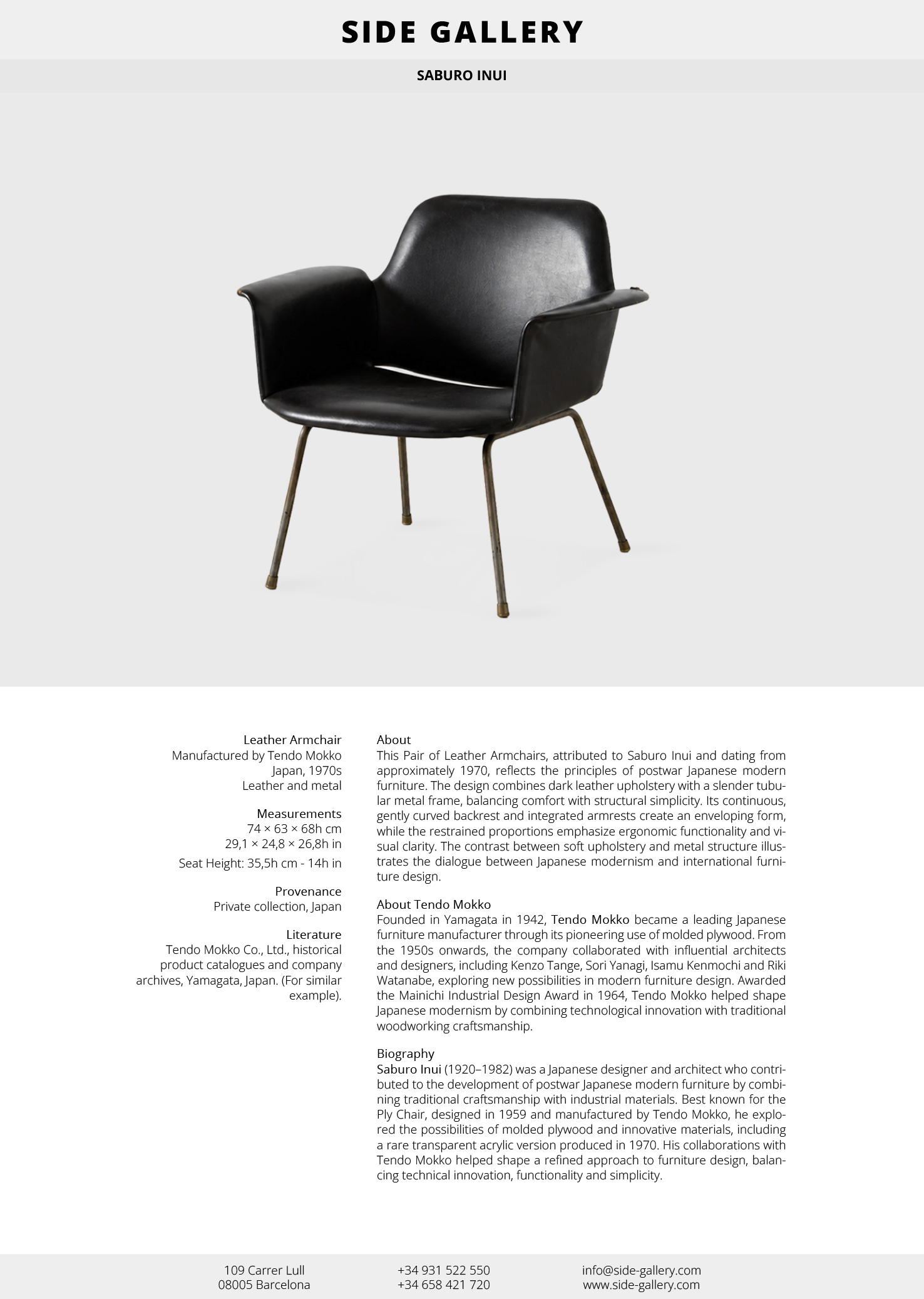
Leather Armchair
Manufactured by Tendo Mokko
Japan, 1970s
Leather and metal

Measurements
74 × 63 × 68h cm
29,1 × 24,8 × 26,8h in

Seat Height: 35,5h cm - 14h in

Provenance
Private collection, Japan

Literature
Tendo Mokko Co., Ltd., historical product catalogues and company archives, Yamagata, Japan. (For similar example).

About
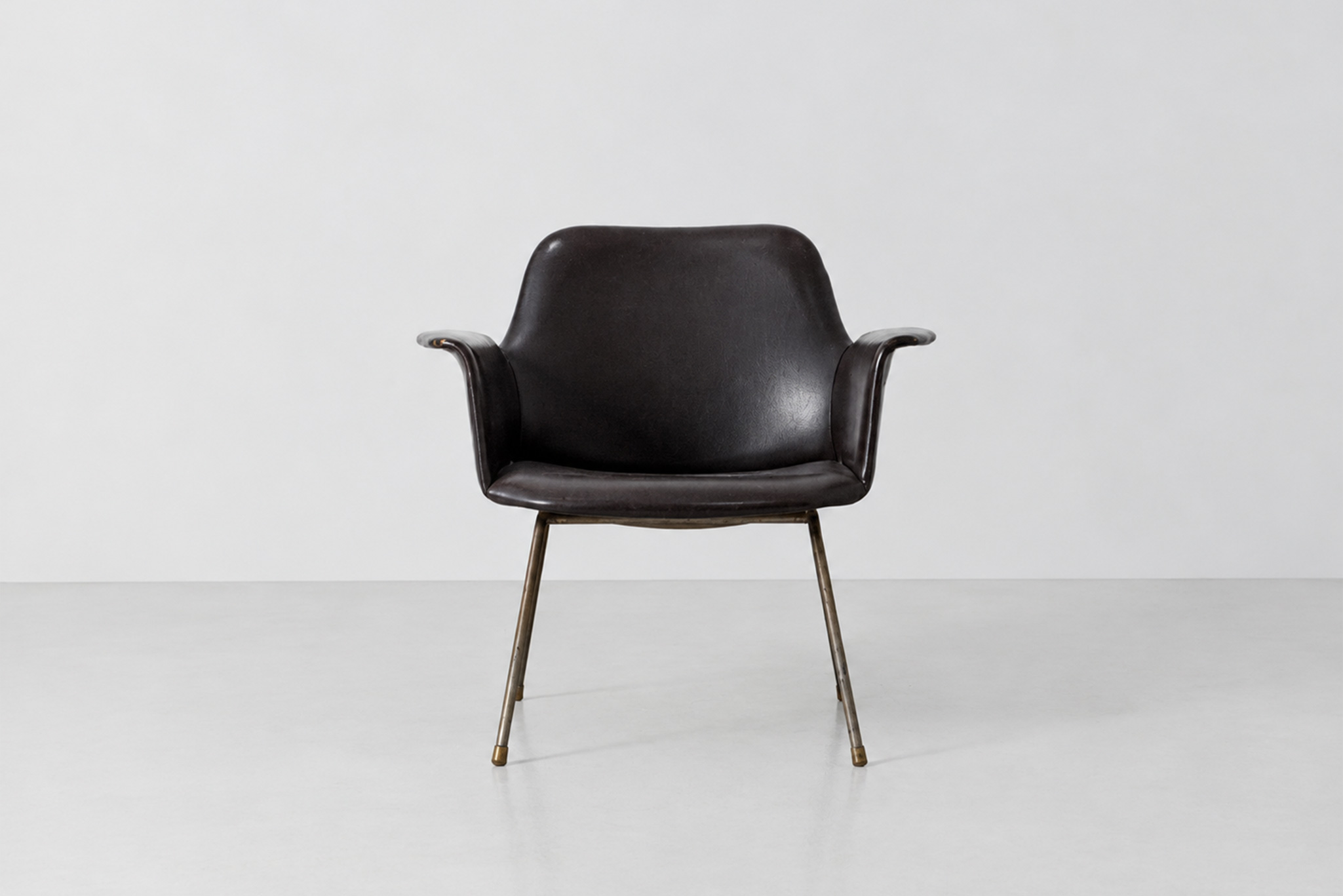
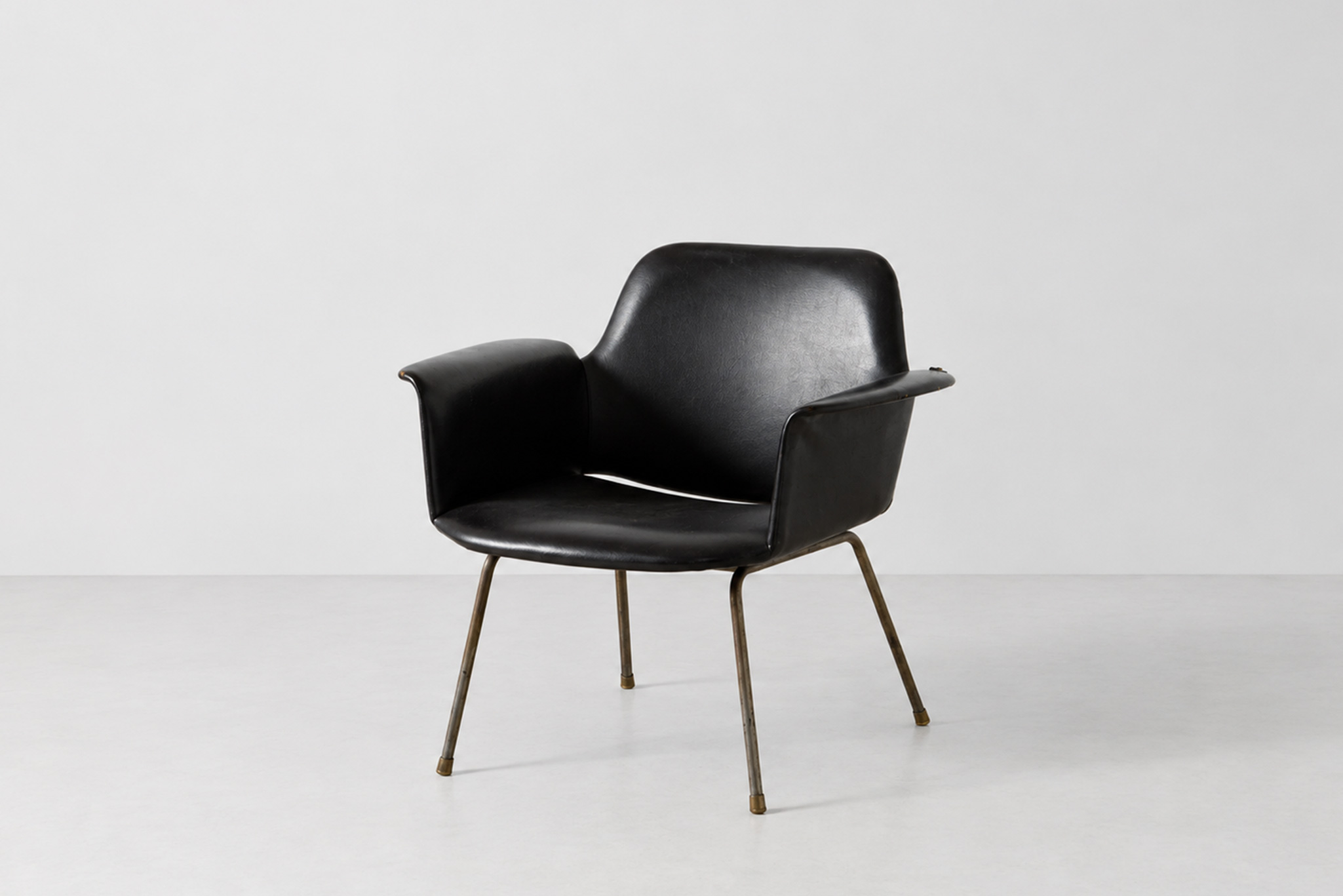
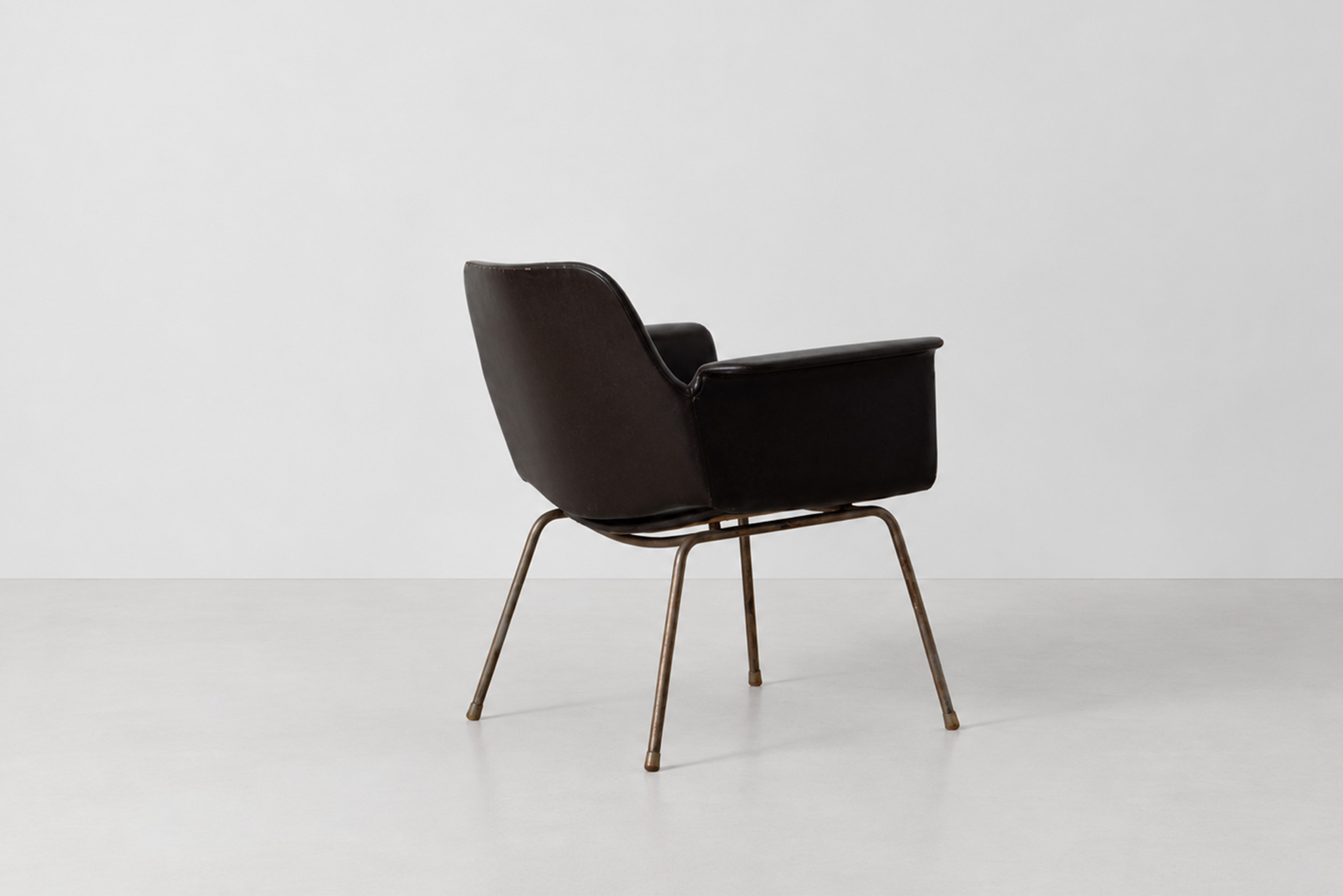
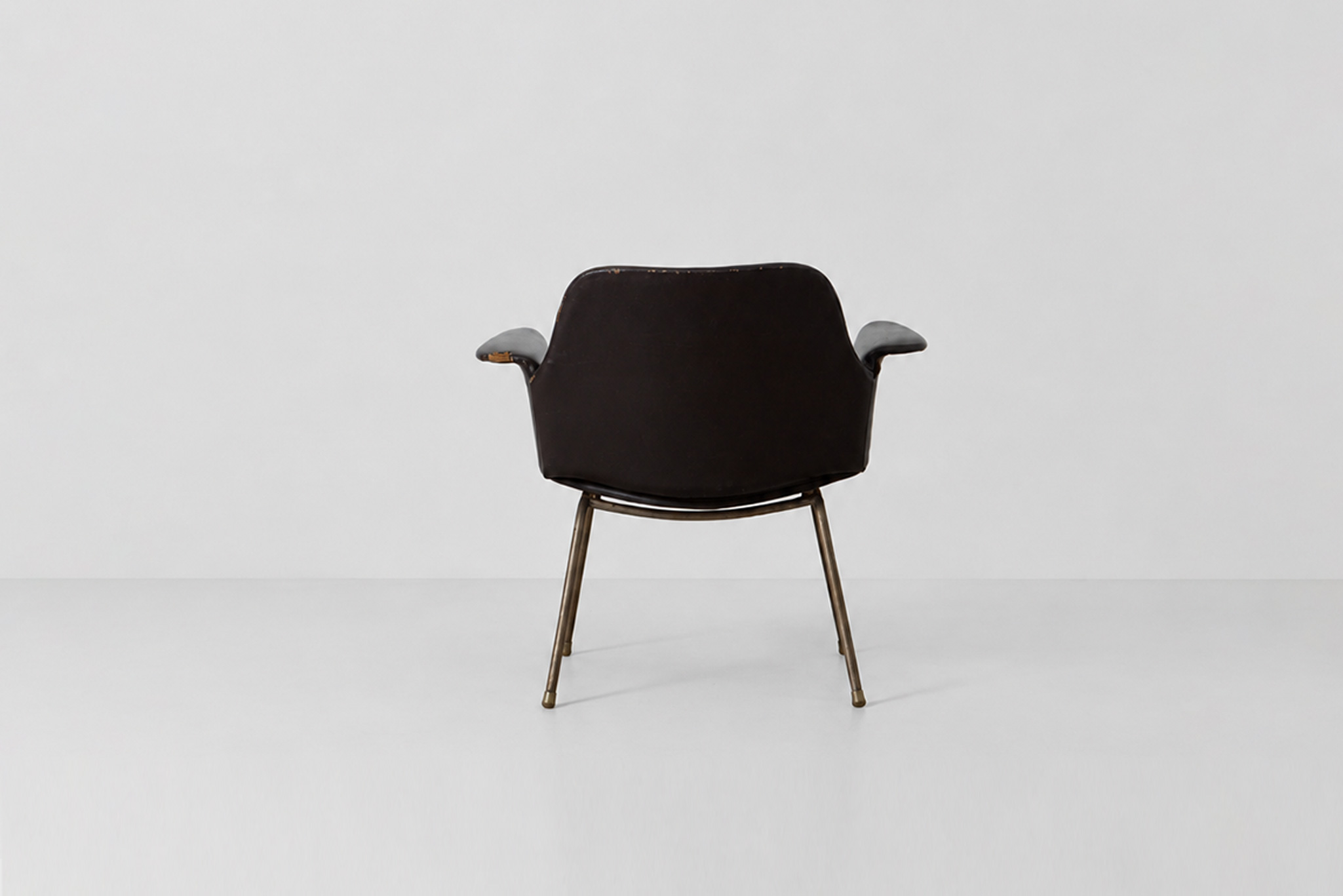
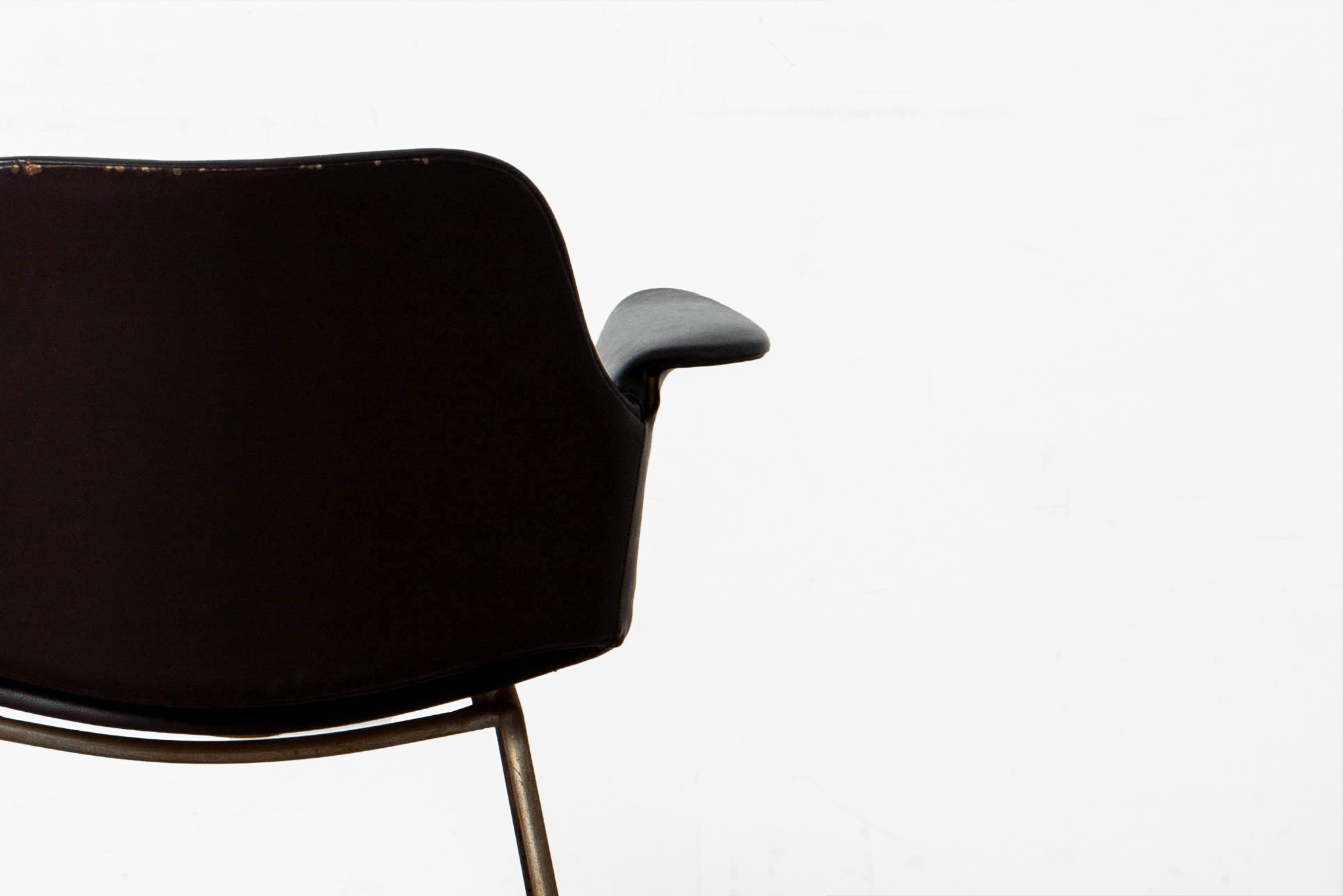
This Pair of Leather Armchairs, attributed to Saburo Inui and dating from approximately 1970, reflects the development of Japanese modern furniture during a period of increasing experimentation with industrial materials, ergonomic forms, and refined construction techniques. Combining dark leather upholstery with a minimal metal framework, the chairs establish a dialogue between comfort and structural simplicity. Their restrained appearance and carefully articulated proportions embody the functional and aesthetic principles associated with mid-century modernism.
The design is distinguished by its continuous upholstered composition, in which the backrest, seat, and integrated armrests create a cohesive and enveloping form. The gently curved backrest follows the contours of the body, while the slightly outward-projecting armrests provide additional comfort without compromising the chair's compact silhouette. The slender tubular metal legs introduce an architectural quality, contrasting with the softness and visual weight of the leather upholstery. This relationship between materials emphasizes the structural clarity and understated elegance of the design.
Reflecting the broader evolution of Japanese furniture during the postwar decades, the armchairs illustrate an approach to modern design that integrates practical considerations with sculptural expression. The combination of leather and metal demonstrates the increasing diversity of materials employed in domestic and institutional furniture, while the chairs' balanced proportions reveal an interest in human scale and ergonomic comfort. Their distinctive silhouette situates them within the wider dialogue between Japanese craftsmanship and international modernist furniture design.

Biography
Saburo Inui (1920–1982) was a Japanese furniture designer associated with the development of modern furniture in postwar Japan. Working during a period of significant industrial and cultural transformation, Inui explored the relationship between traditional Japanese craftsmanship and the possibilities offered by contemporary manufacturing techniques. His work reflects an interest in functional clarity, ergonomic design, and the expressive potential of materials.
Inui is particularly recognized for his collaboration with Tendo Mokko, one of Japan's leading modern furniture manufacturers. Among his most notable contributions is the Ply Chair, designed in 1959, which demonstrates the possibilities of molded plywood construction. Through carefully considered proportions and innovative production techniques, his furniture contributed to the development of a modern design language that balanced industrial efficiency with refined craftsmanship.
His work emerged within a broader movement that brought Japanese designers, architects, and manufacturers together to reconsider the relationship between furniture, architecture, and everyday life. Characterized by simplicity, material sensitivity, and structural precision, Inui's designs reflect the principles of postwar Japanese modernism. His contribution remains relevant to the history of twentieth-century furniture and the development of modern Japanese design.

Designer image

Saburo Inui (1911–1991) was a Japanese industrial designer and craftsman, recognized as one of the pioneers of modern furniture design in Japan, especially through his innovative work with molded plywood. He was born in 1911 in Hsinchu, Taiwan, which at the time was under Japanese colonial rule. Inui later moved to Japan, where around 1936 he joined the Industrial Arts Institute (IAI), working in the wood department. There he began to explore and develop the possibilities of bent and molded plywood, a material that would become central to his life’s work. Within the Institute, he collaborated closely with other designers such as Kenmochi Isamu, and this professional relationship would influence his career deeply.

During his years at the IAI, Inui became a key figure in the technical development of plywood furniture, helping to establish methods that allowed Japanese design to compete with the international modernist movement while retaining a uniquely Japanese sensibility. One of his most significant early contributions was his role in bringing to life the iconic Butterfly Stool designed by Sōri Yanagi. Although Yanagi had created a prototype, no factory in Japan was capable of producing the elegant, curved form. Inui took on the challenge at the IAI and, after two years of experimentation and refinement, successfully oversaw its production with the furniture manufacturer Tendō Mokko in 1956.

In 1958, Inui left the Institute to work directly for Tendō Mokko, where he would spend the most important years of his career. At Tendō Mokko he designed furniture that combined technical ingenuity with a sense of simplicity, elegance, and everyday usability. Among his most celebrated works is the Zataku low table, created in 1959, which became one of Tendō Mokko’s classic pieces. Other notable designs include the Ply Chair and contributions to the development of the Teiza chair, showing his versatility in adapting plywood to different forms and purposes. His furniture was characterized by clean lines, soft curves, rounded edges, and a minimalist aesthetic that placed emphasis on the material itself rather than decoration. He was deeply committed to the idea that plywood, often regarded as a purely utilitarian material, could embody both functionality and beauty.

Inui’s contributions were recognized during his lifetime with several important awards. His Zataku table won the Good Design Award in 1964, and later the Long Life Design Award in 1981, acknowledging its enduring relevance. In 1973, he received the prestigious Kitaro Kunii Industrial Arts Award, further establishing his reputation as a master of Japanese modern design.

Beyond the awards, Saburo Inui’s true legacy lies in how he bridged tradition and modernity. His work harmonized Japanese craftsmanship and aesthetic sensibility with the industrial techniques of the twentieth century. By mastering molded plywood, he created furniture that was light, durable, and graceful, and his designs remain admired and collected today. Many of his pieces continue to be produced, exhibited, and sold at auctions as iconic examples of postwar Japanese modernism. Inui’s vision helped shape the direction of Japanese furniture design in the second half of the twentieth century, leaving a lasting mark on both Japanese design history and global design culture.


ENQUIRE ABOUT THE DESIGNER