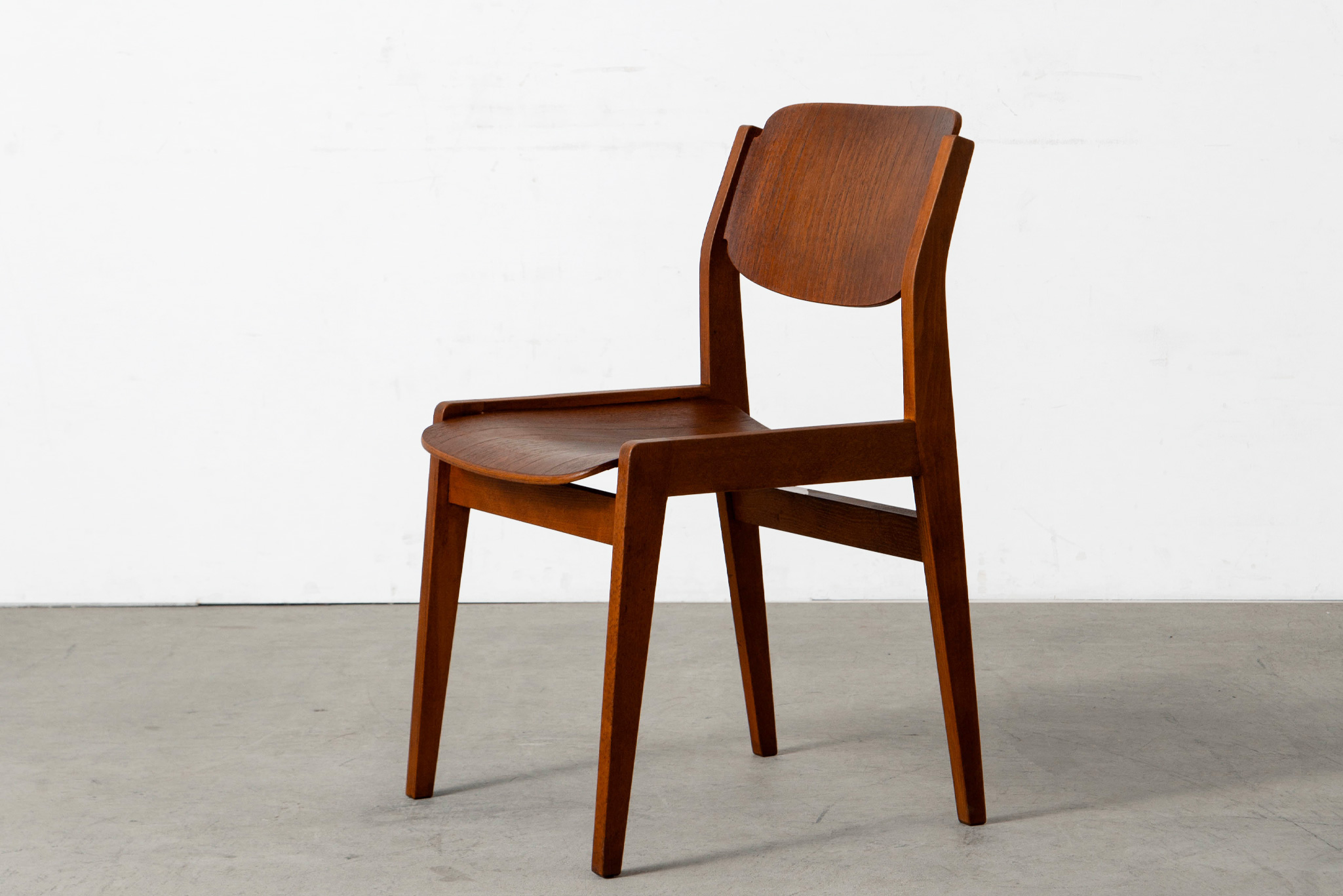
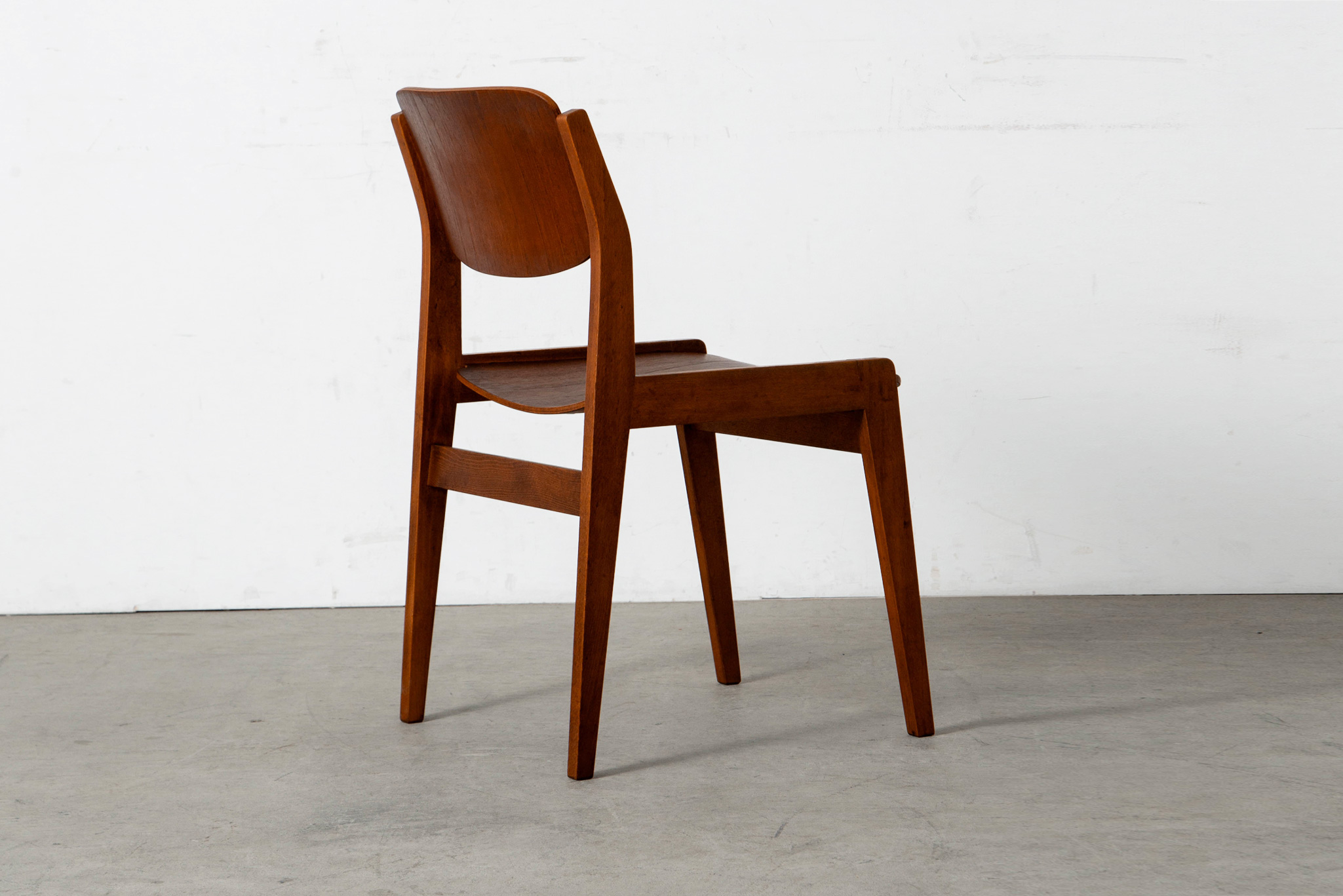
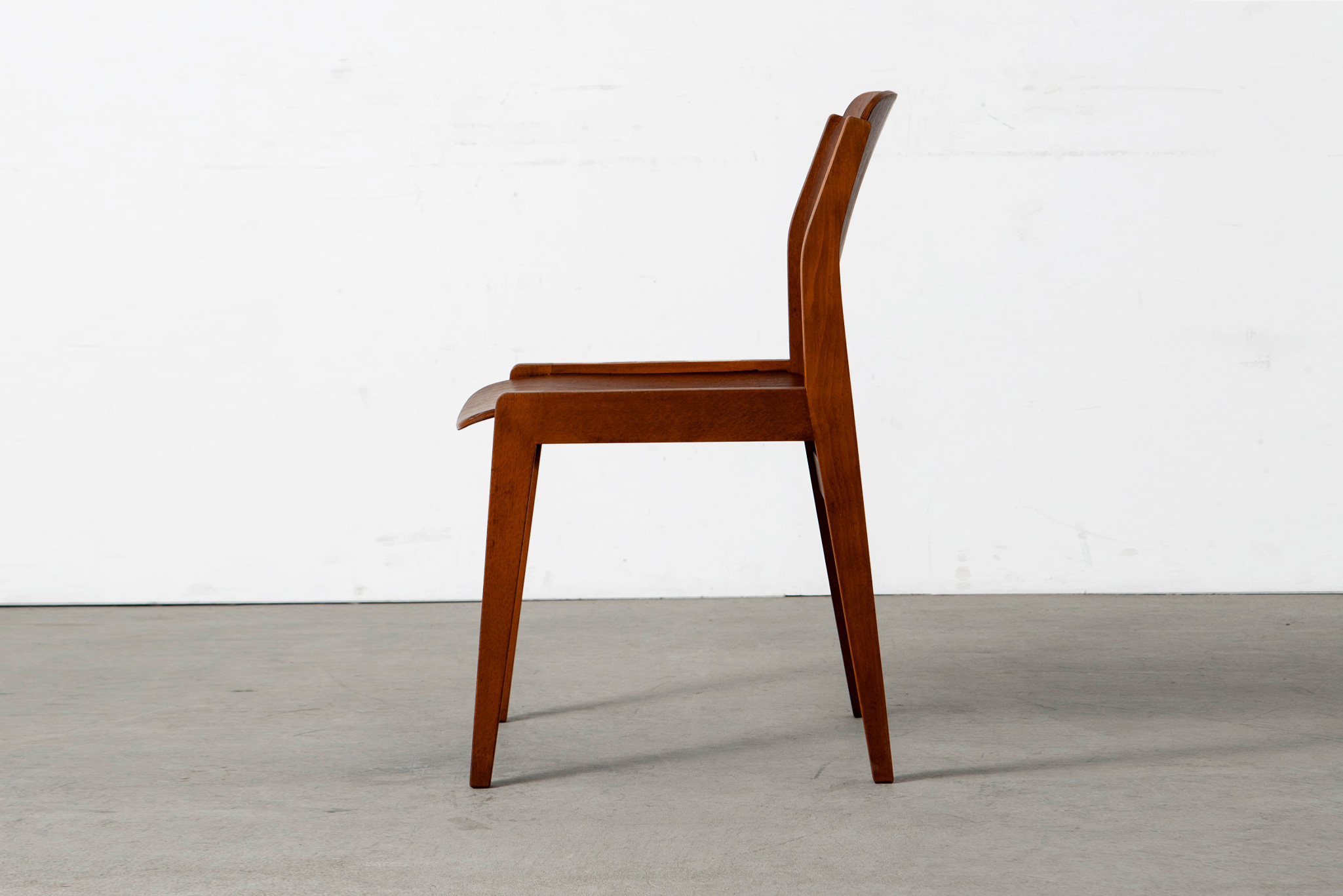
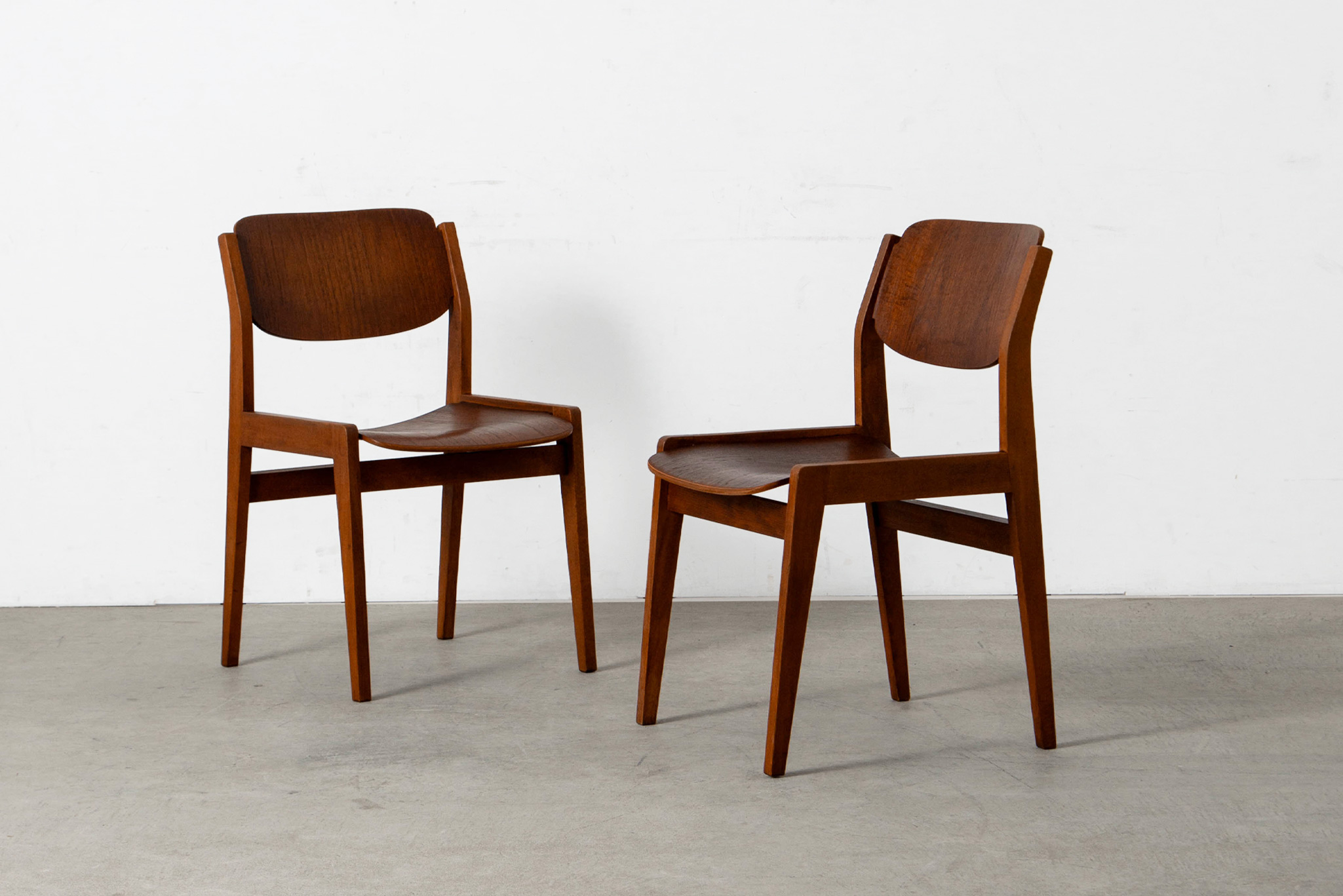
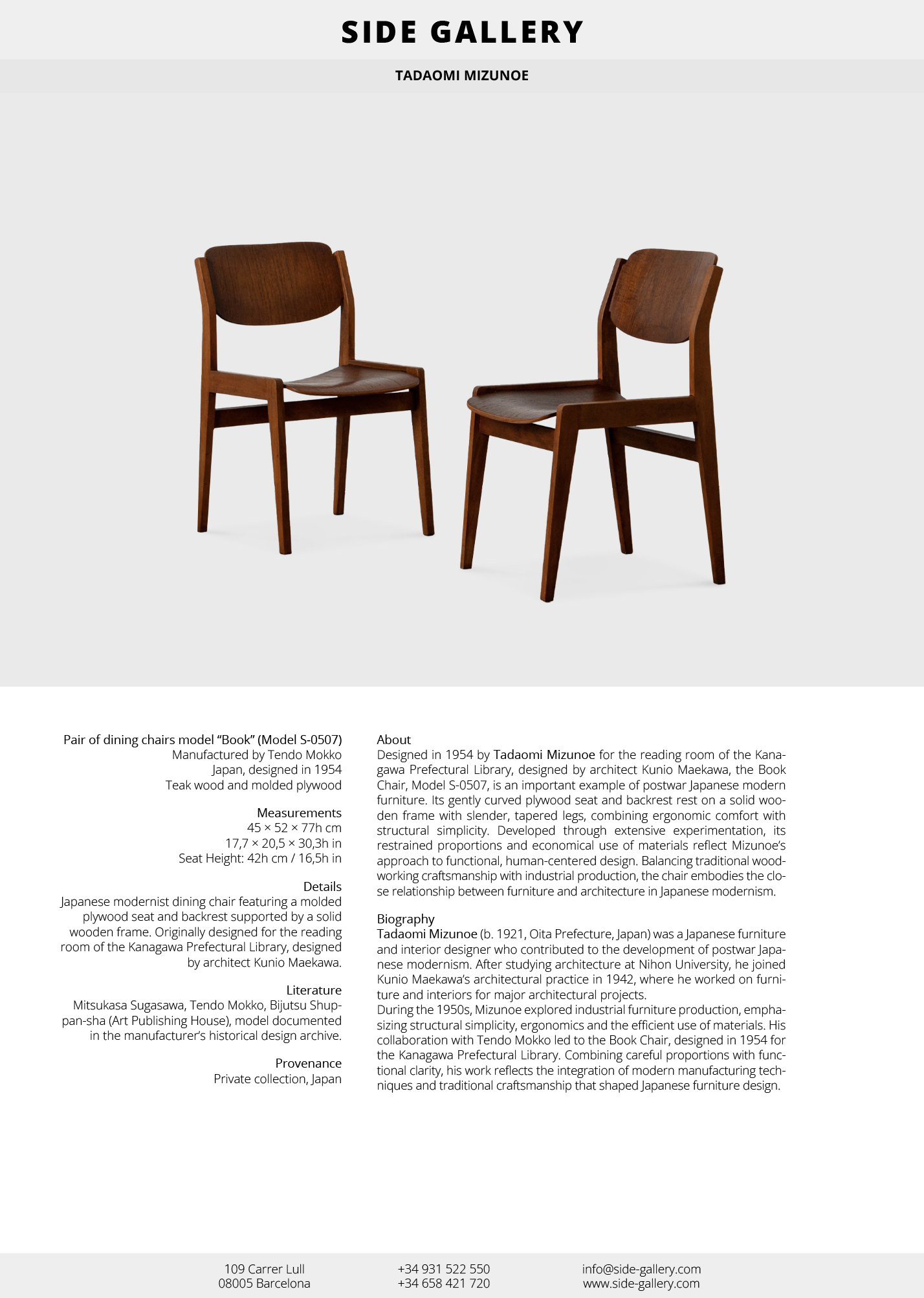
Pair of dining chairs model "Book" (Model S-0507)
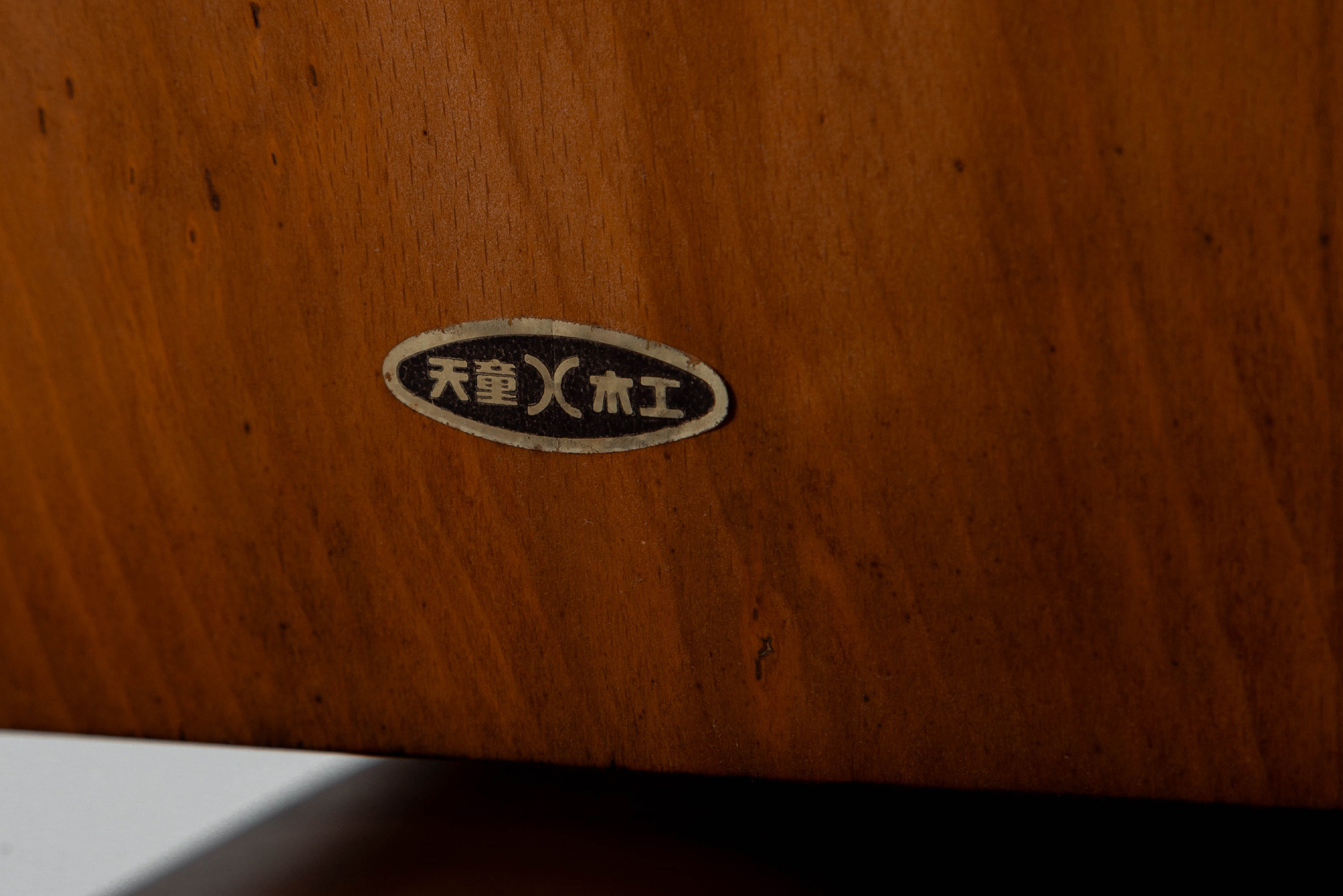
Manufactured by Tendo Mokko
Japan, designed in 1954
Teak wood and molded plywood
Measurements
45 × 52 × 77h cm
17,7 × 20,5 × 30,3h in
Seat Height: 42h cm / 16,5h in
Details
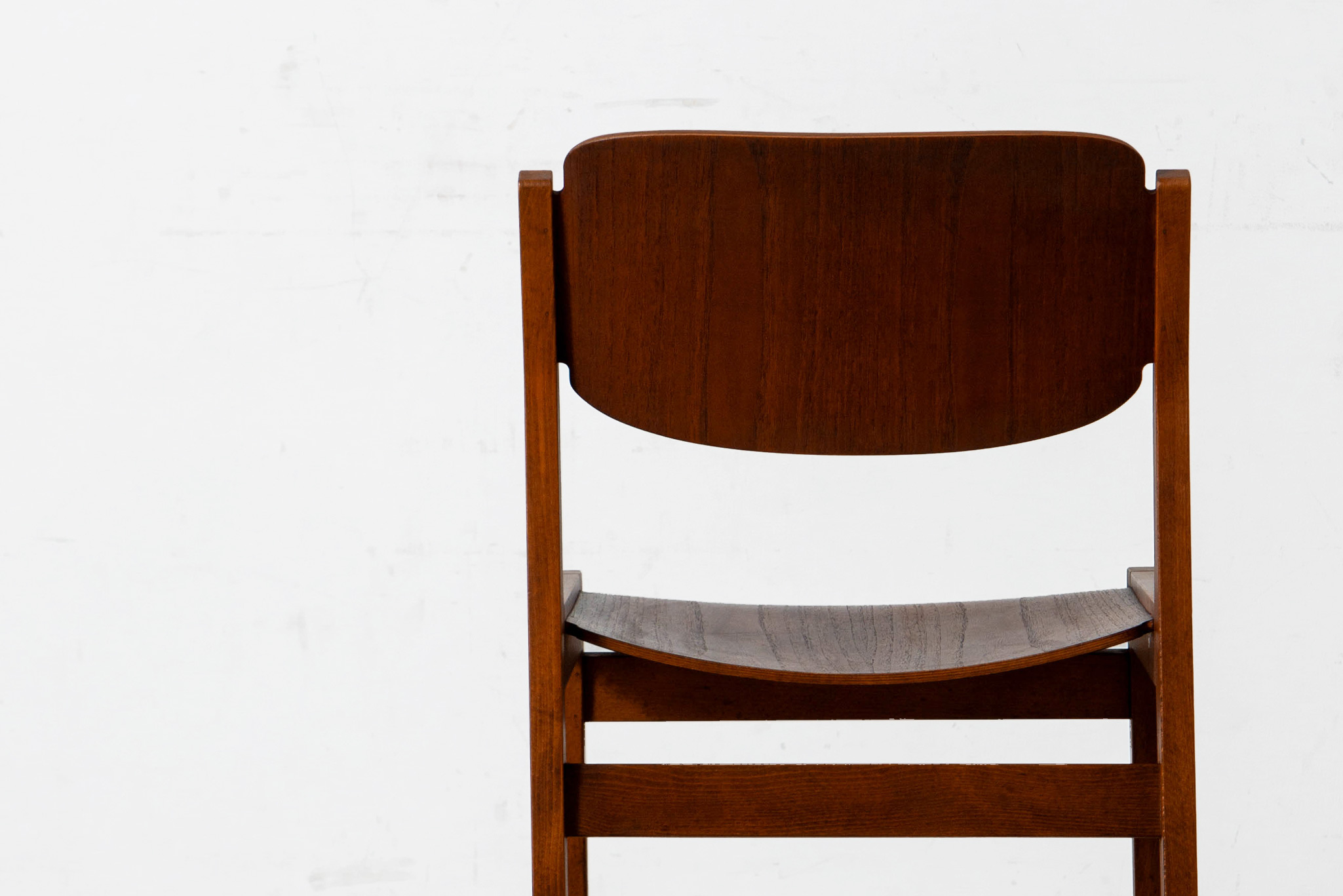
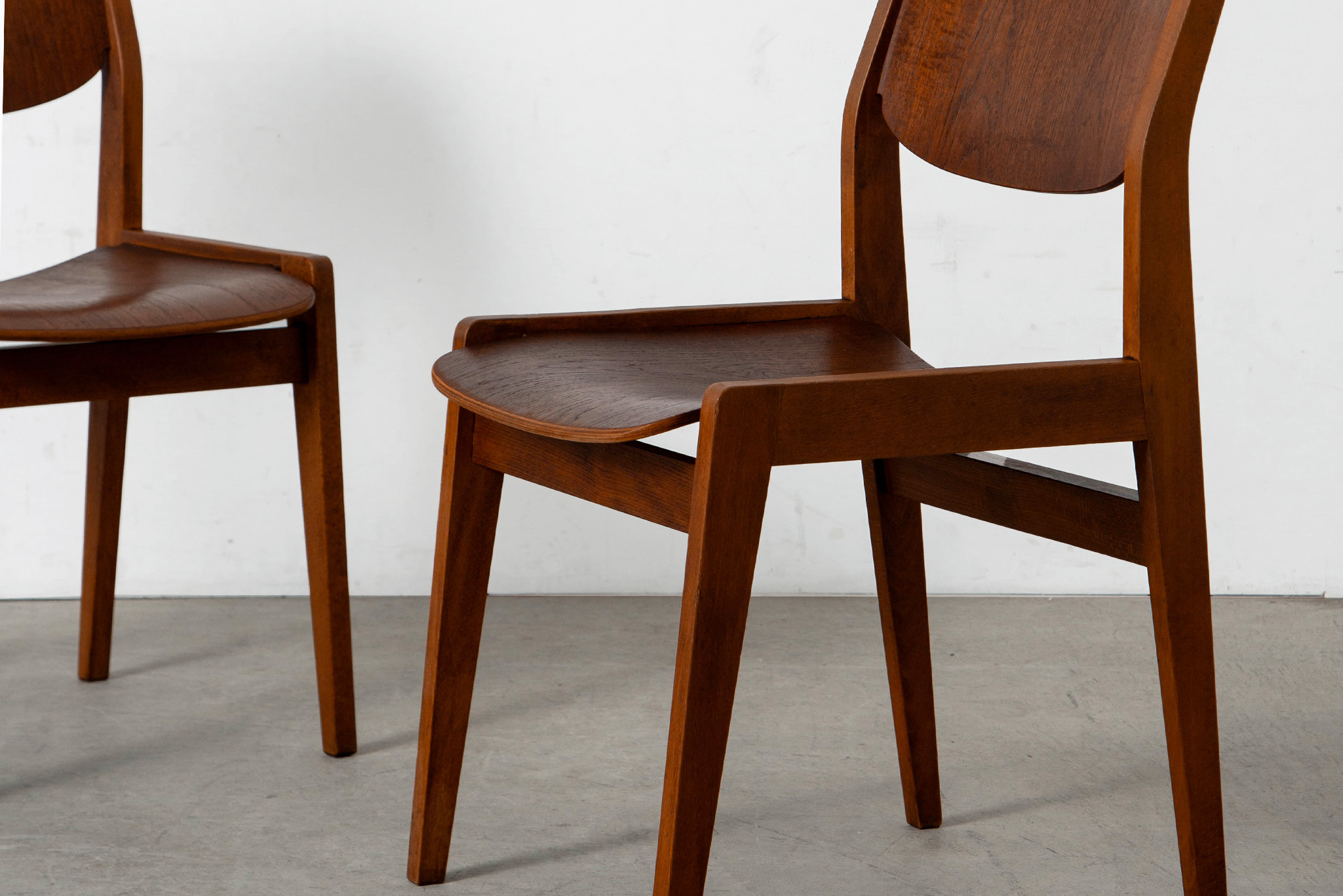
Japanese modernist dining chair featuring a molded plywood seat and backrest supported by a solid wooden frame. Originally designed for the reading room of the Kanagawa Prefectural Library, designed by architect Kunio Maekawa.
Literature
Mitsukasa Sugasawa, Tendo Mokko, Bijutsu Shuppan-sha (Art Publishing House), model documented in the manufacturer's historical design archive.
Provenance
Private collection, Japan
About
The Book Chair, Model S-0507, was designed in 1954 by Tadaomi Mizunoe for the reading room of the Kanagawa Prefectural Library, an architectural project by Kunio Maekawa. Conceived during a formative period in the development of Japanese modern furniture, the chair represents an important dialogue between architectural thinking, industrial production, and traditional woodworking craftsmanship. Its restrained proportions and carefully articulated structure reflect Mizunoe's commitment to creating functional furniture through an economy of materials and construction.
The chair is distinguished by its gently curved plywood backrest and seat, supported by a solid wooden frame with slender, tapered legs. The slight inclination of the backrest and the sculpted profile of the seat respond to the natural contours of the human body, establishing a balance between ergonomic comfort and structural simplicity. The contrast between the broad wooden surfaces and the angular supporting elements creates a composition characterized by clarity, lightness, and visual harmony.
Developed through an extensive process of experimentation and refinement, the Book Chair became one of the most recognizable examples of postwar Japanese furniture design. Its adaptability to domestic, educational, and public environments reflects the enduring relevance of Mizunoe's approach, in which industrial manufacturing and human-centered design coexist. The chair remains an important expression of Japanese modernism, embodying the relationship between craftsmanship, functionality, and architectural restraint.
Biography
Tadaomi Mizunoe (born 1921 in Oita Prefecture, Japan) was a Japanese furniture and interior designer whose work contributed significantly to the development of modern furniture in postwar Japan. After studying architecture at Nihon University, he joined the architectural practice of Kunio Maekawa in 1942, where he became involved in the design of furniture and interiors for major architectural projects. His work developed within an environment shaped by the principles of modern architecture and the integration of furniture into spatial design.
During the 1950s, Mizunoe explored the possibilities of industrial furniture production, focusing on structural simplicity, ergonomic considerations, and the efficient use of materials. His collaboration with Tendo Mokko resulted in the development of the Book Chair, designed for the Kanagawa Prefectural Library in 1954. The project demonstrated his interest in refining everyday objects through careful attention to proportion, construction, and the relationship between the human body and furniture.
Mizunoe's practice reflects the broader transformation of Japanese design during the twentieth century, when traditional craftsmanship increasingly intersected with modern manufacturing techniques. His furniture is distinguished by its functional clarity, understated elegance, and commitment to enduring design. His contributions remain closely associated with the emergence of a distinctive Japanese modernist furniture language.