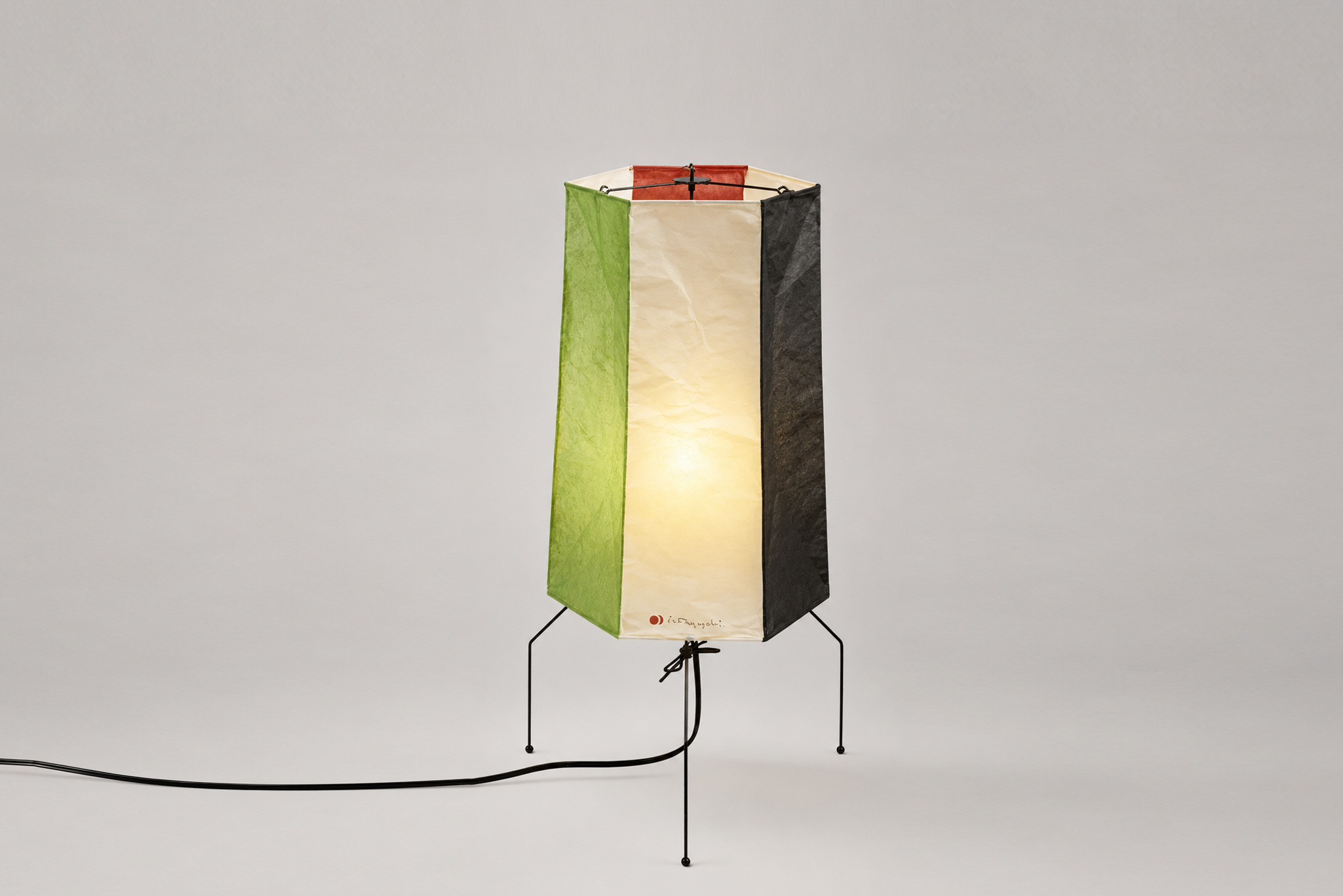
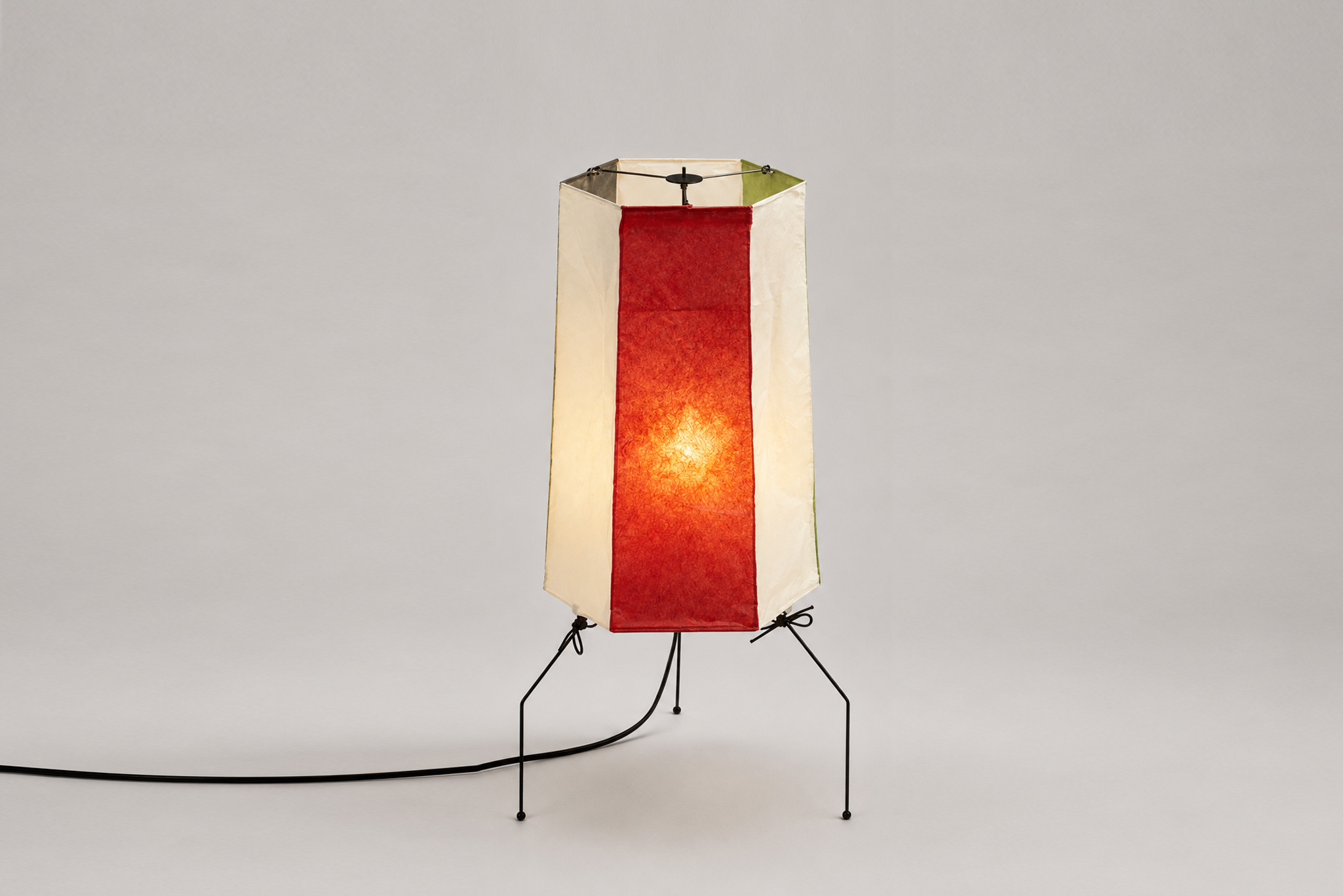
Akari Table Lamp Model "UF1-C"
Manufactured by Ozeki & Co., Ltd.
Japan, designed 1984
Washi paper, bamboo, metal
Measurements
33 × 33 × 55h cm
13 × 13 × 21,7h in
Provenance
Private collection, Japan
Literature
Catalog of Latest Akari, Ozeki & Co., Gifu, 1988.
Bonnie Rychlak, Dakin Hart, Mutsuko Mori, Masayo Murayama and Kengo Matsumoto, Design: Isamu Noguchi and Isamu Kenmochi, The Isamu Noguchi Foundation and Garden Museum, New York, 2022.
Dore Ashton, Noguchi East and West, University of California Press, Berkeley, 1992.
The Isamu Noguchi Foundation and Garden Museum, Akari Light Sculptures catalogue.
About
Designed in 1984, the UF1-C belongs to Isamu Noguchi's UF series, a group of Akari light sculptures distinguished by their softly rounded forms inspired by the silhouette of unidentified flying objects (UFOs). Created during the later years of Noguchi's career, the series demonstrates his continued fascination with light as a sculptural medium and his ability to distill complex forms into elegant, organic volumes.
Like all Akari light sculptures, the UF1-C is handcrafted in Gifu by Ozeki & Co. using traditional techniques. Handmade washi paper, produced from mulberry bark, is carefully stretched over a delicate bamboo rib structure supported by a slender metal frame. When illuminated, the paper softly diffuses the light, transforming electricity into the warm, atmospheric glow that became the defining characteristic of the Akari collection.
The pure geometry of the UF1-C exemplifies Noguchi's lifelong pursuit of simplicity, balance, and material honesty. More than a functional table lamp, it embodies his vision of light as sculpture—an object capable of shaping space through form, texture, and illumination while seamlessly uniting Japanese craftsmanship with modern design.
Biography
Isamu Noguchi (1904–1988) was one of the most important and intellectually ambitious artists of the twentieth century, whose work moved fluidly between sculpture, architecture, landscape, furniture, and industrial design. Born in Los Angeles to the Japanese poet Yone Noguchi and the American writer Leonie Gilmour, he grew up between the United States and Japan, an experience that profoundly shaped his artistic vision. Noguchi never accepted the division between East and West, art and utility, or sculpture and design; instead, he sought to create a unified visual language capable of shaping how people live, move, and experience space.
Noguchi's early artistic formation took place in New York, where he studied at Columbia University before training as a sculptor. In 1927 he traveled to Paris on a Guggenheim Fellowship to apprentice with Constantin Brancusi, an experience that proved decisive for his understanding of form and abstraction. Throughout his life he expanded sculpture beyond conventional limits, creating furniture, stage sets, landscapes, and environments that redefined the role of design in daily life.
His Akari Light Sculptures, begun in 1951, remain among his most influential creations and continue to embody his lifelong pursuit of harmony between tradition, technology, material, and human experience.