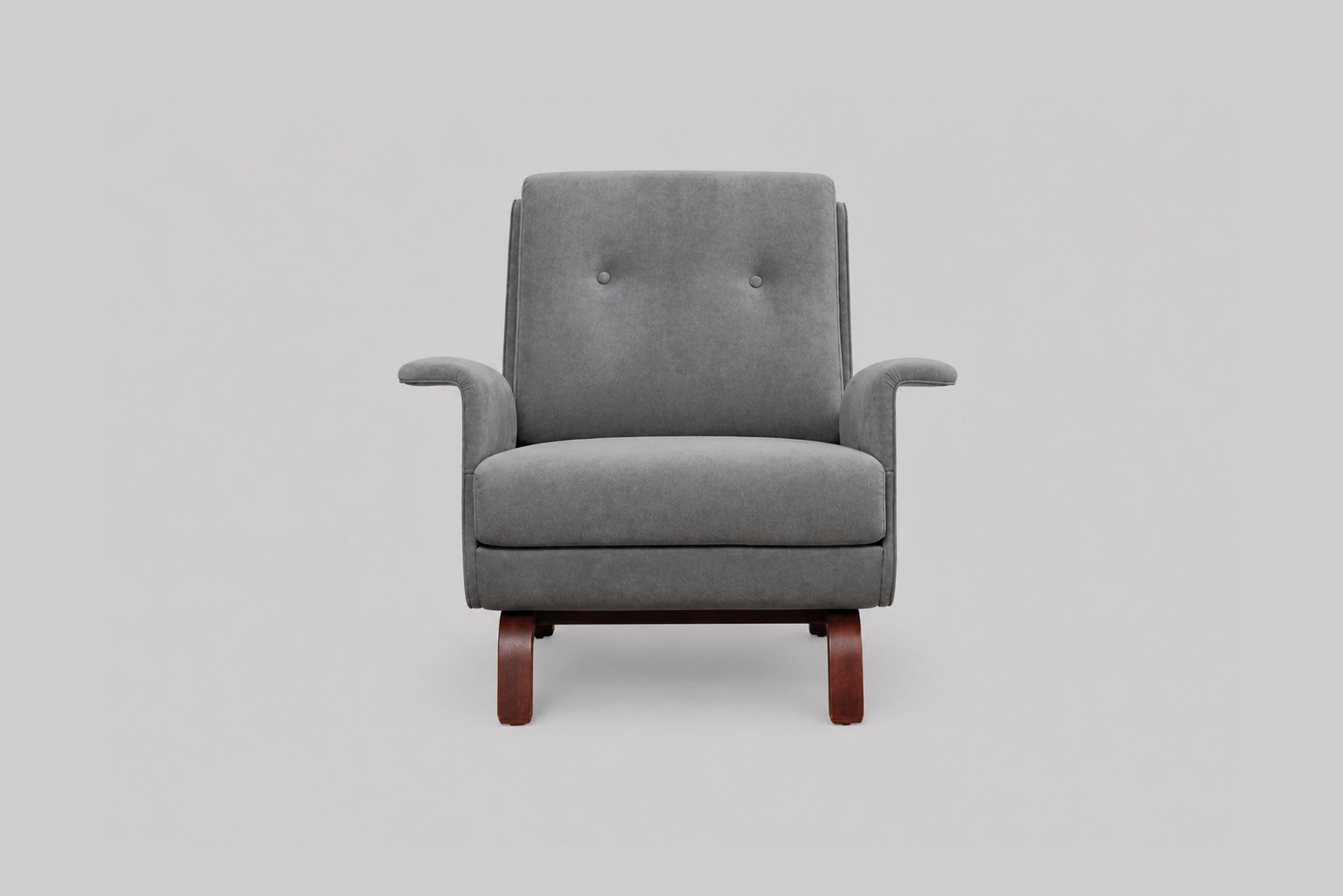
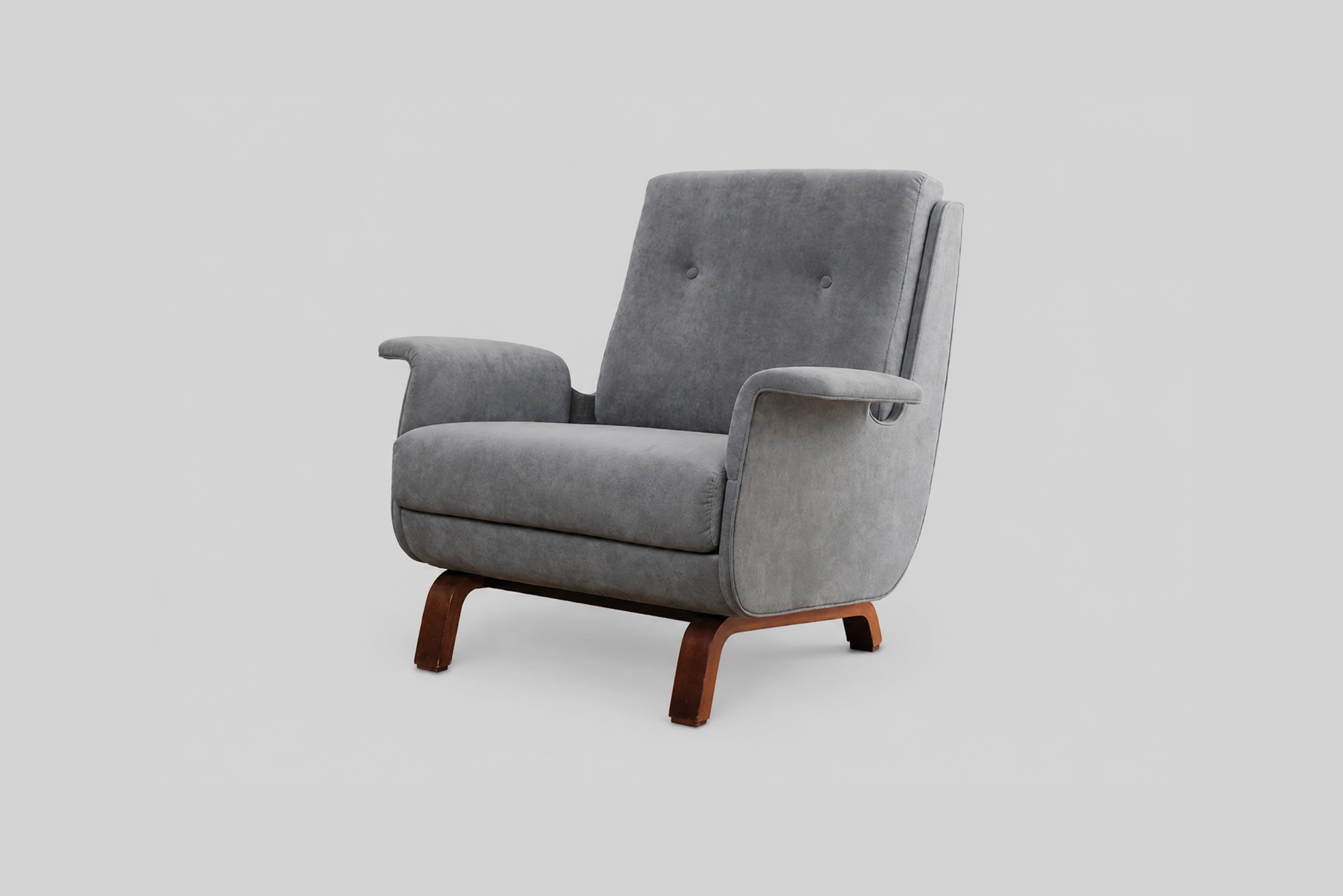
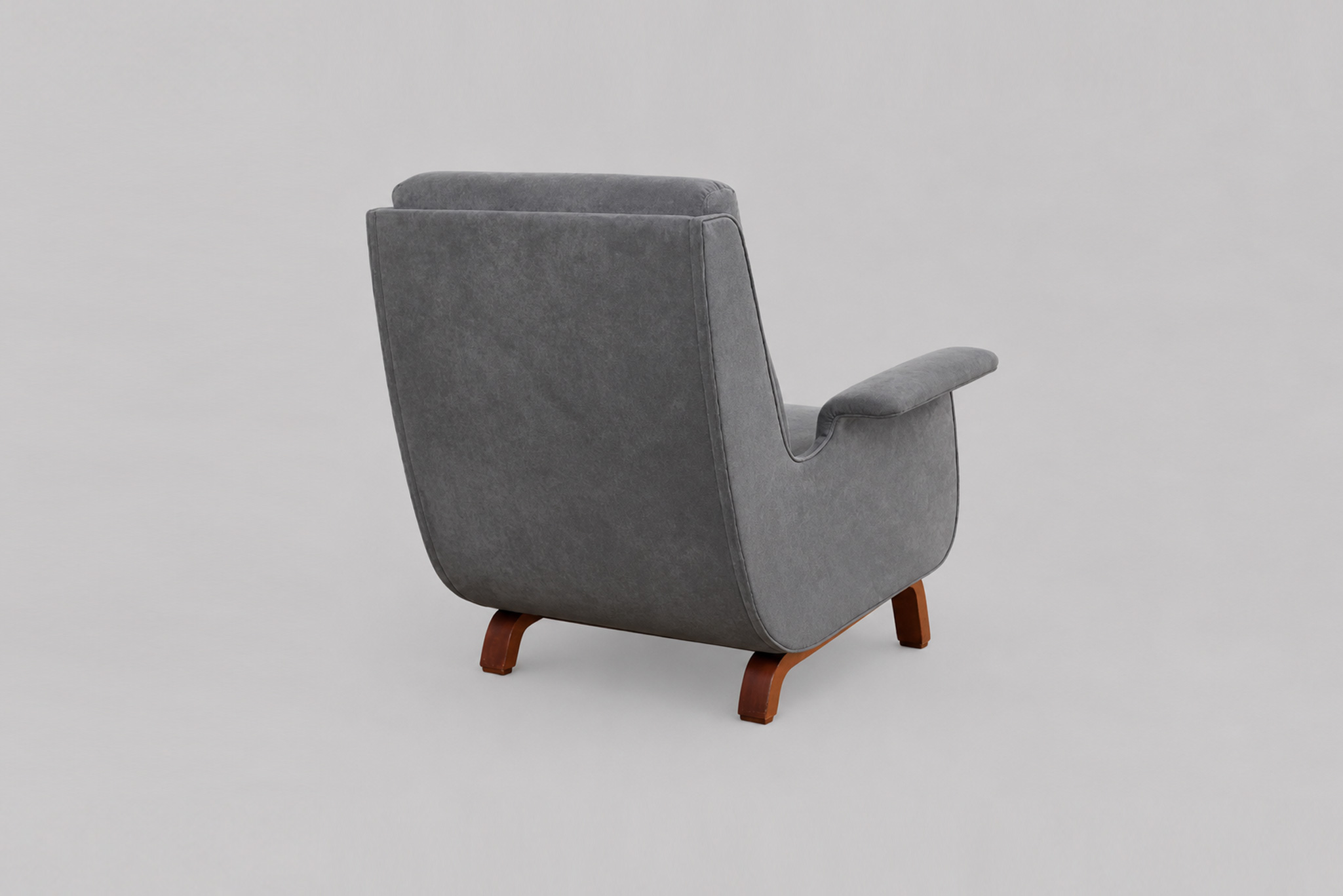
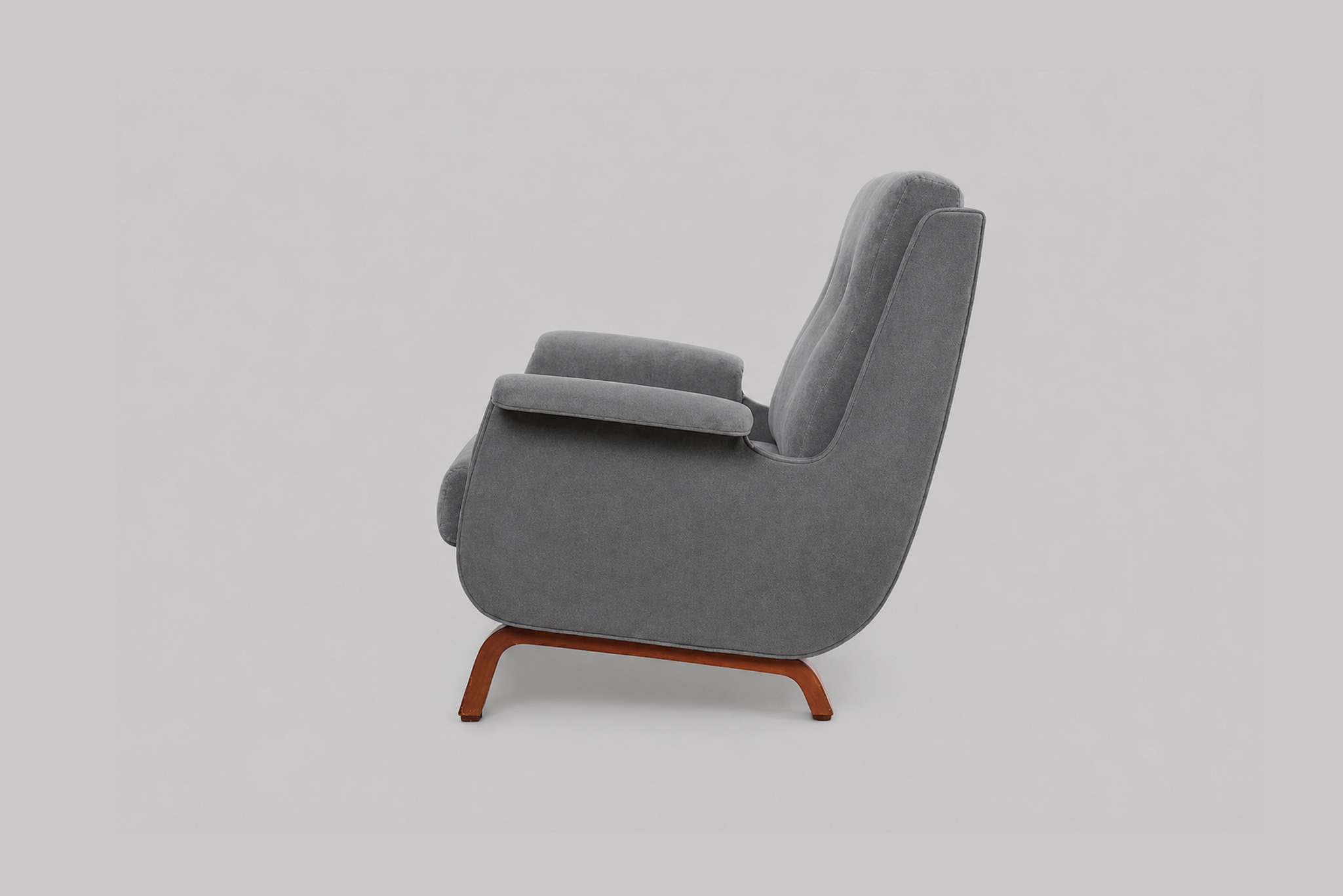
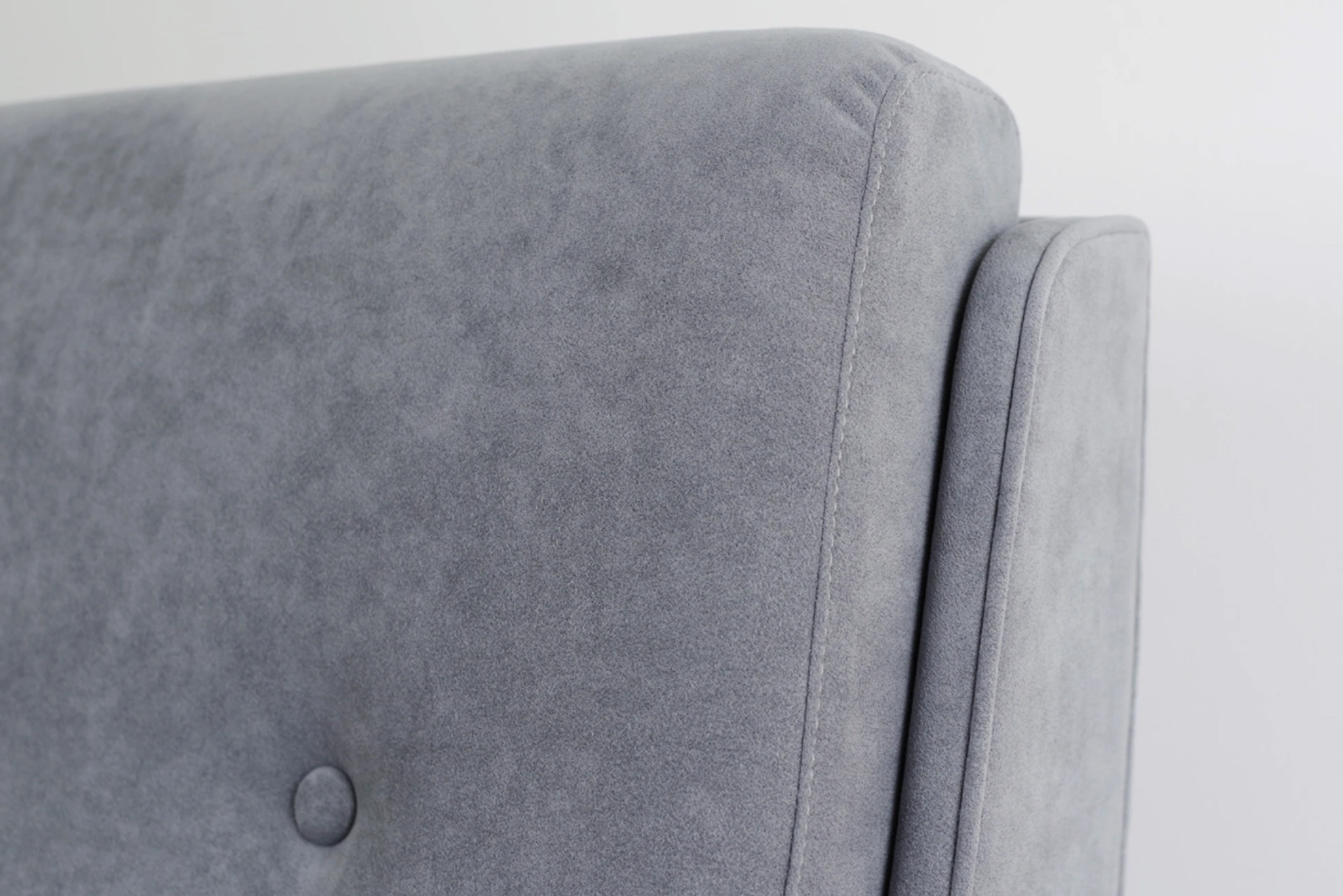
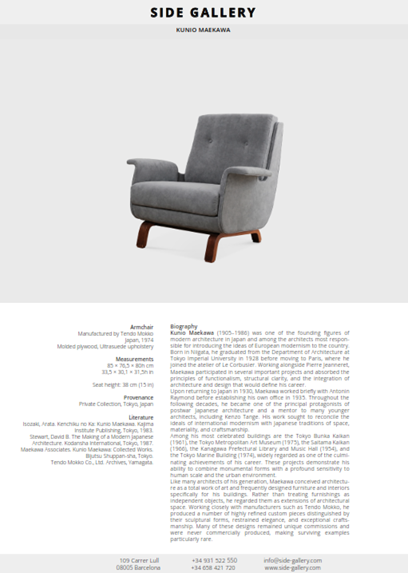
Armchair
Manufactured by Tendo Mokko
Japan, 1974
Molded plywood, Ultrasuede upholstery
Measurements
85 × 76,5 × 80h cm
33,5 × 30,1 × 31,5h in
Seat height: 38 cm (15 in)
Provenance
Private Collection, Tokyo, Japan
Literature
Isozaki, Arata. Kenchiku no Ka: Kunio Maekawa. Kajima Institute Publishing, Tokyo, 1983.
Stewart, David B. The Making of a Modern Japanese Architecture. Kodansha International, Tokyo, 1987.
Maekawa Associates. Kunio Maekawa: Collected Works. Bijutsu Shuppan-sha, Tokyo.
Tendo Mokko Co., Ltd. Archives, Yamagata.
About
This exceptionally rare armchair was designed by Kunio Maekawa for the executive floor of the Tokyo Marine Building, one of the architect's most important works and among the most significant high-rise buildings of postwar Japan. Completed in 1974 after years of public debate regarding its height and proximity to the Imperial Palace, the building became a landmark of Japanese modern architecture and a culmination of Maekawa's career.
Manufactured exclusively by Tendo Mokko for the project, the armchair was never introduced into serial production. Conceived specifically for the executive interiors, it remained in continuous use within the building for almost five decades, undergoing regular maintenance and reupholstery by Tendo Mokko. Following the recent demolition of the Tokyo Marine Building, only four armchairs and one three-seat sofa were released, marking the first time these pieces have left the building since their installation in 1974.
The design reveals Maekawa's admiration for contemporary Italian furniture of the 1960s, examples of which he collected for his own residence. Characterized by its softly rounded silhouette and distinctive armrests, the chair combines European influences with the sophisticated molded plywood techniques for which Tendo Mokko became internationally renowned. The slightly reclined posture, sculptural base, and subtle elevation above the floor create a remarkable sense of stability and visual lightness.
As a unique architectural commission rather than a commercial product, the armchair occupies a special place within the history of Japanese modern design, embodying the close relationship between architecture, furniture, and craftsmanship that defined Kunio Maekawa's work.
Biography
Kunio Maekawa (1905–1986) was one of the founding figures of modern architecture in Japan and among the architects most responsible for introducing the ideas of European modernism to the country. Born in Niigata, he graduated from the Department of Architecture at Tokyo Imperial University in 1928 before moving to Paris, where he joined the atelier of Le Corbusier. Working alongside Pierre Jeanneret, Maekawa participated in several important projects and absorbed the principles of functionalism, structural clarity, and the integration of architecture and design that would define his career.
Upon returning to Japan in 1930, Maekawa worked briefly with Antonin Raymond before establishing his own office in 1935. Throughout the following decades, he became one of the principal protagonists of postwar Japanese architecture and a mentor to many younger architects, including Kenzo Tange. His work sought to reconcile the ideals of international modernism with Japanese traditions of space, materiality, and craftsmanship.
Among his most celebrated buildings are the Tokyo Bunka Kaikan (1961), the Tokyo Metropolitan Art Museum (1975), the Saitama Kaikan (1966), the Kanagawa Prefectural Library and Music Hall (1954), and the Tokyo Marine Building (1974), widely regarded as one of the culminating achievements of his career. These projects demonstrate his ability to combine monumental forms with a profound sensitivity to human scale and the urban environment.
Like many architects of his generation, Maekawa conceived architecture as a total work of art and frequently designed furniture and interiors specifically for his buildings. Rather than treating furnishings as independent objects, he regarded them as extensions of architectural space. Working closely with manufacturers such as Tendo Mokko, he produced a number of highly refined custom pieces distinguished by their sculptural forms, restrained elegance, and exceptional craftsmanship. Many of these designs remained unique commissions and were never commercially produced, making surviving examples particularly rare.
Throughout his career, Maekawa maintained a strong interest in contemporary European furniture, especially Italian design, which influenced the organic forms and material sophistication found in his later interiors. His custom furnishings for the Tokyo Marine Building, among them the present armchair, reveal this dialogue between Japanese modernism and international design culture.