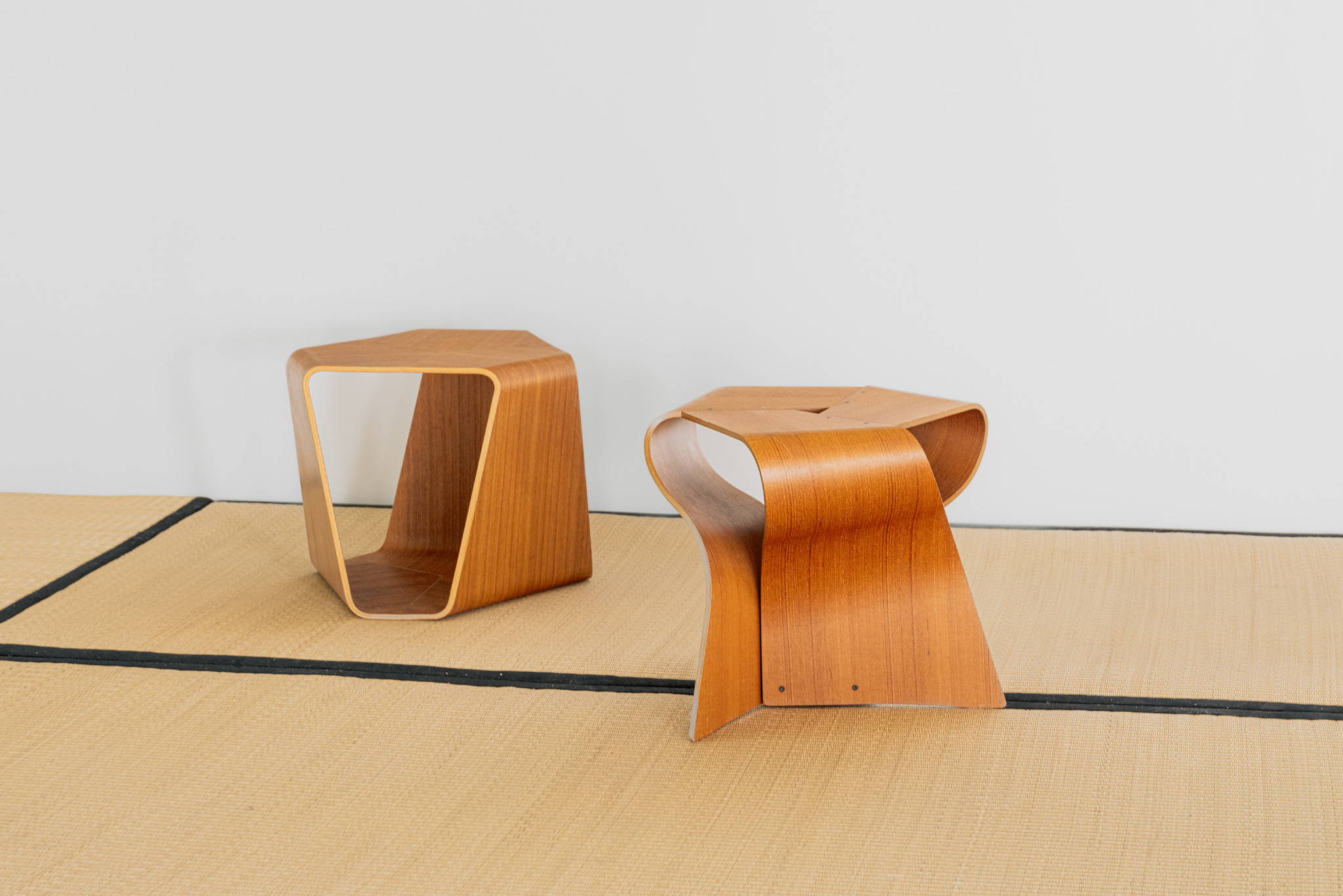
Stool Model "Mushroom"
Manufactured by Tendo Mokko
Japan, 1960s
Molded teak plywood
Measurements
38,5 × 38,5 × 45,5h cm
15,2 × 15,2 × 17,9h in
Details
Award-winning stool originally designed in 1960 for the first Tendo Mokko Furniture Competition.
Literature
Tendo Mokko Co., Ltd. Tendo Mokko Catalogue, Yamagata, 2003.
Hiesinger, Kathryn B., and Mio Wakita-Elis. Japanese Design Since 1945: A Complete Sourcebook. Philadelphia Museum of Art, 1990.
Mira Locher. Japanese Modern: The World of Shiro Kuramata, Isamu Kenmochi and Sori Yanagi. Tuttle Publishing, Tokyo, 2016.
Japanese Design: A Survey Since 1950. The Japan Foundation, Tokyo, 1991.
About
The Mushroom Stool is one of the most remarkable examples of the experimental spirit that characterized Japanese design during the postwar era. Conceived in 1960 by the Yamanaka Design Group for the first Tendo Mokko Furniture Competition, the design demonstrated an ambitious exploration of the expressive possibilities of molded plywood.
Inspired by simple strips of paper manipulated into three-dimensional forms, the stool achieves a surprising structural complexity through the combination of three identical plywood elements. Twisted and assembled together, these components create a dynamic silhouette whose organic form recalls the cap of a mushroom, giving the piece its name. The result is a design that appears simultaneously playful, sculptural, and structurally sophisticated.
Despite receiving recognition at the competition, the manufacturing technologies available in 1960 proved insufficient to produce the stool economically. Consequently, the design remained unrealized for more than four decades until advances in plywood production techniques finally allowed Tendo Mokko to commercialize it in 2003. This delayed realization transformed the Mushroom Stool into a unique example of a visionary concept brought to life through technological progress.
Today, the stool stands as an important chapter in the history of Japanese furniture design, demonstrating Tendo Mokko's longstanding commitment to innovation and the creative possibilities of molded wood. Its elegant geometry and remarkable construction continue to make it one of the most distinctive contemporary interpretations of Japanese modernism.
About Yamanaka Design Group
Yamanaka Design Group was a Japanese design collective active during the postwar period, associated with the wave of experimentation that defined the emergence of modern Japanese furniture in the 1950s and 1960s. Working closely with manufacturers such as Tendo Mokko, the group explored the expressive and structural possibilities of molded plywood, contributing to the development of a distinctly Japanese interpretation of modernism.
Their work was characterized by a synthesis of sculptural form, technical ingenuity, and material efficiency. Rather than emphasizing ornament, the group pursued designs rooted in clarity of construction and organic geometry, reflecting both international modernist influences and traditional Japanese sensibilities.
Among their most notable creations is the Mushroom Stool, originally conceived in 1960 for the first Tendo Mokko Furniture Competition. Although the design received recognition at the time, the technical limitations of the period prevented its realization until 2003, when advances in manufacturing finally allowed production to commence. Today, the Mushroom Stool is regarded as one of the most remarkable examples of Japanese molded plywood design and a testament to the visionary approach of the Yamanaka Design Group.