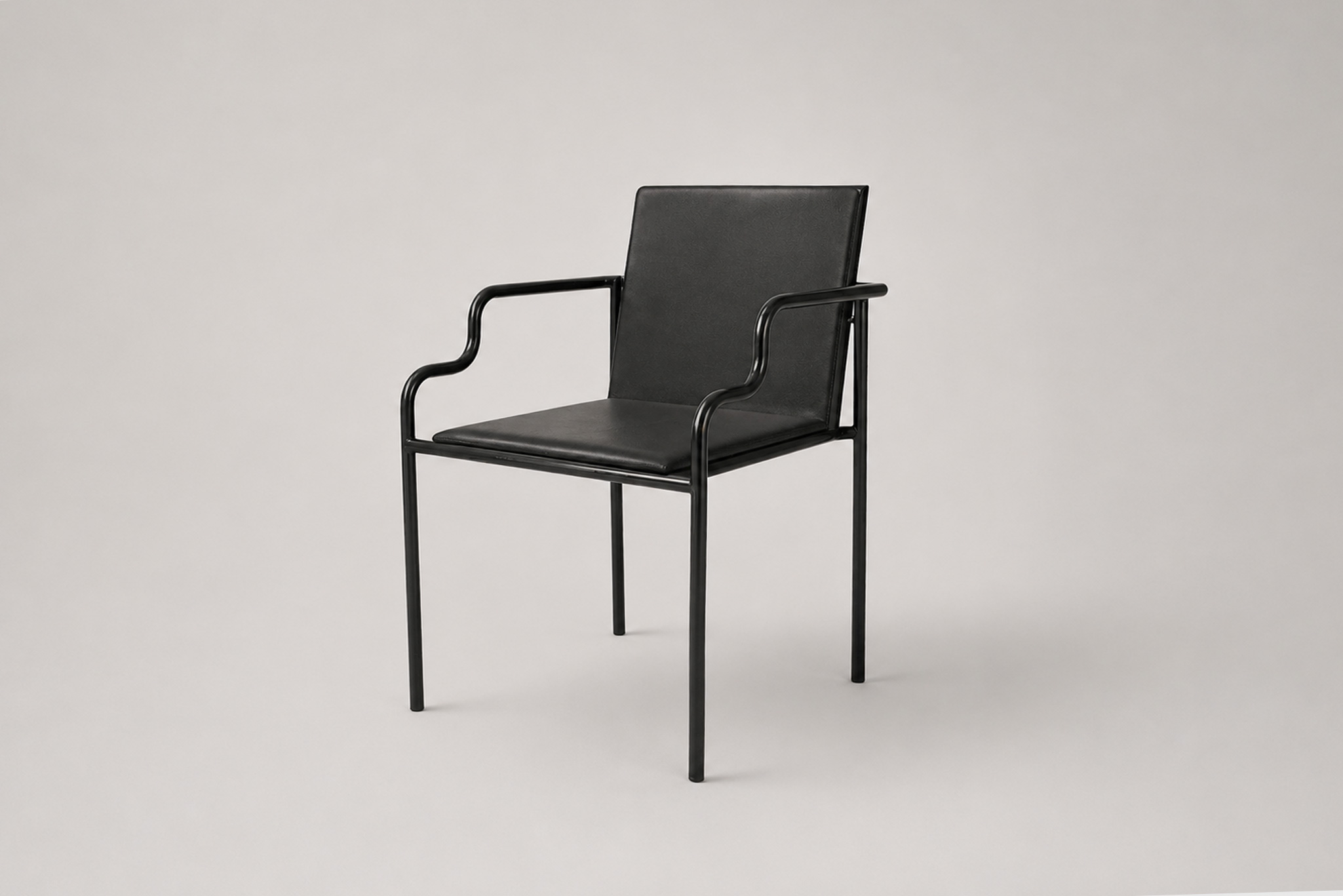
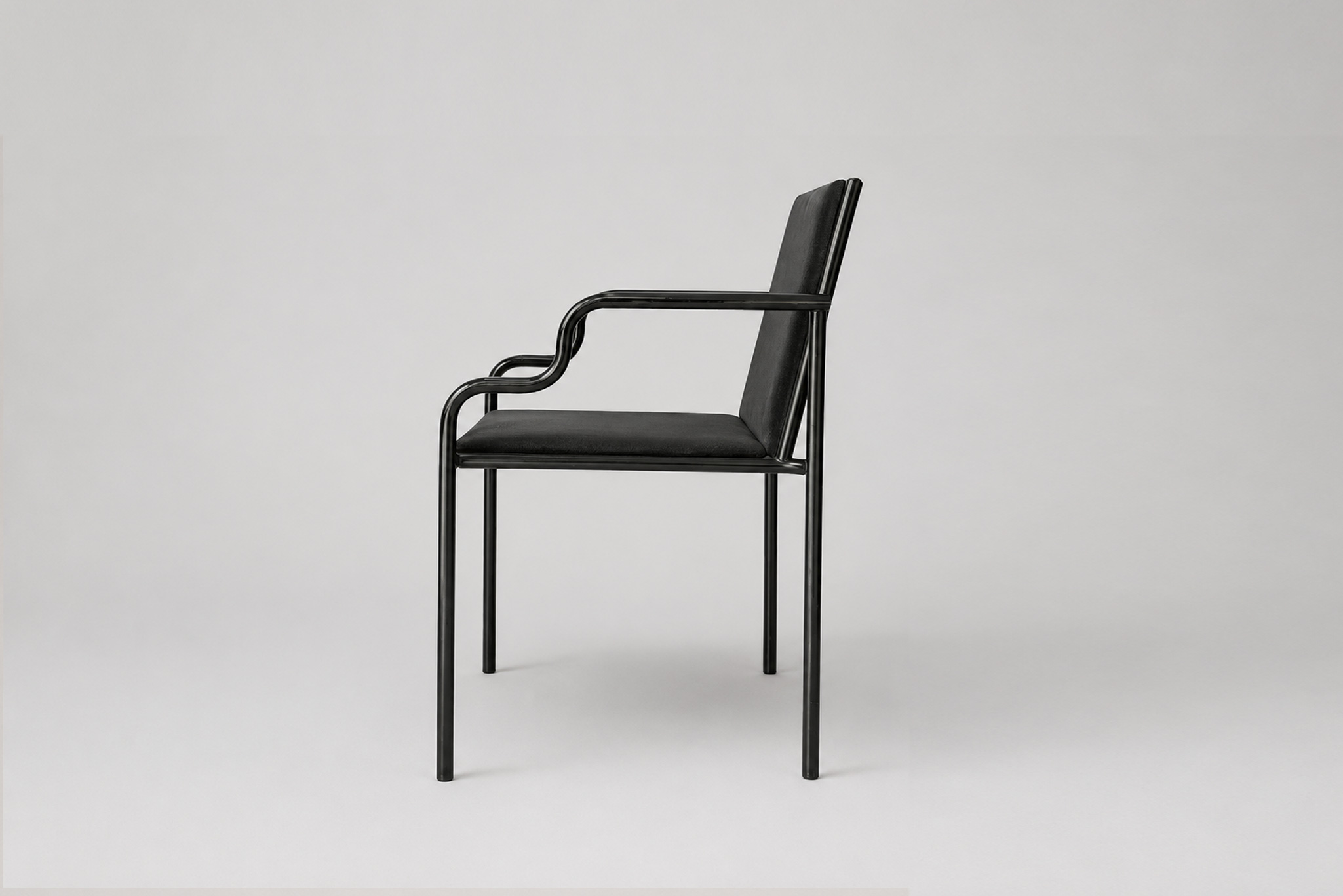
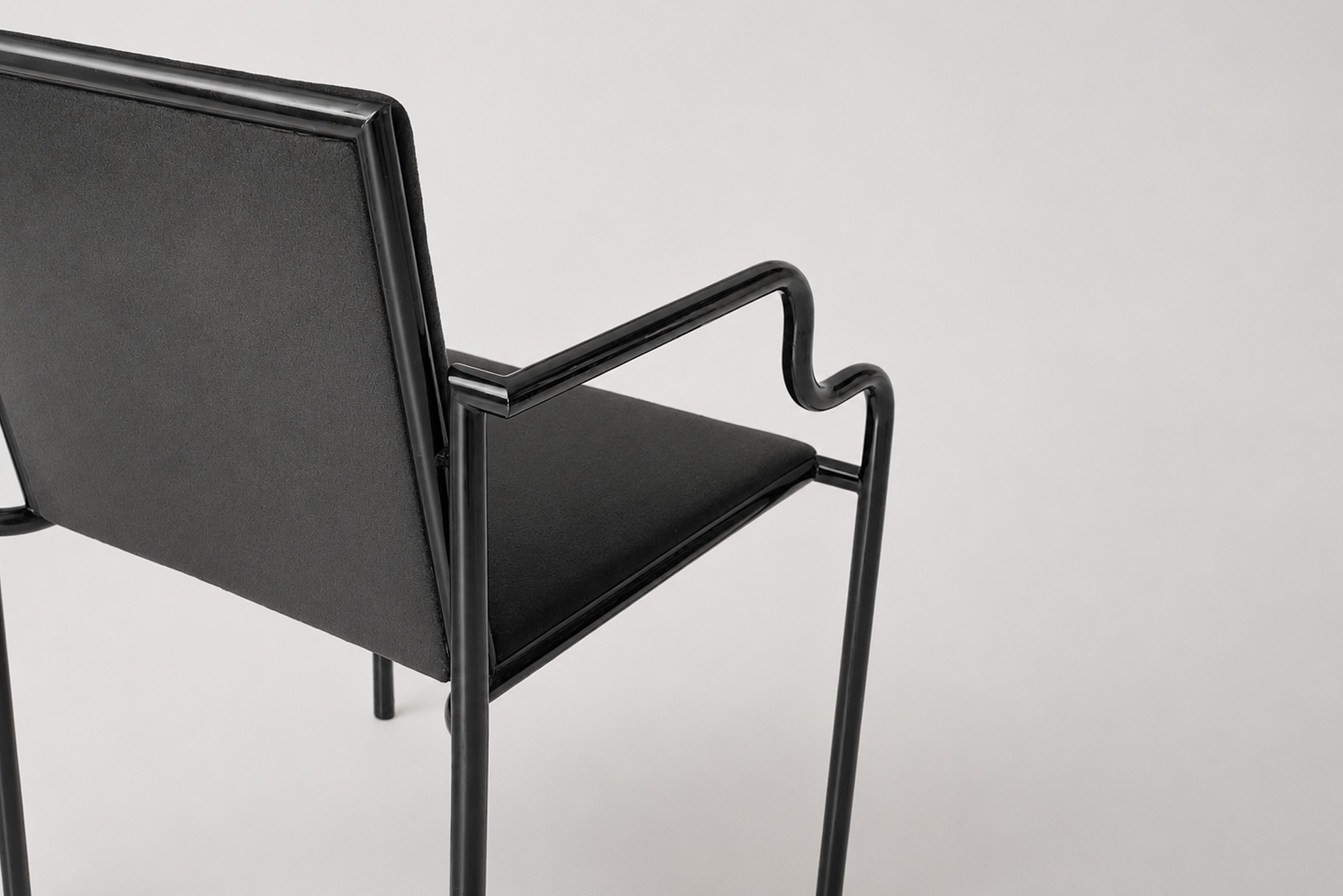
Armchair Model "Feb"
Manufactured by Uchida Design Institute
Japan, 1985
Lacquered steel, Upholstered fabric
Measurements
55 × 57 × 80h cm
21,7 × 22,4 × 31,5h in
Seat height: 45.5 cm (17.9 in)
Arm height: 65.5 cm (25.8 in)
Literature
Shigeru Uchida, Furniture and Interior Design, Rikuyo-sha, Tokyo, 1990.
Naomi Pollock, Japanese Design Since 1945: A Complete Sourcebook, Thames & Hudson, London, 2020.
Shigeru Uchida: Interior / Furniture / Architecture, Musee des Arts Decoratifs, Paris, exhibition catalogue.
Penny Sparke and Fiona Fisher (eds.), The Routledge Companion to Design Studies, Routledge, London, 2016.
About
The Feb Armchair is one of Shigeru Uchida’s most celebrated furniture designs, embodying the architectonic clarity and refined minimalism that defined Japanese postmodern design during the 1980s. Designed as an exploration of the relationship between structure, body, and space, the chair reflects Uchida’s belief that furniture should function as a subtle architectural presence rather than a decorative object.
Constructed from slender steel tubing, the chair achieves a remarkable visual lightness while maintaining exceptional structural integrity. Its defining feature is the continuous armrest profile, whose gentle curves soften the rigor of the geometric frame and create a natural ergonomic relationship with the sitter. The balance between straight lines and fluid gestures exemplifies Uchida’s ability to reconcile rational construction with human comfort.
This early upholstered version is particularly significant, as it predates the perforated mesh variants that later entered larger-scale production. The upholstered seat and back emphasize the graphic outline of the frame while reinforcing the chair’s sculptural quality, resulting in a more intimate and refined expression of the original design.
Biography
Shigeru Uchida (1943–2016) was a defining figure of post-war Japanese design, whose prolific output shaped a distinctly modern yet deeply reflective aesthetic. Born in Yokohama and educated at the Kuwasawa Design School, Uchida went on to direct the institution and establish Studio 80 in 1981, marking the beginning of a multifaceted career spanning interior architecture, furniture, industrial design, and urban planning.
A key concern in Uchida’s work was the dialogue between Japanese spatial philosophy and contemporary global design. His furniture, in particular, embodies a search for “transparency and lightness that transcends physicality,” reflecting his belief that form should almost disappear in order to let space breathe. His iconic September chair (1977) exemplifies this vision through its delicate geometry, steel structure, and open mesh seat—an exploration of presence through absence.
Uchida stood at the intersection of design and cultural discourse. In Japan, he was closely aligned with creatives like Shiro Kuramata and Yohji Yamamoto, while internationally, he shared affinities with figures such as Ettore Sottsass, Aldo Rossi, and Gaetano Pesce. Through these relationships, he became an influential voice in the postmodern movement, shaping an approach that valued restraint, ambiguity, and material poetry.
Beyond his acclaimed interiors for Yohji Yamamoto boutiques and institutions like the Kobe Fashion Museum, Uchida also delved into philosophical investigations through the design of contemporary tea houses and experimental architecture. His work is represented in major collections, including the Metropolitan Museum of Art and SFMOMA.
A noted design theorist as well as practitioner, Uchida wrote extensively on Japanese aesthetics, the body’s relationship to space, and the poetics of the everyday. His legacy endures in both his objects and his thought—quiet, rigorous, and deeply attuned to the subtleties of form and life.